A radical, ecosocialist take on the climate change crisis and the challenges confronting humanity in the face of global warming, resource depletion, religious intolerance, media manipulation and social injustice.
Shades of grey - 4 variations on the same theme; even if there is a more "exciting" range of suit shades; sort of.
Nick
Clegg famously (well, sort of) "realised" that austerity was a
necessary remedy for Britain's banking crisis one morning as he was
shaving during the 2010 election campaign - although he neglected to
share his insight with the rest of us until after the polls had closed.
After all, perhaps sales of "I Agree with Nick" memorabilia (for that is
all it is now) would not have been so brisk at the Lib Dem shop.
Wind
forward to earlier this year - the morning of 27 March to be precise,
and you might have wondered what Nick was thinking as he looked in the
mirror that morning - perhaps he had to look twice when he thought he
spied a little Nigel Farage dart behind him with a broad smile requiring
no toothpaste. After losing the first of their two televised debates by
a wide margin (57 to 36% favoured Farage), Clegg must indeed have
pondered about what he had let out the linen cupboard.
Fact-stuffed
to his finger tips, Clegg had set out to disabuse the public of
Farage's claims about the EU. In typically misguided technocratic
fashion, he thought that he could blow away the UKIP leader by showing
his claims to be little but castles of sand: £55 million a day for
Britain's membership of the EU? Nonsense, it's a snip as £33 million net after deductions and repayments! 70% of British laws set by Brussels? Nonsense - anyone could tell you that it is between 10% and %50 depending how you catgeorise things. How could Farage possibly win the debate after getting such facts wrong?
Clegg
like so many in the political class, inured to years of tick box
politics, is blinded by facts: but the fact is that their much-loved
evidence-based research can prove just about anything: hospital queues
have increased or decreased; poverty is better or worse (or absolute
or relative and if so what sort of relative?); people are better or worse off - all dependent on which
sleight of hand or "weighting" is applied. All these statistics, they
believe, can justify what they have done, how they have behaved and
prove pesky people like Nigel Farage wrong.
Except it doesn't work. Because Farage cleverly represents how some people feel and
very powerfully in some respects. Like so many populists, he has caught
a mood, played on it and capitalised on it. Fear of the (supposed)
unknown: foreigners taking our jobs, foreign governments telling us what to do while supposedly breaking all the rules themselves,
and so on. And as we have seen this week even in a town with few
migrants indeed, Clacton-on-Sea, it works powerfully to UKIP's gain -
and nearly did so hundreds of miles away in the north at the Heywood
& Middleton by-election on the same day as well.
Now
these feelings may not be based on facts (although years of spurious
facts being peddled by the media has very effectively created the
impression that they are). They may even be factually incorrect - but
that still doesn't matter; because facing declining living standards and
joblessness, some people will indeed turn to the most visible
scapegoats offered up by UKIP (and reinforced by the media) in their
midst, however wrong it may well be to blame them. Similarly, the "fact"
that UKIP stands for tax cuts for millionaires, deregulation for
bankers and cuts to the NHS may not go far unless there is an
alternative narrative that says we can feel ok about ourselves and
others, that we can trust our neighbours and unite against
disproportionate inequality. So far, none of the main parties offer
such, nor, with all of them united on things like the benefits cap, are
they likely too.
And what our stats-driven,
pseudo-technocratic elite don't understand, perhaps because to their
Vulcan-mindsets it isn't logical, is feeling. How emotional can
you get over a table of even the most damning figures set against a
tearful human face, or a photo of an empty factory, or a queue at a food
bank? Yet they will happily, even sociopathically, reel off lists of
these things, their smug, knowing faces turning to perplexed confusion
when it dawns on them that it isn't working. For while facts are important, especially in laying low some of the lies propagated by UKIP and others on the right, if they are all you have, then shorn of any Vision all you have is an encyclopaedia of today, not a manifesto for tomorrow.
New Labour
started this trend among our politicians of putting figures up in place
of politics; of citing "key performance measures" over political change.
And little wonder, given Blair's abandonment of political ideology -
performance targets were all he had left to try to make out it doesn't
matter if your liver scan is done by the NHS or by profit-seeking Virgin
Clinics or whoever. The result is the Deputy Labour leader, Harriet
Harman, flailing about on national TV this morning trying to outdo UKIP
on tackling immigration rather than offering a counter-view. But how could
she? After so many years of evaluating stats and focus group
analyses, she may well not actually have her own view any more, her
original thoughts, feelings even, long since lost in the smoke and mirrors of think-tanks and policy wonkery.
So now we face the outcome of this: bereft of belief or values, the self-created, self-serving "political class"
(the two words that say it all, really) spread among the two and a
quarter established parties are left floundering as UKIP and others
advance. UKIP triumphed last week and at the Euroelections in May.
Simultaneously, both at the May vote and in many opinion polls since the
Greens are vying to overtake the Lib Dems nationally in spite of a
virtual media blackout - quite the opposite of UKIP's wall-to-wall
coverage of Nigel's every pint. Meanwhile in Scotland, the enthusiastic
Yes campaign seems almost undiminished in spite of the referendum
defeat as all the three Westminster parties can, still almost literally,
bring themselves to say is, indeed, No or possibly Not Yet. The three
Yes parties - the Greens, the Scottish Socialists and the SNP have each
experienced an exponential growth in membership - the latter party now
approaching 100,000.
People are looking for
alternatives - to my mind, some of these seem very unpleasant
alternatives indeed whilst of course I have my own preferences; but what
they all do, is touch on humanity (both its good and bad aspects)
infinitely more than the anodyne, focus group media politics of the
established parties. With UKIP, the challenge for the left is to avoid
the pathetic denunciation of their voters as "f***ing thick" and "just fascists" (both cited on a supposedly progressive webpage today) and look beyond vote totals to the actual beliefs of many UKIP voters (as
distinct from UKIP itself) - pro-welfare state, pro-public NHS,
pro-rail nationalisation and in favour of a higher living wage, in some
cases more emphatically so than Labour voters. These are people who feel
abandoned because the Labour Party especially took the view so
eloquently articulated by that Tribune of the People, Lord Peter
Mandelson, when he suggested that "traditional" Labour voters had "nowhere else to go". Well, they've gone and they won't come back to Labour or any other party that treats them so off-handedly.
We
need to offer a different story; the one that says ordinary people's
problems are not caused by their disabled, migrant, ethnic minority or
unemployed neighbours, but rather by the tax-minimising elitists who,
among other big parties, fund UKIP. And that UKIP, offering yet another Man-in-a-grey-suit, are not a challenge to the current system - rather just more or the same with a little extra bile and bombast.
The
collapse of the political system that has effectively prevailed for the
last century marks many dangers ahead - but also the greatest
opportunities yet to build a new, fairer society: we can only achieve
that by providing a positive way ahead, an end to the politics of fear
and loathing and transition to the inclusive, more egalitarian democracy
that so many are so desperately seeking.
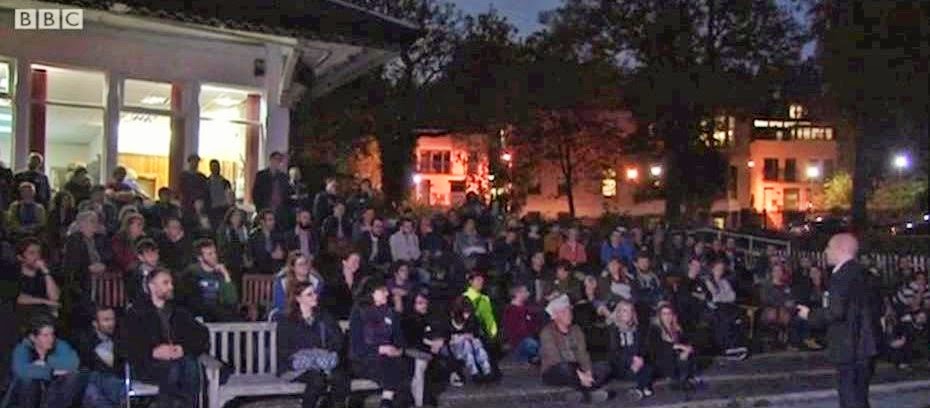
Below:
looking for a new way; so many people turned up at the first
post-referendum meeting of Glasgow Green Party that surprised party
officers had to move the meeting outside the booked venue.
“All over the place, from the popular culture to the propaganda system,
there is constant pressure to make people feel that they are helpless,
that the only role they can have is to ratify decisions and to consume.”
- Noam Chomsky
Over a year ago inWeimar Britain and again in April this year in On The Eve, this author, like many other progressives, previewed the momentous times we are living through now. As our world and the societies within it continue to convulse and shatter in the face of the growing crises of an economic system in terminal decline, we have seen the panic of the banking collapse, the wars for oil, and the demolition of human rights to ensure control not only over terrorists but over peaceful domestic opponents as well - in particular opponents of corporate interests.
It was indeed all going as well as the Establishment could have hoped - better in fact, as the electorate continues, on balance, to be convinced by the espoused case for austerity and denigration of the public enemies of migrants, disabled people and the unemployed. With political revolt gingerly contained, even if only transiently, in the even more neoliberal Aunt Sally of UKIP, the private island-owning, off-shoring elite has gleefully seen its wealth grow to become larger and more obscenely skewed than at any other time in British history. The "free trade" TTIP treaty is set to seal it all for good. Divide and rule indeed.
But then, last weekend, a YouGov poll put the pro-Independence camp in Scotland narrowly in the lead for next week's referendum. Of Scottish voters expressing a preference, 51% said they will vote in favour, while two thirds of those still to make up their minds were tending towards the independence option. It was just one poll, though it confirmed a trend of some weeks of rise in the Yes vote. But it slammed a Panic Button among the Establishment in Westminster and ever since, as Alex Salmond has put it, everything including the kitchen sink and the whole lounge has been lobbed frantically at the Yes Scotland campaign.
First we had the faux homage of the three Westminster leaders - Cameron, Miliband and Clegg - to Scotland on Wednesday, dramatically cancelling PM's Question Time to make apparently passionate pleas for the Union to be preserved.
Cameron nearly wept as he begged Scots not to use the vote to "kick the 'effing Tories"; Miliband said he might even stay the whole week; while Clegg dashed just inside the Borders to promise, with the others, the exciting prospect ofa timetable for proposalsto give Scotland's devolved parliament additional powers, although none of them could quite explain what these would be. Labour's Gordon Brown was also wheeled out to remind people that he is Scottish too, although at least unlike John Prescott he didn't need to remind himself that he was supporting the "No" campaign, Better Together by writing its name in biro on the back of his hand.
But much, much more has since been deployed to stop secession. The Governor of the Bank of England, a Government appointee, has warned of financial chaos for Scotland after reiterating that there will be no common currency; while Lloyd's Bank and RBS (bankers to the Tory Party) have said they will move their headquarters south if there is independence. Next, at Cameron's prompting, Asda has said its milk prices might go up in a separate country. Morrisons and John Lewis made somewhat more ambiguous statements about divergence rather than disadvantage, but the increasingly shrilly pro-Union BBC reported these as warnings of higher prices.
And yet, and yet... wasn't this entirely foreseeable? A combination of bribes and threats spawned the Union in 1707, so it seems appropriate and unsurprising that the descendants of the elite that pushed through the creation of the UK would use the same methods to prolong its existence. Even more so, in fact - there is a commonly held misconception that neoliberal capitalism seeks to minimise the state and its powers. In truth it minimises the state only in terms of its responsiveness to the masses and their needs and wishes. It maximises the deployment of coercive state power to ensure the continued dominance of the Establishment - and this has never been as nakedly in evidence in British politics as in the last few days over Scotland.
Bankers, politicians, city traders, journalists and multinational companies have come together to warn of everything from economic apocalypse to "difficulties" for Scottish viewers wishing to watch Celebrity Come Dancing on the TV.
The bankers and traders whose sociopathic greed and lawlessness created the crash of 2008 and nearly busted the world economy; the politicians who deregulated finance so completely that the crash happened, and who then spent tens of billions of tax money and loans to bail the banks out before billing the rest of us for it; the industrialists who rage against any form of consumer or employee protection and who have plundered our society via PFI arrangements, outsourcing and tax evasion; and the journalists who, when they are not hacking celebrities' telephone messages are busy telling us all that there is no alternative to what we have got.
Yes, all the people who obviously have the best interests of the rest of us engraved on their cold, cold hearts and foremost in their absent consciences. These people are stepping forward to tell Scottish voters that they are too crap, too lazy, too...Scottish...to hope to govern themselves. And if they don't listen to their friendly warnings, there will be a less friendly price to pay. The bankers, traders, and industrialists will make sure their political puppets send the bill personally.
The message, of course, is not just for the Scottish voters. Indeed, if Scotland could be got rid off, perhaps tugged out into the mid-Atlantic and quietly sunk, many of the people currently hoarsley calling for the Union to be preserved would be first in the queue to pull the plug. However, as geography dictates otherwise, the last thing the Establishment want the rest of the UK to see is part of it defying our Masters' wishes and giving us ideas above our station. Even a mildly social democratic Scotland would not just be an annoying neighbour - it could become an existential threat to the neoliberal consensus. Hence, it must be strangled at birth - or preferrably before.
The big question is whether enough Scottish voters will be browbeaten or scared into voting against independence to stop it happening. The trend over the last fortnight has been a clear and big upswing for separation - one based on seeking a more inclusive, fairer society than the one emerging in the UK as a whole. It remains to be seen if the crisis response from Westminster and its paymasters will stem the flow, or be seen through as the insincere, last gasp blandishments of panicking machine men.
A frequent refrain from the Better Together camp is that an independent country would be moving into uncertainty; taking risks, and be a journey rather than a destination. But isn't that just life? Life for all of us. Salmond (who is no socialist but is equally no neoliberal either) has ackowledged that independence is the start of something, not the finish. Meanwhile the Radical Independence Campaign of leftwing parties like the Greens and Scottish Socialists as well as cultural groups like the National Collective positively embrace the nascent potential of such a future.
Besides, if there are no guarantees for a free Scotland, what is guaranteed about Britain as it is? A
harsh, low wage, "flexible" economy increasingly unkind to the poor and
vulnerable, suspicious of strangers, and selling off what little remains of its public services? A State whose main functions involve spying on its own citizens and vying with the USA for the number one spot as the most unequal developed society on the face of the Earth?
“The smart way to keep people passive and obedient is to strictly
limit the spectrum of acceptable opinion, but allow very lively debate
within that spectrum.”
Isn't this Britain now? An oligarchy centred on acceptance of a full-blown market system where all decisions, in all aspects of life public and private, are ultimately commodified, priced and sold. The health service, even now the jewel in the crown of the nation, is subject to not just creeping but full-on tendering out of its services to Virgin Clinics and other profit-seeking privateers; public buildings are in hoc to construction firms for tens of billions for decades to come; Serco, Capita, Balfour Beatty and other mega-corporations run our benefits system, our education authorities, our passport offices. A food company executive scripted the Government's policy on public health, a brazen act of corporate power imposed on the Body Politic.
Everything is up for sale, often to the same companies that fund our political parties - even Labour Party conferences have been sponsored by supermarket chains.
What then is left? US linguist and activist Noam Chomsky characterised such a world thus:
“Neoliberal democracy.
Instead of citizens, it produces consumers. Instead of communities, it
produces shopping malls. The net result is an atomized society of
disengaged individuals who feel demoralized and socially powerless. In
sum, neoliberalism is the immediate and foremost enemy of genuine
participatory democracy, not just in the United States but across the
planet, and will be for the foreseeable future.”
Today, the Murdochs' News International company's mass circulation rag, The Sun, is seeking to boost its circulation by having a special World Cup "This Is England" copy delivered by the privatised Royal Mail to every house in the country - some postal staff are reportedly threatening strike action. This paper, after all, is the one that demonised the victims of Hillsborough, that publishes wildly inaccurate stories about migrants, scapegoats benefits claimants and even gleefully over-reported on an internet countdown-to-legal-sex-with-Charlotte-Church clock as the child singer approached her 16th birthday - one of many lurid stories it has published with no regard to the impact on the people covered.
In so many, many ways, The Sun epitomises the neoliberal system described by Chomsky, reinforcing the status quo, trivialising society into a succession of scandals, celebrities and celebrity scandals. Its owners, who also control the equally sensationalist and right-wing Fox News in the USA, have grown rich on its sales and, needless to say, the last thing they want to challenge is the way the world works.
CAUTION:This man (below) is just as neoliberal as the rest of them. Former stockbroker, he is keen to increase your taxes and cut them for millionaires, cut regulations on the banks and roll back support for mums and dads in the workplace. He also voted against action to stop female genital mutilation. Neoliberal Nigel is not the friend of ordinary people. He is just the Authorised Opposition by Appointment to the Establishment.
A Reminder for SCOTTISH READERS - It's on 18th September...
The last 24 hours has been filled with repeated fanfares and breathless TV newspeople proclaiming about the earthquake caused by the increase of the United Kingdom Independence Party's vote in the British stage of the European elections. A group of millionaires and friends of millionaires, funded by a multi-millionaire, have managed to win a 27.5% vote share (on a 34% turnout = 9.5% of eligible voters) - up from 16.5% last time (on a 35% turnout - 5.8% of eligible voters) and have the biggest grouping of MEPs from the UK in the European Parliament.
But UKIP's historically lazy MEPs are not the real issue - the issue is the attitudes and culture they foster and amplify. And these are ones of manufactured anger and fear of difference; of lies about EU regulations which often are the sole protection for workers and consumers against the big predatory multinational corporations that UKIP loves; and of a willingness to berate and bully their opponents in the name of a twisted democracy.
And they are not alone. All across Europe in these elections, we have seen the rise of bitterly angry, right-wing eurosceptic parties, perverting the troubles of the poor into a crusade against equally poor migrants while shoring up the real problem - the tax-dodging, austerity-imposing rich. Although Greece has turned more to the leftwing Syriza coalition in response to the neoliberal European Central Bank's savage public spending cuts, the far right has grown there too. Neo-Nazi Golden Dawn has taken one in ten Hellenic votes and there is even talk of an army coup - according to Forbes Magazinethe "only half joking" preference of some international financiers.
In France, the Front National under Marine Le Pen has taken first place with a quarter of the vote, wiping out the Greens and pushing the governing socialists into third place. In Denmark, the far right People's Party topped the poll while the
extreme-right Jobbik, widely accused of racism and anti-Semitism,
finished second in Hungary. In the Netherlands, the Dutch Freedom
Party of Geert Wilders' - which plans an alliance with Le Pen - finished
joint second in terms of seats. Similarly the far right has performed well in Finland.
All these parties, and similar ones in other EU states, have common themes of taking back their countries, which generally translates into a call to continue with free trade by big business but to do away with laws such as the working time regulations and common product safety standards. This is because these, apparently, destroy the culture of their respective countries. But they don't talk about consumer protection, they talk about bureaucracy; they don't refer to safety in the workplace, but rather decry job-destroying red tape. They use the fears of ordinary people to reinforce the power of the elite.
Perhaps most troubling of all, rightists from Flanders, Denmark and elsewhere happily endorse Vladimir Putin as a true democrat after their own hearts, echoing as he does their calls to "take (his) country back". And perhaps it is Putin's Russia - also praised by Farage - that provides us with the nationalist right's ideal template for a "country taken back". Putin's nationalism uses the language of patriotic freedom to crush many of the values and freedoms we have achieved, however tenuously, here. Gender equality, gay rights, respect for cultural diversity, freedom of expression, any attempt to seek economic or social justice - these are all subordinated to and largely suffocated by the National Will, expressed by a Leader selected via a managed democracy on behalf of a super-rich elite. "Difference" is tolerated very narrowly: and those who find the courage to kick against the limits placed on them end up out of work, in jail or exile, or dead in a ditch.
As growing numbers of Europeans embrace the xenophobia and monoculturalism of the Far Right, and the Establishment parties flounder, hoist on their outsourced elitist petards, now more than ever is it vital for the Left to advance the true alternative. That has to be one that focuses on a renewed drive towards egalitarianism, traversing national and cultural barriers to challenge the unbridled capitalist economic system and the thousand multinational corporations to whom our planet is so in thrall. It is possible - and if the elections show one thing, it is that, with their low turnouts, even the allegedly surging far right are still supported by minorities of national populations. We must not cede a narrative that allows the corporate media and the Tory rightwing to use UKIP's 9.5% share of the electorate to dictate yet further assaults on the rights and welfare of ordinary people.
As twice before, Europe sits on the fault-line: we can eradicate the gross inequality of wealth and power at the centre of our economic orthodoxy; we can put co-operation rather than competition at the heart of our Continent and yet become a beacon to the world. But equally, if our Demoi, our voters, commentators and political class,continue to indulge the grinning masks of Farage and his internationally franchised ilk, if we turn our world into one of closed borders and closed minds, we may once again sleepwalk into a nightmare from which, this time, there will be no coming back.
As Britain, France and the USA step up their preparations to supply weapons to some of the rebel factions in increasingly divided, sectarian and violent Syria, Edward Thomas, who has worked on a wide range of children's rights projects in Africa and the Middle East, writes on the unreported plight of disabled children in the emerging warzone.
This article originally appeared on 14 May on the Middle East Research & Information Project website, here
For background, see Peter Harling and Sarah Birke, “The Syrian Heartbreak,” Middle East Report Online, April 16, 2013.
Jamal is not yet a teenager. His school closed in 2011, soon after the Syrian revolution turned into an armed conflict, and his father found him a factory job. One day in 2012 as he returned from work there was a battle going on in the main street near his home. Jamal immediately started carrying wounded children smaller than he is to shelter in a mosque. Then Syrian army reinforcements arrived, clearing the streets with gunfire and hitting Jamal in the spine. The youngsters who took him to the hospital advised him to say that “terrorists” had caused his injury. But Jamal did not want to lie -- he told the doctors that a soldier had fired the bullet. The doctors told him to shut up and say it was the terrorists. But they treated him anyway.
From "The Guardian" 28 May; Steve Bell on William Hague & Vladimir Putin's arming of Syria's fighters.
Syrian hospitals are at the front line of the conflict. Bullet wounds in children’s bodies are regarded as signs of sedition. Security men prowl wards disguised as medical staff; there are checkpoints outside hospitals and snipers on the roofs. Arrest and torture await doctors who treat opposition fighters or demonstrators, instead of handing them over to the security services.[1] Doctors loyal to their jobs or salaries are sometimes targeted for kidnapping by criminal gangs or armed opposition groups. [2] Health workers in conflict zones cannot get to work and vaccination systems are disintegrating -- the government reported in March that 36 percent of its hospitals are out of service. [3] Many pharmaceutical factories have been destroyed, leading the World Health Organization to express worry about shortages of life-saving medicines. In opposition-controlled areas, makeshift field hospitals slopping with infections offer crude, agonizing surgical procedures.
Things are worse in areas contested between the government and its revolutionary adversaries. Up to half of Syria’s population -- including Jamal’s family -- lives in informal urban settlements, relatively poor districts that provided the vanguard for the revolution and now are often battlegrounds. [4] These settlements mostly populated by rural in-migrants are also places where over the past four decades the Baathist state created a new Syria of textile and service industries, with free education, health and social services, and electricity and running water in nearly every home. Syria largely avoided foreign debt on its path to development. Instead, the country amassed “strategic rent” -- aid from Iran, and before that from the Soviet Union and Saudi Arabia. Syria traded with these donors its resistance to US hegemony; alternative possible futures for the Palestinians; and a version of the Arab state that was not dependent on Israeli or US guarantees.
Jamal is seeking treatment in a neighboring country. Syria’s health care system, which before the conflict delivered better health outcomes than Saudi Arabia’s, is now too politicized to cope with a child hit by indiscriminate fire. [5] Nonetheless, many of the government’s supporters today have kept their faith that the Syrian state has provided for the people. “Didn’t we give you houses? Didn’t we give you schools? Are you tired of them?” are rhetorical questions sometimes brandished by security men in house-to-house raids or torture centers.
No Longer Free
But the Syrian success story was in trouble before the conflict began. The government was not able to supply productive opportunities for many rural youngsters, many of whom were shipped off to Lebanon’s harsh labor market. Conflicts between factions of the country’s inscrutable elite -- rent-seeking bureaucrats and businessmen -- generated periodic economic crises that pushed Syria to seek external resources and policy inspiration. [6] The crisis of the past decade prompted a reconsideration of the country’s social welfare system. In 2005, a new “social market” policy encouraged foreign investment and simultaneously cut social welfare provision. The new approach brought in billions of dollars of Arab and Asian investment in construction, banking and tourism, and opened Syria’s producers to competition from countries with less generous welfare systems. As the policy came into effect, Syria’s oil production peaked and three years of mismanaged drought walloped agricultural workers. Refugees from the Syrian countryside arriving in neighboring countries tell stories of unexpectedly low social provisions -- of unvaccinated five-year olds and unschooled teenagers. These reports suggest that the service provision in rural areas was deteriorating before the conflict -- that the drought-stricken countryside was being de-developed while the center boomed. Or perhaps that the Baathist tale of modern transformation was something of an exaggeration.
Along with the lack of rainfall, the government’s social and economic policy shifts shaped the backdrop to the conflict. Farmers were pushed off the land into cities where industrial workers were being laid off, rents were no longer controlled and Gulf capital fueled feverish markets in land. [7] Government wages and pensions no longer covered basic needs and the security forces had a correspondingly bigger role in maintaining social discipline. The new rich established private hospitals and schools, while government health spending contracted. With the support of the European Union and the World Bank, the government began to outsource health services, and out-of-pocket expenditures on health care increased. [8]
Many international institutions promote a model of health financing that stresses the state’s regulatory role, allowing a retreat from the public financing of health care. Syria’s adaptation of these international models began in 2003, with immediate implications for its small disability sector. In addition to mostly free health care, Syrians with disabilities are entitled to special schooling and cash benefits, provided by the state. Like other authoritarian socialist disability systems, Syria’s did not promote independent living. The system isolated disabled people from everyday social and economic life in special schools or residential institutions. Rehabilitation services -- the mix of physiotherapy, social activities and assistance technologies designed to include disabled children and young people in social and economic life and give them the capabilities needed to live independently -- were rare, and were mostly provided by local charitable organizations. But as Syria restructured welfare, it also opened up to the international language of disability rights that inspired the UN’s 2006 Convention on the Rights of Persons with Disabilities. Syria ratified the convention in 2009, and the first lady, Asma al-Asad, pushed the language of disability rights through her charitable foundation, the Syria Trust for Development. The rights of persons with disabilities, like women’s and children’s rights, became a resource for reframing the legitimacy of her husband’s government as it withdrew investment from welfare.
Syria’s experiments in “social markets” were intended to shift costs from the state to families and small-scale social actors. This shift involved a reshaping of its constituencies -- the security men, bureaucrats, farmers and industrial workers who benefited to varying degrees from Baathist rule. In retrospect, the experiments were catastrophic. The government’s post-conflict budgets have tried to reverse the catastrophe, injecting new resources into the welfare and subsidies systems that helped the Baath Party to maintain social control for so long. [9] This generosity will eventually find its limits, though, and the forces that were prodding Syria toward a shrunken neoliberal private sector will resume their efforts. Syria will probably emerge from its current crisis into a long period of indebtedness, and its health and welfare systems will probably no longer be free.
The Neighbors
What would a debt-laden, post-crisis Syrian health and social system offer Jamal? How could that system help Jamal and his family work out how to bear the heavy financial burdens that war-induced disability has brought them -- increased health costs and loss of income? Might Syria’s neighbors, some of which have also undergone protracted conflicts, have found some solutions worth emulating? These questions, which weigh on the mind of every refugee now looking to finance health care in Jordan, Lebanon, Turkey and Iraq, are not easy to answer because the health and social systems of Syria’s neighbors are not at all easy to generalize from. Two neighboring post-conflict systems -- Iraq’s and Lebanon’s -- are particularly heterogeneous, but each offers some starting points for comparison. In Iraq, there is sobering evidence of the effects of sanctions and drawn-out urban bombardment on health and social systems. In Lebanon, the unique mix of markets and sectarianism provides insights into how privately financed health and social welfare systems operate.
The Red Cross estimates that 150,000 people have been disabled in the course of Iraq’s multiple wars -- they make up part of a much wider population of disabled people. [10] Article 32 of Iraq’s 2005 constitution assigns the state the task of rehabilitating and reintegrating the disabled: In practice, responsibility for services to disabled children is scattered among government and charitable associations. [11] And health care, which represents much of the financial burden of disability, suffered terribly during Iraq’s uniquely unfortunate recent history. After Iraq’s defeat in the 1991 Gulf war, its well-funded, high-performance, authoritarian health care system was eviscerated by 13 years of sanctions, which eventually replaced government finances with a cashless Oil for Food system. With the state’s coffers empty, public spending on health care fell to 1 percent of total health spending, foisting nearly all the costs of health care upon families.[12] Under the US-led occupation, health spending saw modest increases. Between 2008 and 2010, as the occupiers withdrew and the Iraqi government sought to garner popular legitimacy, per capita health spending more than doubled, from $118 to $247 ($340 at purchasing power parity). [13] Iraq’s health spending is still well below the global average and disabled people are poor -- Celine Cantat, a disability worker in Damascus before Syria’s conflict broke out, commented on the large numbers of disabled Iraqi children who were on the streets there at the time. A 2011 report on child disability financed by the UN Children’s Fund bemoaned the continuing lack of statistics on disability prevalence, the low state benefits (or social salaries) for disabled people, and the way that the state has devolved to NGOs its constitutional responsibility for disability services and their financing. [14]
NGO funding and NGO services are a sign that the state is relinquishing the financial burden of disability care. Families can cope with short-term illnesses using their own resources, but the costs of chronic disease and disability are much harder to privatize. Social institutions have to play a role. Lebanon’s private health and welfare systems illustrate the importance -- and the political costs -- of giving private institutions responsibility for health and social services. Three quarters of all health spending was in the private sector in 2011, according to World Health Organization data. Private religious associations provided most of the social welfare there, too. Private health and social welfare systems do not necessarily deliver better outcomes: In 2010, Lebanon’s gross national income per capita was more than three times that of Syria, but Lebanon’s child mortality rates and life expectancy were marginally worse. [15]
Under Lebanon’s largely private welfare system, the financial burdens of disability are mostly borne by private individuals and the family. With severely limited public funds, disabled people need to find affiliations and networks outside the state in order to bear the costs of disability. In Lebanon’s uniquely sectarian political system, disabled people often seek assistance from religious institutions. Most institutions providing subsidized health and social care are linked to Lebanon’s officially recognized sects. They fund themselves through international charitable donations or by using their sects’ political clout to colonize the government’s modest welfare budgets. In order to gain access to this subsidized welfare system, poor disabled people and their families often have to invoke their religious identities. As in any private system, resources for poor people are limited. One way of limiting resources for disabled children is to provide services in residential institutions that separate them from family and social life. They are often known as orphanages, not because the children in them are parentless, but because underfunded institutions can limit costs by imposing the drastic condition of family separation on the beneficiaries of their services. In 2003, Lebanon’s privatized welfare system had 32,484 children in residential institutions; in 2004, Syria had 3,904 such children (Syria’s population is more than five times larger than Lebanon’s). [16]
Disabled people in Lebanon’s privatized, confessional welfare system have to negotiate its soup kitchens and emphatic sectarian markers in order to survive. Syrian refugees in Lebanon (there were nearly half a million as of April) sometimes get caught up in this sectarian system of services. Because Syria and Lebanon have a similar ethnic and religious diversity, Syrian refugees can negotiate access to sectarian services by representing themselves as Shi‘i Muslim or Greek Catholic or whatever -- in the same way that many disabled Lebanese people must. By forcing disabled and other poor people to invoke sectarian identities for food and medicine, Lebanon’s welfare systems give its confessional system a material basis, a tangibility lacking in many accounts of its curious identity politics.
From Secular to Sectarian
Syrian identity politics is a different matter. Officially, Syria still has a secular constitution and free welfare services. But all that is changing. The government keeps welfare services functioning in government-controlled areas and malfunctioning in contested or opposition-dominated areas. Access to health and social services is being reconfigured around the geography of conflict. This geography has a sectarian dimension, too, as some of Syria’s smaller religious groups are concentrated in areas where there has been less fighting. People from these areas and groups are then seen as constituencies of the regime. Syria’s religious and ethnic diversity is being turned into the basis for sectarianism, with many Syrian and international actors using religious differences to mobilize military support, build political constituencies, and include or exclude people from the state’s protection.
Possible futures for Syrian welfare financing may aggravate tendencies toward sectarian division. The government is facing an economic crisis -- although its 2013 budget envisages spending increases, the government may not be able to generate enough revenue to deliver them. [17]The government’s flirtation with neoliberalism reshaped the way civil society organized. It allowed religious organizations, financed by businessmen benefiting from economic change, to flourish. In the run-up to the conflict, over half of Syria’s charitable organizations were Islamic ones, and their beneficiaries were largely Syrians who were looking for new social networks to meet basic needs as the state retreated from welfare provision. [18] Syria’s conflict will make people radically dependent on new social networks for survival.
These transformations have serious consequences for children with disabilities. Disability services need to be comprehensive, to join up accessible education and health care with measures for social and economic inclusion if people with disabilities are to live dignified independent lives. But Syria’s welfare system is fragmenting under multiple pressures. Future state-funded welfare systems are likely to be much more parsimonious, and to impose the draconian targeting methods of Lebanon’s orphanages. Families disoriented and impoverished by disability are likely to seek out new social networks to survive -- and these networks are likely to emphasize social differences. International aid agencies are unlikely to step in. With few exceptions, these international agencies invest little in disability -- although good disability services are powerful ways to build an inclusive society, they do not offer the quick, decisive impacts that their management consultants promise them elsewhere.
Jamal did not engage in calculations about responsibility for the costs of health care when he went to help the wounded children he encountered in a street battle. Now a refugee, he has personal experience of the region’s health financing dilemmas. He mostly lies in a hospital bed, his big observant eyes set in a round childish face on the cusp of adolescence. He is cool and assured, and his morale is exemplary. Nursing staff say that with the right treatment he could walk again, and he has taken steps with assistive devices. His father, hard-working, poor, shrewd and warm, with old-fashioned country manners still intact after years of city living, is bravely hustling to gather the thousands of dollars that a spinal cord operation will cost, while trying to keep his family fed.
Endnotes
[1] “Torture in Syria’s Hospitals,” The Lancet, November 5, 2011, p. 1606. [2] UN Human Rights Council, Report of the Independent International Commission of Inquiry on the Syrian Arab Republic, A/HRC/22/59, Geneva, February 5, 2013. [3] World Health Organization, Situation Report, March 12, 2013, p. 1. [4] Robert Goulden, “Housing, Inequality and Economic Change in Syria,” British Journal of Middle Eastern Studies 38/2 (August 2011). [5] UNICEF and Syrian Commission for Family Affairs, Situation Analysis of Childhood Status in Syria (Damascus, 2008), p. 26. [6] See Volker Perthes, The Political Economy of Syria Under Asad (London: I. B. Tauris, 1995); and Bassam Haddad, “Syria’s State Bourgeoisie: An Organic Backbone for the Regime,” Middle East Critique 21/3 (Fall 2012). [7] Raymond Hinnebusch, “Syria: From ‘Authoritarian Upgrading’ to Revolution?” International Affairs 88/1 (January 2012). [8] Kasturi Sen and Waleed al Faisal, “Syria: Neoliberal Reforms in Health Sector Financing: Embedding Unequal Access?” Social Medicine 6/3 (March 2012). [9]Syria Report, October 26, 2011. [10] International Committee of the Red Cross, “Iraq: Giving Disabled People a Chance to Live a Normal Life,” October 20, 2011. [11] Alison Alborz et al, “A Study of Mainstream Education Opportunities for Disabled Children and Youth and Early Childhood Development in Iraq” (London: Council for Assistance to Refugee Academics, London South Bank University, 2011). [12] According to World Health Organization data available here. [13] Thamer Kadum Al Hilfi, Riyadh Lafta and Gilbert Burnham, “Health Services in Iraq,” The Lancet, March 13, 2013, p. 946. [14] Alborz et al, op cit. [15] UNICEF, State of the World’s Children (New York, 2012), pp. 89-90. [16] UN Committee on the Rights of the Child, Consideration of Reports Submitted by States Parties Under Article 44 of the Convention: Third Periodic Reports of States Parties Due in 2003, Lebanon, CRC/C/129/Add.7, Geneva, October 25, 2005, p. 60; UNICEF and Syrian Commission for Family Affairs, Situation Analysis of Childhood Status in Syria (Damascus, 2008), p. 138. [17] Economist Intelligence Unit, Country Report: Syria, March 2013, p. 6. [18] Line Khatib, “Syria’s Civil Society as a Tool for Regime Legitimacy” in Paul Aarts and Francesco Cavatorta, eds., Civil Society in Syria and Iran: Activism in Authoritarian Contexts(Boulder, CO: Lynne Rienner, 2013), p. 30ff.
The Neoliberal Now The philosopher-poet George Santayana famously warned of history as being circular and so it seems is the history of Modernity – the feudal age was broken on the anvil of mercantilist capitalism, which harnessed the massive potential of new technologies to shape a whole new socio-economic order around maximising financial returns on the endless exploitation of the Earth’s resources, including its human ones. As a combination of technology and economics has led increasingly to the concentration of wealth in the hands of a smaller and smaller group of owners, this elite has been increasingly globalised in its composition and its functioning. And, inevitably, it has sought the means to perpetuate its predominant position in the World Order. Consequently, we have reached the end of capitalist history – in the sense that the Capitalism of Adam Smith, involving the exchange of goods and services for money in a completely open market, exists no more. It is questionable if such a pure capitalism ever did exist, and indeed, contrary to the claims of many neoliberals, Adam Smith's pro-free trade Wealth of Nations was written as an attack on the crony capitalists of the eighteenth century, the likes of the monopolisitc East India Company, rather than as a defence of big business. Yet, while claiming Smith's mantle in the name of the free market, more than ever the elite have used para- or non-economic measures to buttress their financial ascendancy. Alongside deregulation of what relatively limited controls existed on business in terms of its accountability and use of resources, including people, neoliberal governments have provided succour to often the most appallingly inefficient private organisations in the procurement arrangements for contracting out of huge swathes of public services, in writing off billions in corporate and personal taxation and generally propagandising for a "business-friendly" environment where any social collectivisation - be it trade unions or public healthcare - is viewed with antipathy. In the rise of the religious right in the USA, we also see the phenomenon of Christian sanctity invoked in the defence of capitalism - as espoused by all the leading contenders for the Republican nomination in 2012. Rick Santorum even calls on Genesis to support the right of man to use up the Earth's resources because of his God-given Dominion over them - environmentalists by default are agents of Evil in suggesting any limitation of human exploitation of the planet's resources. In country after country, the doyens of international finance, led by the World Bank and the International Monetary Fund, have imposed neoliberal solutions any and everywhere - often at the behest of the USA Government, itself a fully-owned subsidiary of massive global corporate interests. "Liberal democracy", whether exported by bankers or bullets, has emphasised the sale of state assets and the privatisation of state services far ahead of any concern for democratic elections or freedom of speech. Indeed, as often as not, rigged ballot boxes and corruptly "elected" Presidents have been the standard bearers of neoliberal freedom - which is essentially the freedom to buy virtually anything of you have the money to purchase it. Any damage caused to people, society or the environment by the mega-finance merry-go-round is left off the balance sheet, exempted from calculation as mere externalities - the truly horrendous costs of capitalism are hidden away, uncalculated and ignored. Consequently, in the name of progress, masquerading as entrepreneurs and swirling in a trough of corruption unparallelled in recent history, we have seen huge infrastructure projects adopted by Governments in the supposed public interest but either contracted at huge cost or sold at below market value to big business in as blatant a climate of crony capitalism as anyone could imagine. It has infected nearly every society on the planet. For example,
- in Egypt, the ludicrously expensive, environmentally disastrous Toshka canal scheme was used to funnel billions of Egyptian pounds into the hands of construction companies and conglomerates run by the allies of President Mubarak and his US sponsors; the supposed objective was the creation of a new river running parallel to the Nile and bringing huge new areas into cultivation using the same supply of water as now. - in China, massive dam projects have hugely overrun costs and dislocated millions of people as former Communist Party apparatchiks have turned capitalist entrepreneurs on the most favourable terms conceivable from the Government; - in Britain, tens of billions of pounds of public funds have vanished into the shareholders' dividends of private companies engaged in ultimately disastrous projects, such as the construction of the now forgotten and largely unused Millennium Dome, or the welfare-to-work company, A4e, whose owner has become a millionaire from tax-funded contracts to get the unemployed into frequently dead-end, low-paid jobs. She has recently been given yet another Government-funded sinecure as the Czarina for Families, with the objective of giving the benefit of her insights from living in a massive rural mansion to the dysfunctional and feckless families of "broken Britain". - in Greece, a massive scam concocted between American share-traders and the conservative New Democracy party government at the start of the 21st century plunged the country into massive public debt. With breathtaking chutzpah, the same traders subsequently turned the crisis they had made into the fault of the Greek public sector and the European Central Bank, neoliberal to its core, demanded a massive squeeze on the poorest in the country, who subsequently became internationally vilified with complete myths about retirement at 55 and a lazy working life. However, the same financiers who pushed Greece into crisis are now reaping dividends from the projected privatization of much of the public sector in a new smash-and-grab raid on the common wealth in the name of efficiency and entrepreneurship. - and in the USA, a combination of punitive "three-strikes-and-you're-out (for life)" laws and privatisation of prisons has created a massive slave labour force of over two million people hired out to manufacturers at less than 25 cents an hour with no employment rights or protection whatsoever. This industry provides the American military with nearly all their helmets, uniforms and even some of their weapons. The Neoliberal elite has backed up this plundering of the common wealth with a growing willingness to deploy state security services both in increasingly brutal policing actions (witness the violent eviction of the Occupy Wall Street protests and the London G8 protest) and in increasingly intrusive private surveillance of their opponents lives, whether via the internet or infiltration of the green movement (exposed in the UK by the disgrace of undercover police agents establishing fake relationships and fathering the children of their targets). The media is bought up, public service broadcasting cowed and access to the internet increasingly restricted and commercialised. There can be no doubt that neoliberals, with all the advantages of incumbency, will fight hard and dirty in defence of their privileges; so their opponents need to choose our grounds of battle carefully.
Democratic Space The architecture and design of towns and cities and people’s dwelling places have always been on the front line of the competing ideas of what modern society should look like and how it should function. The combination of revolutionary culture and commercial development of 19th century Paris made for a sympathetically collectivist experience, where the potency of The Street was evident to both the authorities and the people, with a consequent tendency towards greater social democracy and cohesion. However, function does not always follow form, as we saw in the case of Saint Petersburg with its public spaces without public life.
Boulevards - the veins of Parisian discourse
Since the Agora, the Athenian market place, combined commerce and democratic politics, town centres and squares have been the focus of urban life. Throughout the Roman Empire, the forum was the proudly beating civic heart of any municipality. Here, as well as goods and services, people could exchange news and ideas – throughout history, everything from religion and politics to language and learning has followed the same routes as merchants took. This has persisted as an embedded historical memory which, even today, is often twistingly invoked by big business to justify its profitable engagement with the most unsavoury regimes allegedly for the benefit of their repressed people.
And yet, in more and more western societies, the traditionally public town centre has already gone or is vanishing rapidly; and it is being replaced by private, purely commercial space. Take the city of Sheffield in South Yorkshire, where the rise of the huge out of town Meadowhall Centre has sucked many of the shops and most of the customers out of its High Streets – the Centre, a giant American-style Mall, is privately owned. You can shop until you drop, but you won’t find anyone engaging you in political discourse or asking you to sign a petition as you might have found in an old public town square or street. Lottery tickets and store cards are the only potential life-changing options available.
Even where traditional town centres remain, some have been sold off or leased to private companies which are free to restrict the types of activities that can take place. In others local authorities impose registration requirements before people can hand out leaflets or talk to other citizens about anything other than where to get ten per cent off hamburgers. Sadly, all too often, it is taken as read that private commerce is, literally, the only game in town. Particularly under the debt-driven boom of the Blairite New Labour years, Britain saw an explosion in ironically named public-private partnership deals which signed over public assets to big private companies for often minimal redevelopment in return for leasebacks costing tens of billions of taxpayers’ money for decades to come. As Owen Hatherley has written in “A Guide to the New Ruins of Great Britain” (2010), the result has been a plethora of anodyne, “pointless piazzas with attendant branches of Costa Coffee”. The ill-titled Urban Renaissance drove forward more than ever the syndrome neatly coined by the New Economics Foundation as clone towns, where it really does not matter whether you are in Newcastle or Newquay, Maidstone or Motherwell, you will find the same uniform appearance, the same shops and brands, often even with the same interior layout for stock.
Where in the world?
And outside the commercial zones, the story has been similarly dismal. In Britain, New Labour’s Pathfinder scheme demolished thousands of older Victorian buildings in favour of cheap new build. Rather than expect profit-seeking developers to retrofit buildings that had been built to last, the Modern view was that they should be demolished and replaced using low-cost/ high-profit construction materials and methods which may last two or three decades at most before their maintenance costs will make them unsustainable. Even where, as is all too often the case, the existing, usually less well off population is replaced by the upwardly mobile in allegedly prestigious developments (Hatherley views their Scandinavian appearance with some disdain), they will not stay the course anything like as long as the buildings they replace – and so the Faustian cycle of destruction and renewal will kick in with alarming rapidity. All that is solid melts into rubble and cement dust.
As mixed tenure developments decline and concierge-screened apartment blocks or gated communities become the norm for the aspirational, the slightly more tasteful design of social Darwinism has, in Hatherley’s view, provided an empty, sterile Modernist edifice, “a Modernism without the politics, without the utopianism, or without any conception of the polis; a Modernism that conceals rather than reveals its functions; Modernism as a shell.”
Globally, the architecture and morality of neoliberalism are complemented in dreadful perfection in the emergence of new St Petersburgs in the most bizarre places, each of them a monument to excess, an icon to the blatant greed of an elite that is beyond the reach of any democratic restraint at all. Mike Davis and Daniel Bertrand Monk in their book, “Evil Paradises: Dreamworld of Neoliberalism” (2007) take a tour of these citadels of privilege. In 19 case studies from Managua in Panama and Arg-e Jadid in Iran, to
the notorious new Babylon of Dubai, the epitome of globalised greed, they show
the hubris of the Rulers of the World, erecting pleasure domes into the skies,
creating artificial ski slopes in the desert and conquering the sea to create a
world of their own. All this excess rests on the dreadful exploitation of the
planet and its people – a planet where two billion exist on less than $2 per
day and where the servants of the rich in these elitist enclaves sometimes
sleep on the roofs of these great buildings alongside the chickens that will
feed their Masters and Mistresses.
Against Nature - the impossible Dubai
The model for these modern Gomorrahs is, unsurprisingly, California. Although Brecht decided that “Hell must be more like Los Angeles”, this is precisely the unsustainable template for most of these pseudo-paradises. Monk and Davis warn apocalyptically that this is in effect the final stage of late modernity – behind their gilded barricades, the wealthy are gradually readying themselves for the crises to come, their unsustainable lifestyles driving us all towards an ultimate reckoning.
“In the large perspective, the bright archipelagos of utopian luxury and supreme lifestyles are mere parasites on a planet of slums...Viewed as an ensemble, these idle redoubts stand as testaments to the resignation with which humanity squanders the borrowed time on which it now lives.”
The Unreality of the Real
It is a seemingly bleak perspective. Modernity has been bought – or sequestered even – by a self-perpetuating elite which has acquired the necessary means to destroy, deflect or, if necessary, absorb any challenges. It has even been able to bury, deep within the public conscious, the concept that it is something that it patently is not – a “free” market which is increasingly neither free nor, with effectively increasingly limited genuine choices, is it in essence even a market. And, as the Soviet era fades from memory, the vulgarity of Fukyama’s absurd declaration of The End of History and the permanent triumph of capitalism is replaced with a subtler message, calibrated to reassure the masses in the wake of the neoliberal crises sweeping the world economies since 2008.
Now, capitalism is not arrogantly triumphant; rather, as Mark Fisher notes in “Capitalist Realism” (2008), it is pragmatic – it is post-ideological because, in this narrative, all ideologies have failed. In the absence of ideology, capitalism emerges as the natural system and so any challenge to it can only, by default, be a ludicrously fantastical and counter-productively ideological one. Quoting Badiou, Fisher expands of this reductive (yet seductive) call to inaction: “We live in a contradiction. A brutal state of affairs, profoundly inegalitarian – where all existence is evaluated in terms of money alone – is presented to us as ideal. To justify their conservatism, the partisans of the established order cannot really call it ideal or wonderful. So, instead, they have decided to say that all the rest is horrible...Our democracy is not perfect. But it is better than the bloody dictatorships. Capitalism is unjust. But it’s not criminal like Stalinism...We kill Iraqis with our airplanes, but we don’t cut their throats with machetes like they do in Rwanda."
Fisher pointedly describes this capitalist realism as “analogous to the deflationary perspective of a depressive who believes that any positive state, any hope, is a dangerous illusion.” Long gone is the pioneering spirit of the dawn of the Modern Age, the belief in progress, in betterment – however unevenly distributed or brutally attained, all the proponents of Modernism from Goethe onwards held to a belief that science and reason could deliver a better life for all. Whether the utopianism of Chernyshevsky’s chessboard mega-towers or the ville radiuese of Le Corbusier, in their divergent but Modernist minds, even the poorest would have happier, more contented lives.
Instead now, in the twenty-first century, the gap between the richest and poorest on the planet is greater than ever before. And abject human misery is the default experience of more people than ever before. It is a searing indictment of our way of life that when there is more than enough food to go round, two billion go to bed hungry while hundreds of millions face the problems of obesity. Even in wealthier countries, the imbalance is obscene – for example, in 2004, the mean annual income of the top 10% of US families was nearly 18 times that of the lowest 40%. With the emergence of new capitalist elites in countries like Brazil, Russia, India and China, the skew of wealth is on a relentless trajectory which terminates in the twisted towers above the dunes of Dubai, the megaliths of modernity gone wrong.
Amidst this gloomy prognosis, some of the elite seek to paint a different picture – Bill Gates and Warren Buffet in particular have sought to spearhead a sort of kinder capitalism, the former in particular articulating an ethical outlook which was never particularly apparent in his ruthless development of Microsoft to a position of near monopoly of global IT software products. Both men have made great play in public about their devotion of much of their wealth to charitable causes – like all charity, ultimately based on the random desires of the donor rather than the actual needs of the recipients. And yet, in his book, “Creative Capitalism” (2010), which I purchased at a suitably low market price in a remaindered bookshop, Michael Kinsley documents a nauseating, self-congratulatory conversation between these would-be gods of charitable largesse, the Smashy and Nicey of contemporary capital. It puts into some context the value they really place on corporate social responsibility:
Bill Gates – So someone can read the words “creative capitalism” and say “Ok, Bill Gates said that you should serve the poorest two billion (people) and ignore profit.” That’s not what I intend to say at all, but then I am being a bit ambiguous about how far you go in being willing to give up something. Am I saying one per cent? Two per cent? Three per cent?.....
Warren Buffet - .....Ace Greenberg used to insist that all the managing directors of Bear Sterns give four per cent to charity and in December each year he would go round and talk to everyone who hadn’t yet given his four per cent. And he told all the Jews that they had to give any shortfall at year-end to Catholic charities, and he told the Catholics they had to give it to the United Jewish Appeal. Well, this would be a variation on that. Take three per cent – pick a figure – of corporate income (to be administered by corporations for society’s benefit)...If there are things to be done in society that the market system doesn’t naturally lead to, something like this would be a supplement to the invisible hand.”
Three per cent. In a world where the richest man on the planet, the ironically named Carlos Slim Heliu of Telmex, holds more wealth than the annual GDP of some eighty countries, these Masters of the World are generously prepared to surrender about 3% of their corporate income - on the condition they get to administer its expenditure themselves and, as the conversation winds on to show, as long as their donations generate goodwill that leads to further profit generation.
There is no more momentum to be had from this accountant’s view of the modern world. The neoliberals have largely removed objective truth from the public domain in any case; so Gates’ and Buffet’s calculated self-justification of their privileged wealth appears as nothing more significant than a half-hearted defence of a system for which no one outside the elite has any regard beyond a resigned acceptance of its claimed inevitability.
Capitalism - the least bad system? Carlos Slim Heliu, centre, was worth $63,100,000,000 at September 2011. His fellow humans, left and right, from America and Africa were worth less.
The Future of Modern And here sits the opportunity for those who want to return to the Modernism whose absence Owen Hatherley laments – Modernism with politics; Modernism with the Polity; Modernism for people, not profit. But while resolutely rejecting the grand narrative of neoliberalism, we must be deeply mindful of the need for true humanity in the alternatives we construct.
As far back as Dostoevsky’s warnings that a combination of love for humanity with hatred for actual people (is) one of the fatal hazards of modern politics, the challenge for those advocating a better world for all as opposed to a minority has been to show both that it is more than a dreamland in itself and that it is not to be achieved through some rigid ideology that in its prescriptive nature becomes self-defeating. In All That Is Solid Melts Into Air (1982), Marshall Berman queries the inevitability of a communist society as predicted by Marx on the basis that the very freedoms communism would bring would immediately undermine it – either because some people would actively choose to undertake a different path; or because communist society would have to actively suppress such choices, thus removing at a stroke the freedom it promised.
Whether egalitarian or not in their conception, the paternalistic dangers of grand, top-down Modernism illustrated by Goethe’s Faust need to be the lodestar for any who seek to snatch the concept and reality of the Modern from the neoliberals’ clutches. Both Chernyshevsky and Le Corbusier’s dreams of great scientifically planned mega cities would always be doomed because of their inherent lack of human scale - both had the potential to degenerate into the dystopian uber-city of Fritz Lang's epic film, Metropolis (1927).
The early Soviet writer Zemyatin, concerned by the fantasies of super-cities that sliced across the ideological divides of the 1920s, recast Chernyshevsky’s chessboard urbanism with one where its cities were constructed out of ice to symbolise its inherently inhospitably to real people, its sheer size coldly crushing them. “We are just little creatures...little animals,” one of the characters in HG Wells Things To Come protests when faced with the prospect of relentless development and endless "progress" to the stars and beyond.
The world of tomorrow faces massive challenges – environmental degradation, food insecurity and resource scarcity, ever rising demands for currently dwindling reserves of energy, continued increases in economic inequality, chronic financial instability and, underpinning all of these and more, growing low level conflict and terrorism punctuated by greater conflicts (all the more dangerous with the gradual spread of nuclear weaponry). Neoliberalism cannot provide a solution – although it will certainly provide a harshly authoritarian and violent response to its troubles. Nor can any remedy be found by a return to an essentially illusory "pure" capitalism, with its ludicrous commodification of everything and anything and theoretical assumption of inexhaustible supply (regulated only by the magical Invisible Hand of the market).
Baudelaire saw the Parisian boulevards, The Street, as the repository of change. It was here that the People and people could meet and mix, understand and develop their ideas. It was along these broad expanses that public life could take place, just as once thousands of Athenians gathered to hear and debate with Pericles, Alcibiades and Socrates. Recent years may have seen the streets in many cities cleared of anything more subversive than the ubiquitous metal chairs outside chains of coffee shops, but starting with the anti-globalisation movement in the late 1990s, there have been sporadic instances of protest against the prevailing Worldview. This crystallised as the banking collapses of 2008 and 2009 profoundly shook public confidence in capitalism. Since the first protesters arrived in Cairo’s Tahrir Square just over a year ago, the world has seen a remarkable, global demonstration of the People and people against the “capitalist realism” that supposedly provides the foundation stones of post-Modern society.
Baudelaire - the father of "Modern"
In city after city, first the protesters of the Arab Spring and then of the Occupy protests seized public spaces, their spaces, back from oppressive authorities and the private owners who claimed them. And with powerful effect they used the New Street - the virtual highways of the internet - to garner a worldwide movement, loose and amorphous, but unique to our times, a glimpse of something not possible before the very latest stage of modernity. The foci of the protests have been varied, although the greed of the global elite has featured frequently, and even after many months of legal wrangling and numerous brutally violent attacks by the authorities (viz the facial pepper spraying of a sit-down protest in the USA and similar assaults by police on a man in a wheelchair and a woman in her eighties), the Occupy Movement remains slow to adopt any particular political perspective. Perhaps reflecting the success of the neoliberals in establishing the idea that capitalism is the sole viable system, there is an apparent hesitance to propose any clear alternatives.
Yet, talk to the people still (just) at St Paul’s Cathedral in London (facing a bizarre coalition of City-appointed Church Trustees, City traders, and rightwing press which spends more time worrying about occasional graffiti as opposed to the despoiling of the nation’s wealth by our financial elite), and their concerns and nascent solutions chime readily with the ideas of social justice and environmental sustainability advocated by many in the socialist and environmental movements. The increasingly red-green alliances, fused in the concepts of ecosocialism, have often been born of such unformed protests initially against what is wrong as opposed to in favour of something new - as Derek Wall explored in his "Rise of the Green Left" (2011) indigenous Latin Americans have led the way in this.
Traditionally radical: Greek democracy - then and now...
There is a treasure trove of ideas for a different modernity, stretching far back, beyond Marx and Goethe. The Levellers and others in the days of the English Civil War were the first to coherently argue for social as well as political change. And as considered both in this essay and in the previous A History of Modern, throughout the last two centuries, many individuals and movements have argued with some success for the harnessing of the new learning and technologies to more egalitarian and humanistic ends. Ultimately though, the large scale of some distinctly Modernist projects, especially in building, led to concerns about social engineering and a liberal elitism that echoed Dostoevsky’s concerns about loving humanity but hating people.
The antithesis of the likes of France's Le Corbusier and New York's Robert Moses was the American architect Frank Lloyd Wright. His work repeatedly emphasised the human and the genuinely natural environment. For him, living spaces were not the densely concentrated but simultaneously isolating boxes of his French counterpart – rather, they were constructed in harmony with their surroundings, in some cases, like his iconic Fallingwater house, almost absorbed by their surroundings. Within, there was an emphasis of space and continuity, reflecting a belief in the holistic nature of the human experience – an approach Wright came to refer to as organic architecture.
The future, for there to be one, will have to be more human, more local, communitarian and small scale. Rising transport costs will require more localised production and distribution of goods and services – permitting a return to much greater diversity in ownership, in form and product. Likewise, the need to develop renewable energy such as solar schemes and wind farms will only be viable on a community level - individual household schemes have only a limited potential. This will in turn drive a need for community use of public buildings and structures, existing and new.
The Modern of tomorrow can be very different to what we know now. But only if the Left can seize the moment to show that neoliberalism cannot be repaired, cannot become a magically kinder capitalism. As Bakan demonstrated pretty conclusively in The Corporation, the pathology of corporate capitalism is fundamentally psychopathic, functioning in complete self-interest and without conscience. It's time is over. It has no future to offer humanity.
In its place, we need to develop ways to demonstrate a fairer world, as ever before embracing the potential of new technologies in energy, transport and communications, but with an emphasis on the small, the near, the human. Politics has to deliver genuinely democratic participation at grassroots and a willingness to tackle and dismantle the giant corporations that now dominate our world in the ultimate interests of no one at all. Indeed, many of them are now so massive that they are genuinely impersonal entities beyond the control of any workable group of individuals. We need governments to take back and simultaneously devolve ownership of key resources, break cartels and limit the size of large companies, foster mutuals, co-operatives and community enterprises, rebuild the public sectors and massively redistribute wealth in all its forms. The concept of the Global Commons, of Earth’s resources belonging to all and held in trust for now and for the future, should be given legal status to replace the corporate privilege that currently dominates our world. Any remaining market mechanism should be heavily regulated to ensure it serves the community, not the other way round. With its emphasis on an essentially humane perspective rooted in a scientific awareness once ahead of its time, ecosocialism offers the prospect of a final synthesis of the logic and rationalism of the Enlightenment with the more intangible, even spiritual humanity of the Romantic Movement. A sustainable society will at once have to draw on logic and justice to survive. We can and must embrace a more egalitarian future, one that sees economic equality as no less important that political equality: no society anywhere is brazen enough to suggest that some people should get 10 or 20 votes while others only get 1; so if human equality is seen as standard for elections, why is it not the same for access to our limited resources, to the planet that has birthed and nurtured our species? And it will have to be a world that, in its humanity, does not just tolerate but embraces diversity - of ideas, of lifestyles, of belief, of culture. The drive of the Modern we have now is towards a single, global monoculture - whether ever hopeful poor US citizens clinging to the evaporating mirage of making it big; or the Chinese and Brazilians emerging into major economic power status; or the global elite in their pleasure city in the Dubai desert; all roads lead in the end to the American Dream. Yet it is a dream turned nightmare. Like all monocultures when they fail to mix or learn anew, the only real prospect is decline and entropy: like a closed, nationalistic society, or a community that excludes others, or a mind that sticks resolutely to habit and the comfort of the known, ultimately, it will fade and die from lack of challenge, lack of the new, the end of the modern. As resource scarcity and global warming take ever tighter hold, we cannot continue with business as usual and hope to have any chance at all. We can choose that future - indeed, for now, it is the one humanity has selected. The first Dark Ages saw the combination of a totalitarian Roman political system and a narrow, monotheist Catholic church close down all alternative current of thought, exterminating pagan and heretics and banning philosophy and science as an affront to God, leading, as the historian Charles Freeman put so eloquently, to "The closing of the western mind." So, in yet another circular cycle of history, we can bow down to the new Dark Age of neoliberal economics and an authoritarian state which isolates and demonises even its most peaceful opponents as threats to national security and purveyors of international terrorism. In doing so, we can prolong the excess of the tiny elite who are driving our planet to conflict and exhaustion, we can endorse the rapine of our natural resources and prejudice the future of our own and the next generation. Or we can choose to question - we can return to the spirit of challenge and change which is at the heart of true modern progress. We can combine the glorious potential of our modern world with its science and technology with a re-embracing of Nature, our place in it and our common humanity. It is a travesty of the glorious potential of our modern world that our carbon emissions are in fact growing faster than ever, when we have technologies that can deliver sustainable, clean energy to the entire planet - we can choose differently. Likewise, there is food enough to go round - even in many of the poorest parts of Africa, famine has come not because of the collapse of food production, but because of its commodification by international food speculators and its seizure (often violently) for export as cash crops to the richer societies. Again, this is a choice - choice driven only by the economic ideology we choose to use. As we have seen, the creativity of the human mind and spirit offers many and better alternatives. We are at a nexus. As never before, the world is facing the deepest of crisis – the threat of the collapse of human civilisation before the end of this century; and even the possibility of the destruction of our species, as well as many others. The problem is of our own making, driven inexorably forward by a system that is out of control, that has no centre, no benevolently guiding Invisible Hand.
But the answer is ours as well. Trotsky warned of “Either socialism or barbarism.” We can yet embrace a new sustainable and happier Modernity, a Future Modern where we cease being victims of the allegedly inevitable and instead share our world with each other, with Nature and with the countless generations still to come. The choice is ours.
Of everything we've made. The times it's worked before... Of all the things we've said. They've always worked. Before today.
Bibliography
"Meditations" - Marcus Aurelius, pub Penguin Books (1964)
"All That Is Solid Melts Into Air - The Experience of Modernity" - Marshall Berman, pub Verso (2010) 2nd ed.
"Evil Paradises: Dreamworlds of Neoliberalism" - Ed by Mike Davis & Daniel Bertrand Monk, pub The New Press (2007)
"The Closing of the Western Mind: The Rise of Faith & The Fall of Reason" - Charles Freeman, pub Pimlico (2003)
"Capitalist Realism - Is There No Alternative?" - Mark Fisher, pub Zero Books (2009)
"A Guide to the New Ruins of Great Britain" - Owen Hatherley, pub Verso (2010)
"Creative Capitalism: Conversations with Bill Gates, Warren Buffet & Others" - Michael Kinsley, pub Pocket Books (2010)
"The Rise of the Green Left - Inside the Worldwide Ecosocialist Movement" - Derek Wall, pub Pluto Press (2010)