A radical, ecosocialist take on the climate change crisis and the challenges confronting humanity in the face of global warming, resource depletion, religious intolerance, media manipulation and social injustice.
In spite of Iran's repeated assurances that it is not developing nuclear weaponry (a claim largely supported by all the neutral assessments and evidence available), Israel is keen to strike - as are various Sunni dictatorships, such as Saudi and Bahrain, whose Governments (Wikileaks has shown us) have long petitioned for a western-backed assault on the Shia lands of Persian Iran. The period up to the US elections have long been seen as a prime time for an assault, with the narrative being that any US Presidential candidates, rather than opposing or criticising an attack, will instead vie with each other to show support for plucky little Tel Aviv.
The current round of anti-western riots sweeping various Muslim countries may well be used as a suspiciously useful pretext for the long-awaited attack. Unreported in the mainstream media is the growing view by many well-researched activists on the Net that the frankly bizarre video at the centre of the riots was not the production of the Egyptian-born con man, Nakoula Bassey, presented to the media. Rather it is the work of one Jimmy Israel, a film-maker who goes under the pseudonym "Sam Bacile" and who originally cited Israeli backers as the funders of the film. And, in turn, the man who translated the film into Arabic, giving it the boost to reach a mainly Muslim audience, was Morris Sadek, who is closely aligned to the pro-Israeli neocons in the US Republican Party. Both Sadek has obvious interests in whipping up any situation that strengthens the hand of the pro-war argument on Iran; while Nakoula, nominally (and usefully) a Coptic Christian, is clearly motivated by money alone - as witness the previous work he has carried out for people with strong links to Islamic activists.
Predictably, the Western media dutifully parrots the line that Iran should not have nuclear weapons and that, because of President Ahmadinejad's reported hostility to Israel, any attack by the IDF's airplanes or missiles will be justified. If there was any truth to his alleged comments - that Ahmadinejad said, "Israel must be wiped off the map", it might be possible to have some sympathy for Israel; but the plain truth is that he has never uttered these words. What he did say was ”Imam ghoft een rezhim-e ishghalgar-e qods bayad az safheh-ye ruzgar mahv shavad.”This literally translates from Farsi to English as “The Imam said this regime occupying Jerusalem must vanish from the page of time”Neither the words "Israel", nor "map", nor "wiped from" feature - nor indeed was he making his own statement, but quoting from a much older speech by Ayatollah Khomeini. There is, consequently, a huge difference between opposing a specific regime, or government, and seeking to obliterate a country or race of people - and the comment in any case is specific to the illegal occupation of Jerusalem, not the existence of Israel or the Jewish people. Yet while the Israeli Government and the western media repeatedly quote a quote that was never made, they completely ignore the pretty unambiguous statement by the Supreme Leader of Iran, Ayatollah Ali Khamenei, in 2006 that: "We have no problem with the world. We are not a threat whatsoever to the world, and the world knows it. We will never start a war. We have no intention of going to war with any state.”
In any case, even setting aside Iran's insistence that it is developing nuclear energy for the time when its oil reserves diminish, if like the USA and the UK, you claim nuclear deterrence works, why on Earth would Iran not develop nuclear weapons? It is, after all, surrounded by nuclear weapon states - Pakistan and India, as well as US forces in Afghanistan, to its east; Russia to the north; to the south, American forces ranged across the Gulf states in support of Saudi and its allies; and, to the west, Israel, its 200 warheads making it one of the biggest nuclear weapons states on the planet.
Iran is surrounded by hostile nuclear weapons' states or forces.
It seems it is ok for these states, all of whom have launched aggressor wars in recent decades, to have nuclear weapons. Iran, by contrast, in spite of not actually having developed a nuclear weapon yet and having not invaded another country since 1826, is fair game for an attack. Ironic beyond all measure, Israeli generals have even been contemplating exploding a high altitude nuclear pulse weapon above Iran to "blast it back to the Stone Age". All with at least the tacit approval of the USA and its British allies (the Israeli military is 20% funded by the US taxpayer) - and even the British Lib Dem leader, whose party once prided itself on its opposition to the Iraq war, appears to be clearing the way to at least not be too opposed to the latest military adventure.
How in any deluded scenario an assault on Iran is going to make the world more peaceful, or help to reconcile the Muslim and Western worlds, only the insane neurons in the helmet-heads of the Israeli and US military can possibly explain. These, of course, are the same men (and nearly all of them are men) who gave us the lie of the Weapons of Mass Destruction justification for invading Iraq. Given the monstrous dissimulation perpetrated to launch that war, who is to say they and their associates would not happily create a new crisis such as the one we are currently witnessing to pave the way for a "necessary" bomb-run or missile strike on Iran?
Just like Iraq and Libya, the threatened military adventure is about assaulting dissenting states - it is not about democracy or peace, as witnessed by America's continued support for vicious regimes in Saudi and Bahrain. The American neocons who did so much damage and took so many lives in Iraq are the real movers behind this latest aggression. Don't let them away with it again!
2012 - the wettest summer in Britain in 30 years; droughts across America, the worst in 80 years, begin to push food prices up across the planet as crops fail - just as last year they did in the Russian grain belt; wild fires torch Spain, the worst in decades; floods engulf the Philippines and China, the worst in decades; while the entire Greenland ice-shelf thaws simultaneously for the first time in thousands of years, and Arctic ice melts at a rate which results in warming equivalent to a doubling of human-created carbon emissions.
Still think it's just a coincidence that global warming just happens to be taking place alongside humanity's continued release of record amounts of carbon gases into the atmosphere? Never heard of cause and effect?
The Earth's temperature is delicately balanced in a range that permits life to exist on its thin crust. Our planet lies in the so-called "Goldilocks zone" as astronomers call the narrow band out from a star where it is neither too hot, like Venus, nor too cold, like Jupiter, for life as we know it to exist. The Earth is particularly blessed by the development of our biosphere into a world with contrasting climates which enhance the overall temperate nature of our planet - keeping it just cool enough for plants to grow and people to flourish.
Key to this is the albedo effect - this is the rate at which the Earth reflects light (and heat) back from the Sun out into space. Without it, the planet would burn, as would anything on it. Albedo is strongest on white and other light surfaces, whereas on dark surfaces it is low to non-existent, causing heat and energy to be absorbed by the recipient material.
Traditionally, Arctic and Siberian ice sheets and snow have played a major role in reflecting heat back off the planet - while just 4% of sun light hitting an asphalt road is reflected back, with snow the rate is between 80% and 90% and ocean ice is around 70%. As global warming caused by human activities heats the planet and these ice sheets melt, the overall albedo of the Earth has started to decline, creating an upwards spiral. As dark water replaces white ice, even more heat is absorbed, leading to more extreme weather patterns such as more typhoons and storms. The feedback loop continues - as Siberian permafrost melts, methane gases twenty times more warming than carbon are released; more ice melts; albedo declines more, and more. Currently, the Albedo effect provides the Earth with an average temperature of around 15C. As ice cover reduces, this is rising, and if, in the extreme, all the ice and snow on the planet was to liquefy, this would rise to an average of 27C: far above the level at which most forms of current life, including humans, could survive.
We need to act urgently more than ever. We need to see a huge switch from carbon fuels to cleaner alternatives. Yet this week, the British Coalition Government has appointed an Environment Secretary, Owen Paterson, who is both a sceptic of climate change altogether and keen to abolish any and all support to alternative forms of energy - "fracking" for poisonous shale gas and oil is his pet project. He is keen on green fields, it seems, as long as they are on rich people's estates and splattered with the blood of shot pheasants and , in his ideal world, the body parts of foxes torn apart by hounds. That, ultimately, his green and pleasant land is going to be parched and turned dry brown by rising global temperatures, seems of little concern to him. Like most Tories and capitalists, he can't focus much beyond next year's dividends sheets.
A poet, Derenz, has written on the beauty of wind power, one of several forms of alternative energy which is clean and limitless, and the bizarre hypocrisy of those who oppose them in the name of a nature in imminent peril from carbon emissions. This is the closing verse:
Wind-flowers, towers, remain unplanted as the planet heats, while the booted arrive in cars of steel, to tramp hill to hill, heel to heel, across the shrinking peat.
Since time immemorial, humans have been asking the same key questions: who are we? Why are we here? And where are
we going?
For millennia, religion was used to offer the response: whether we were
created from, then absorbed and re-shaped and endlessly recreated anew from the
matter of the Universe, as the Hellenic and Buddhist faiths proclaimed. Or
alternatively we are shaped in the image or purpose of a Divine Creator, who
set rules for us to follow and will in the End come to render Judgement, as the
Abrahamic faiths believe.
The Big Bang Theory of scientific creation and evolution similarly holds
to a beginning and end of sorts – though like the Hellenic and Buddhist
schools, each end heralds a new cycle. A new beginning, whereas the
Judaeo-Christian-Islamic themes see the End of Life and in turn of the Universe
as points of departure to a different plain, to Heaven – or by some reckonings,
to Hell.
Although both Jews and Muslims believe in an Ultimate Judgement by God
on all humanity, it is the Christian Book of Revelations, purportedly written
by the Evangelist John towards the end of the First Century, that most
explicitly (though in many respects also in the most obscure fashion possible)
sets out the End and the Judgement. The Four Horsemen - sometimes identified as War, Famine, Pestilence and Death - will be sent out near the End Times to proclaim the coming Judgement of Souls (notably a concept derived from the Egyptian God Anubis, who weighed the souls of the dead).
While
many of all faiths have argued that humans are stewards of God’s Creation for
the future, US fundamentalists, who comprise over 20% of the population, hold
that, if the world is due to end anyway, it exists for our exploitation rather
than needless conservation.
Indeed, one such believer, James Wyatt, dreadfully appointed by
President Reagan as US Interior Secretary in 1981, chillingly told a
bewildered Congressional Committee that “When the very last tree is felled, then Jesus Christ shall return.” He was,
unbelievably, responsible for the environment policy of the most powerful nation on Earth – and the ruin of our planet was a
divinely-ordained inevitability he was actually looking forward to. (He has in recent years denied meaning and, sometimes, even saying this - alternately claiming he was taken out of context. What is beyond doubt was his implying that environmentalists should be gunned down because of the "trouble" they cause.)
Yet he was (and is) far from alone: both US churches and, unsurprisingly, the internet are awash with fundamentalists eagerly awaiting the destruction of our world and the return of Christ. If through war and resource destruction they can help that day along, they will willingly do so. Apocalypse Soon website depicts global warming as the culmination of God's Plan, not the result of human greed and folly - there is nothing we can do to prevent it and, indeed, as seeking to do so runs counter to God's Will, those who argue for clean energy and resource conservation are in effect blasphemers. There an ironic consensus between the prophetic fatalism of some
religious thinking and the believe of many secular progressives that if the planet continues on its current
trajectory, the dreams of apocalypse revealed by Saint John all these
centuries ago may well come true.
Science has shown us that there have been Mass Extinctions before on the
Earth – five in all, and many now talk openly of a Sixth Extinction: this is
opening up rapidly with the destruction of a record number of animal and plantspecies every year, a trend that is escalating almost daily. Sitting atop the thin membrane that is the Terran biosphere, human
society is increasingly under pressure as our current economic system
of unalloyed global capitalism fosters growing consumption and an obsession
with short-term profits rather than any form of restraint or long-term
planning. Taking its cue from the Abrahamic Genesis myth that sets Man’s Divinely-granted Dominion over Creation (including over women), Capitalism holds that anything and everything may be commodified and
bought and sold as long as there is a demand for it and some degree of scarcity
(i.e., it is not freely available to all – such as air, for now at any rate).
In consequence, the economic system blindly drives forward the prospect
of oblivion: and while there may be elites who even now enjoy obscene levels of
wealth, their control over the course of
events is as illusory as ever. Whether the Bilderbeg Group actually means
anything or not, nothing and no one is ultimately in control of capitalism. Our species is riding an
increasingly ravenous tiger and no one is going to come riding to the rescue. There is no
Free Market White Knight – because had such a mythical figure ever actually
existed, he would have rented out his armour and sold the horse.
And it is this prospect of our world of today gone totally out of
control that, more recently, has spawned an alternative cannon of literature,
counter-posed to the stories of Revelations which culminate in the arrival of
Divine Judgement. For over a century, science fiction writers have asked the
three key questions over and over again, and some of the most compelling
visions they have created have been in response to the third enquiry of where
we are headed. Whilst tapping into both our natural curiosity about what could be, as well as our morbid mix of fear and fascination with what might go wrong, few of the greatest texts offer an optimistic vision.
Meal-time for Morlocks...
H.G Wells blazed a trail with his short novella, “The Time Machine”, which sees the protagonist hurled forward to a
time when civilisation has collapsed and humanity is divided into two newly evolved branches
- the cattle-like Eloi who are farmed and eaten by the ferocious, troglodyte Morlocks –
each a response to a world gone awry. This inspired Russian Yevgenny Zamyatin's 1921 novel "We", which projected the man-machine theories of the early 20th century nearly a thousand years forward to imagine a de-personalised totalitarian nightmare. This was to be evoked further in films like Fritz Lang's "Metropolis" and novels like Huxley's "Brave New World" and, of course, Orwell's "1984" - all of which projected then-current schools of thought about social and bio-engineering to extreme but logical conclusions. Zamyatin's efforts in particular attracted the wrath of the nascent Bolshevik regime as it began to clamp down on the torrent of free thought briefly unleashed by the collapse of Imperial Russia and propagated by the herculean efforts of Maxim Gorky. In subsequent decades, writers conjured
up many versions of how the world as we know it might end, each responding to
some of the threats of the writers’ times: in the years following the war, with
atomic deadlock between the West and the Soviet Bloc, both literature and
cinema focused on the potential for nuclear holocaust.
Kubrick’s “Dr. Strangelove”
movie posits a world of extremes where the the justification of nuclear
arsenals lead to a suitably Freudian Love
of The Bomb. Obsession with nuclear weaponry, which led to many in the
American military positing the concept of “limited” nuclear war (helpfully
“confined” to Europe), was to be parodied at its most extreme a few years later
in “Beneath the Planet of the Apes”,
where a mutant human community worship a planet-killing plutonium missile and
sing hymns in its praise.
More meal-time...
Over-population was one of the first big environmental themes to be
raised by the mass media in the 1960s, spawning films like “Soylent Green” depictinga world of massive social injustice,
authoritarian politics and the total devaluing of human beings. Less
successfully, “Logan’s Run” depicted
a future society which controlled over-population via a mythological re-birth
which permitted the elaborate ritualised execution of everyone reaching their
30th birthday. In tandem, the threat from man-made viruses
accidentally unleashing a species threatening plague provided the foil for
films such as “The Omega Man” (later
remade as “I Am Legend”) and books
such as “Earth Abides”.
(NBIt should be noted here that the
frequent appearance of arch-Republican and avowed capitalist Charlton Heston in
several of these films was almost certainly contingent with the size of his
cheques as opposed to any endorsement of the movies’ premises – indeed, Serling
commented that Heston was so bigoted that his narrow worldview meant he just
didn’t notice the range of progressive political messages in the first two Apes films, even when later on they were
explained to him!)
Technology has also both fascinated and terrified humans since the first
loom was invented: and again, science fiction has offered up dystopian visions
of a future run by robots, whether the prophetic Thatcheresque android of “Metropolis” or the
indistinguishable-from-human replicants of Ridley Scott’s “Bladerunner”, which was based on Philip K Dick’s story, “Do Androids Dream of Electric Sheep?” 1970’s “Colossus: The Forbin Project”combined several themes – nuclear
war, overwhelming technology and scientific hubris- to create a nightmare
scenario of artificial intelligence deposing its human creators that was far
more convincing than the later series of Terminator films, which again portrays
profit-seeking companies developing robotic weaponry endowed with independent
thought seeking to destroy humanity.
With many artificial life form programmes now underway and within
striking distance of recreating human-levels of intelligence, and last month
the Disney Corporation perfecting the ability to graft human-like faces onto
robots “for entertainment purposes”, this theme remains as pertinent today as
80 years ago in Lang’s Berlin studios.
Viggo Mortensen and Kodi Smit-McPhee as father and son
However, perhaps the bleakest tale of all is one of the most
understated. Published in 2006 and made into a strikingly beautiful but harrowing
film, “The Road”, by Cormac McCarthy,
tells the story of a man and his son walking an endless road in a dead world,
hopelessly seeking some solace among the debris. It is hauntingly written and
evokes so powerfully the relationship between the father, who has known a world
of abundance, and his boy, who has known nothing but grey skies, ash-covered
landscapes, scavenging for the last few tins of food and hiding from the
dangers of cannibalistic strangers. All the hopes and dreams a father might
have for his child are gone – all he can do is try to keep his offspring alive,
hoping against all logic that somehow they might find something to offer just
the faintest chance of a future. The cause of the apocalypse is unstated, but
the skin deep nature of civilisation is revealed as the survivors scramble to
secure what resources remain. Appropriately, much of the film version was made
in the deserted and devastated streets of post-flood New Orleans.
This is one scenario, a sudden collapse. Other novels tell of more
gradual endings – “A Secret History of Time
to Come”, by Robie Macauley, is set three or four centuries on from a race
conflict that destroyed the USA and presaged global conflict and the collapse
of society. In this tale, a wanderer, Kincaid, follows an old ESSO road map
around the Great Lakes of the Mid-west, encountering remnants of the old
societies – while most live in wooden huts and barter for goods, occasionally
some half-remembered title or post comes up such as a “Shirrf” in charge of one community. But in this world, no one
travels far and strangers are seen as a threat and so Kincaid frequently
encounters hostility. Underpinning his Odyssey is a concept of embedded
biological memory – he keeps seeing an image of something which drives him ever
on towards a destination he does not understand. This haunting book, while not
as desperate as “The Road”,
nevertheless shows how the human society we cling to now has shallow roots and
how, left untended through a combination of greed and complacency, can wither
and die faster than we dare contemplate. All that remains are the empty shells
of once great buildings and the overgrown highways traversed by the solitary
figure of Kincaid on his journey to nowhere.
Perhaps, though, the most assertive rebuttal of humanity’s claim to
Dominion over the planet and the other species on it is to be found in
Paul Dehn and Rod Serling’s film adaptation of Pierre Boulle’s “Monkey Planet” – 1968’s “Planet of the Apes”. In this, two
thousand years from now, humanity’s remnants have lost all power of speech and
reason, roaming the Savannah in search of crops to sequester from the farmlands
of the now dominant Simians. The Apes have an evidently deep hatred and fear of
these seemingly docile if destructive creatures. Their conservative society is unable
to come to terms with the true reasons for this antipathy, but in their religious
writings and the repressive actions of their Government in the form of
Minister Doctor Zaius, humanity’s destructive potential is clear: “Beware the beast man, for he shall make a
desert of his home and yours.” A
desert area known as the Forbidden Zone
is described as having been a paradise, ruined by mankind. The facts are long
lost, but the folk memory of the Simian culture that has emerged stretch far
enough back to recall however vaguely the inherent folly of our degraded
species.
It is perhaps the most apposite illustration of the potential outcome of
our current complacency as we face both deep resource scarcities and
environmental degradation of catastrophic proportions – too often, we are told
by both greens and the media that we must “save the planet”. Yet the truth of
the matter, which much apocalyptic science fiction tells us, is that it is not
the planet that is in danger – it is us; it is humanity, as well as many of our
companion species.
It is said that good science fiction tells you more about the world in
which it is written than it has to say about any alternate realm. And in this
respect, the nightmares of tomorrow, forged
in the minds of the authors of the last century or so, are a far more powerful
warning and road map than any of the fantastical and whimsical dreams of
apocalypse conjured up by Saint John. And science fiction is decidedly not
prophetic – as often as not, it is a warning, a call to arms against folly and
injustice. Unlike the writings of Saint John, where our species is so damned it
has no means of redemption or escape other than by Divine Fire, the visions of
tomorrow created by contemporary writers draw both on our very human
fascination of our potential destinies and
on our potential for action.
By depicting the very worst of outcomes, whether the big bang of Strangelove, the subversion of our own
creations in Bladerunner or the
poisonous legacy of the Apes films,
science fiction offers choices. On a range of threats to our species survival,
it portrays the possible – but not the inevitable. Where are we going? is a question that we can answer for ourselves;
it is not pre-ordained by a spiteful deity intent on revenge against his own
creation – we have no right to absolve ourselves of the responsibility of the
stewardship of our planet so easily. In all the scenarios painted above –
nuclear holocaust, environmental destruction, artificial
intelligence, genetic manipulation and so on, the
protagonist is not God, or Nature, or aliens. It is us, people. And just as we
are the threat, so we can be the solution. Our behaviour, our choice of
economic system and the social norms we adopt, our exploitation of the natural
habitat and our damaging of our biosphere – all of it is our choice, our Free
Will.
Unfortunately, with born again Christians mobilised to powerful effect
in the US elections, and increasingly making their political presence
felt in other countries too, it is the chilling Visions of Divine Inevitability that are more likely to inform
public policy in the near future. As the Believers rapturously eye up the final
trees and sharpen their apocalyptic axes, we need more than ever the authors of
alternative futures to sharpen their pens and help to save us from leaving
behind the most dystopian of legacies.
We deserve better.
*Post-apocalypse London picture - credit to Hellgate London pc game
Ironically, the prosecution was keen to find him insane and apparently even now may conceivably appeal on this point.
However, this seems to typify the reaction so common when a white man slaughters people in the name of a political creed - in Breivik's case, white supremacy and Nordic racism. Within hours of his murder of scores of young socialists on the island of Utoya, the media and others were declaring him sick, mad, the product of a broken family, a loner obsessed with violent video games, and so on.
Strikingly, the media often does this with rightwing white terrorists - in spite of their normal revulsion of excuses for criminal activities, they all too frequently hurry to explain their excesses as mental aberrations and write them a get out of jail free pass. We don't hear the same excuses about other terrorists - they don't write about Osama being ignored by his Mum, or the 9/11 bombers being gripped by paranoid delusions: their activities are correctly ascribed to their ideology; so why not Breivik's and the likes of Timothy McVeigh as well?
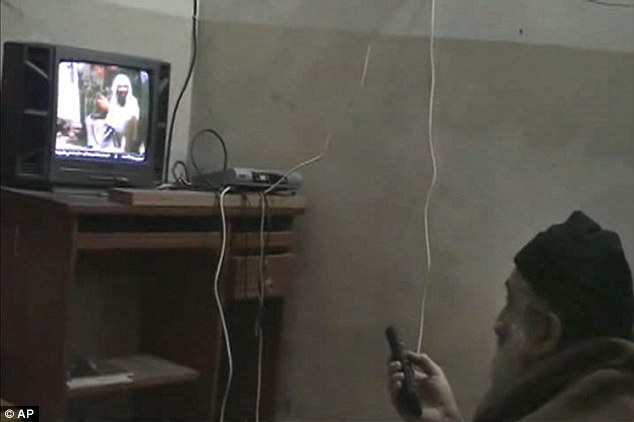
Everything would have been different if only Osama's parents had let him watch "The Prisoner"
Yet in truth, Breivik and his muderous activities, while maybe superficially inexplicable to the many ordinary citizens who would never contemplate such extreme acts whatever their views, are not so inexplicable at all. They are simply the tip of a very dangerous iceberg of hatred which we ignore at our peril. Look at the messages of support he got from rightwingers across Europe on web boards; or the excusatory comments to be found written by Daily Mail readers under the articles about him of the "it's terrible but not surprising.." variety. Breivik is responsible for his own actions, but the slaughter of Utoya, by his own admission, was in part inspired by the commentaries published by journalists like the odious Melanie Philips. His manifesto took their extreme views and moved them on a few stages to what was, for him, a perfectly logical conclusion.
Supremacist ideologies lend themselves to violence - we have seen that time and again, from the anti-Semitism of the Nazis to the "ethnic cleansing" by the Serbs in Bosnia, or the current spate of murderous assaults on Christians by Boko Haram in Nigeria. Breivik and his acolytes may spend most of their time in their bedrooms online, devising fantastical pseudo-organisations with kitsch medieval names and symbols, but that does not make them mad, nor any less dangerous.
Utoya, Srebrenica, Zaria, Kaduna - cultural supremacists of different nationalities and faiths continue the slaughter of the innocent, use violence in place of argument and twist sometimes genuine grievances into weapons of scapegoating and hatred. Their acts betray their own deep insecurities about themselves and degrade the very cultures they claim to defend or promote, but that does not give any credence to writing them off as aberrations, excusing their wider societies of their own (and our own) failures to be inclusive and humane with each other and with strangers.
It may offend those of us with inherent liberal beliefs in the fundamental goodness of humans, but for whatever reasons, the people who would bomb and kill others in the name of culture are usually far from insane, no matter how unpalatable their beliefs. In so many ways, they are simply the extreme manifestation of their own societies, of the savagery that lurks beneath the thin veneer of civilisation which can so easily be stripped away - just look at how quickly ordinary people were committing the most gross acts against their neighbours in former Yugoslavia, or in Rwanda, or Chechnya, or scores of other places at many times in history.
So they are not mad and indeed the act of declaring their actions necessarily insane both reinforces totally inappropriate stereotypes about mental health and completely misses the real causes of the atrocities they commit. In the film Downfall, Adolf Hitler was powerfully portrayed as a dark-minded, manipulative and angry human being - causing great offence to many, not because it was in any way inaccurate, but because by showing how banal and even normal evil can be, it conveyed the very uncomfortable truth that such terrible acts can be carried out by someone who is ultimately just flesh and blood, like any of us.
And so the people who blow up cars in streets or detonate bombs on underground trains or shoot defenceless teenagers in the name of defending culture or religion are not insane at all - but they are very, very bad. And rather than writing them off as not responsible for their actions and in the process exculpating ourselves, we must certainly resist them with every breath we can find. But to begin with, we need to take a very, very long look at ourselves and our societies and how they can so easily provide the fertile ground for the poisonous seeds like Breivik to bud and bloom so very, very tragically.
It was almost certainly a deliberate and very telling editorial decision, but one page of the print Guardian should have caught the attention of any reader today.
Emblazoned across the top of the page was the headline:
Pakistani girl accused of Qur'an burning could face death penalty
In an outskirt of Islamabad, an eleven year old Christian girl has been accused of blasphemy, a capital crime in Pakistan, for allegedly burning some pages of the Qu'ran - her family dispute this, claiming she was tricked by a Muslim neighbour into throwing ash into a pot with pages from the Muslim holy book already in it. Whatever happened, this child has now been arrested and nine hundred Christians expelled from the area.
Although he is a priest for a faith whose founder called on its followers to extend special protections to Christians and Jews as "Peoples of the Book", the local mullah is quoted as approving of the expulsions, not only because of the alleged book burning, but because of the infernal singing of hymns in the local churches (now closed).
On the same page, the next article similarly told the tragic tale of religious intolerance and the hypocritical taking of lives in the name of faiths that all outlaw killing.
Jewish settler attacks on Palestinians listed as 'terrorist incidents' by US
The US Government has finally declared as terroristic a longstanding pattern of hate crimes by Jewish settlers in Palestinian lands against Arabs - and even the Israeli Government has condemned in similar terms a series of attacks by settlers over the last few weeks which have included the random beating of a young Arab by a mob and the firebombing of a taxi carrying Arab children. The "Hilltop Youth", a group of Zionist extremists, has been linked to attacks that have killed three Palestinians and injured 183 over recent months. 10,000 olive trees, vital for Arab farmers' livelihoods, have been destroyed and in 90% of cases, the Israeli police have closed the case without charge.
During the same time, Palestinians have murdered a Jewish settler family in their home and bombed a bus terminal in Jerusalem, killing one and injuring fifty. Some may argue that the continuing and desperate siege of Gaza, where hundreds of thousands live in ghetto conditions surrounded by the Israeli army, somehow justifies such assaults, yet how can it? Such attacks are not war, but simple murders with civilians as their targets - as such, they detract from the real injustices and murder committed against Gazans by the Israeli state and invite the enemies of Palestine to create some moral equivalence between oppressor and oppressed.
And the three faiths involved - the Judaism of Israel and the Islam and minority Christianity of the Palestinians all talk of the sanctity of life. Yet here we see blood shed in the name of these same faiths.
The final article is less directly focussed on interfaith disputes, but shows how bigotry, in this case Christian-led against Muslims, can lead to laws with supposedly unintended consequences for all.
Pussy Riot protesters arrested in Marseille
Arrested because...?
Because in a fit of Islamophobia, France has banned the niqab, the face covering worn by some Muslim women as a mark of their faith. It is a policy advocated by many rightwingers in Europe - curiously adopting the same policy adopted by President Assad in Syria, who enacted a similar ban on such garments in universities, while until recently Turkey imposed a similar ban on Islamic dress in public buildings. Why so many are so obsessed with what others wear has always been a puzzle to me - it also ignores the possibility that, while some people may ban face-coverings now, this is setting a precedent for other people to ban other forms of dress they don't like. For example, what if the fundamentalists of all three Abrahamic faiths club together to ban women wearing trousers? Or to insist that men must stop shaving (a sinful activity in all three faiths writings)?
In France, the law has been used to arrest people who wore balaclavas over their faces to show solidarity with the similarly-clad Russian punks, Pussy Riot, three of whom were jailed for two years at the weekend. Supposedly, the French arrests prove that the niqab law is not about niqabs at all - but about face coverings and so not aimed in particular at Muslims. It seems an ingenuous argument and a patent lie - the law was inspired and argued for by pro-Christian rightists supposedly to defend alleged and undefined "French republican values". The last time I looked, the values of the Republic included liberte; but in modern France, it seems noticeable by its absence, especially for liberal protesters and for Muslim women of a certain outlook.
And the point behind all these sad stories of intolerance, violence and bigotry?
JUDAISM: "You shall love your neighbor as yourself" (Leviticus 19:18)
CHRISTIANITY: "Love your neighbor as yourself.' (Matthew 22:36-40, NIV)
ISLAM: "Do good to parents, kinsfolk, orphans, the poor, the neighbour who is near of kin, the neighbour who is a stranger..." (Qu'ran Ch4, v 36) "We believe in God, and the revelation given to us, and to Abraham, Ishmai'l, Isaac, Jacob, and the Tribes, and that given to Moses and Jesus, and that given to (all) Prophets form their Lord: We make no difference between one and another of them: And we submit to God." Qur'an (2:136)
Each faith stems from the same beginnings, shares a number of Prophets and holds, on paper at least, the many of the same or similar teachings, mostly based on respect and love. Yet, as we know, so often the reality is warped beyond recognition by the fundamentalists and bigots of each. It may be a trait within monotheism - if there is One God with One Way which has to be revealed to His followers, then the corollary is that those who don't agree with you must not only be wrong, but sinfully against God too. And so what is the duty of a believer? The majority of each faith see it as little more than proselytising, if even that - for the truth is that most people of faith live in at least passive tolerance of each other the overwhelming majority of the time; many learn to respect and share each other.
But where belief morphs into blind faith with its attendant dogmatic superiority and is manipulated by those with a political agenda to boot - racial supremacy, land grabs or simply scapegoating for some sort of gain, then we see the headlines of today. A sad, bad and foreboding taste of how the 21st Century presents itself as far from the enlightened "modern" society it would like to think it is; but rather, the echoes of the Dark Ages and the dark hearts of the zealots of monotheism grow louder and louder with every day. It is a harbinger of a dystopian future of neo-Inquisitorial theocracy. Torquemada would approve.
We let the headlines pass at our own risk.
Jews, Christians and Muslims - one God, three faiths.
Ever since humans first created societies involving hierarchy and governed by rules, there has been an unspoken "social contract" binding them together - sometimes voluntarily, even democratically, sometimes by physical force. But underpinning each have been other factors which have governed the acceptance of rulers by the ruled which, if sufficiently out of kilter, have led ultimately to social revolt - whether by the Bolsheviks against the "former people" of the Russian bourgeoisie, or by the anti-Mubarak protesters in Tahrir Square.
What are these rules and conventions? They may be explicitly set out in religious tracts or political ideology, or they may be much subtler, never set out clearly yet somehow understood and accepted (willingly or unwillingly). Social convention may govern how we behave sexually or in our relations with people from different races or faiths; it may silently set the rules of acceptance about property ownership or appropriate behaviour in public - and in private; determine the role of gender and the contribution due from and respect to different age groups, and so on.
In contemporary society, it is generally accepted that millions of ordinary people feel powerless to change society or even have much control over their lives. Unlike at least some previous generations, however, the will to fight for change seems muted even although, superficially at least, there are greater freedoms in terms of speech and more ability to transmit ideas than ever before. And yet, whether bought off by the bread and circuses of mass media and home entertainment or isolated and disempowered by job insecurity and a decline in community cohesion, many are deeply accepting of the status quo - the Queen shall reign forevermore, while Capitalism is the inevitable, irreplaceable climax of history. "They" will always rule "us" and there is nothing we can do - nothing indeed we should even wish to do - to change this.
Engels identified this mindset as one of "false consciousness": Ideology is a process accomplished by the so-called thinker. Consciously, it is true, but with a false consciousness. The real motive forces impelling him remain unknown to him; otherwise it simply would not be an ideological process. Hence he imagines false or apparent motives. ...It is above all this appearance of an independent history of state constitutions, of systems of law, of ideological conceptions in every separate domain, which dazzles most people. On this basis, the rulers maintain their authority: there is often an implicit threat of violence if there is a real challenge, but more often than not does not require deployment, because people succumb to conventions and myths that subconsciously compel them to comply whilst consciously believing they are in fact making an informed choice. So in a capitalist society the unhealthy concept of endless competition with others being at the root of all social interaction becomes accepted as a fundamental and inevitable component of human nature. It could be typified as almost the Stockholm Syndrome of the masses. But history shows how this can unravel - in pain and tears as in the Russian Revolution and civil war, followed by the new oppression of Stalinism; or more hopefully in the rise of Chavez in Venezuela and Correa in Ecuador. A new consciousness can be born, usually, perhaps sadly, from adversity. The old decays and eventually a new paradigm arises, but how that is shaped is critical to the new order - whether mass consciousness awakens to shape change deliberately and equitably, or whether one set of "They" is replaced by another. Do we have an elite revolutionary vanguard, which history shows can be readily corrupted by the power it seeks to acquire in order to disperse (never quite getting round to the latter)? Or can change genuinely come from mass bodies, decentralised, open, democratic - as the original Soviets briefly were in the heady days of 1917? It is more than a historical hypothetical - for never more in human history has there been a greater degree of false consciousness around acceptance of the free market and capitalism; yet never have there been greater dangers if this destructive force is not stopped, tamed and destroyed. For capitalism in its ever onward drive to commodify and consume is driving our world to exhaustion and our species to extinction. Since 2008 the banking crisis has for the first time in maybe twenty years or more led to people questioning the effectiveness and equity of the market system. The coming food crisis may propel this forward as the corporate grip on global food supply and the speculation in hunger that is manifest in the obscene trading of "food futures" in stock markets are revealed as the drivers of inflation and starvation. The 1% concept favoured by the Occupy Movement is technically wide of the mark as there is a substantial degree of unjust inequality among the remaining 99% as well. Yet it powerfully portrays the sequestering of wealth by a tiny elite - "them" - and could, finally and very consciously give the Left both the platform and the audience to show that in a socially just society, "They" can finally and irrevocably be replaced by "Us" - all of us.
Below: Welsh singer Jem released this understated and surprisingly dark song some years ago; its theme of compliance with the rules set by "them" and how we make our own prisons has never been so pertinent.
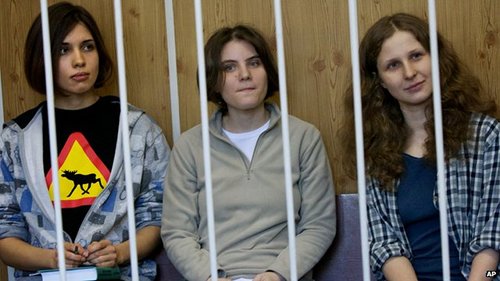
The most notable news story from Russia in recent weeks has been the arrest and trial of the three members of Pussy Riot. This is the female punk band that staged an anti-Putin protest with a satirical hymn to the Virgin Mary in Christ the Saviour Cathedral in Moscow during the run up to the Presidential elections earlier this year (although it is to be noted the music track on the video below was not played in the Cathedral, but overlayed when it was uploaded to Youtube and the world).
Needless to say, their performance was executed without the approval of the religious authorities of the Russian Orthodox Church and the women are now facing up to seven years in jail for "hooliganism motivated by religious hatred." Their trial began last week and appears to be a parody of justice - the prosecution witnesses talk about how they felt hearing the song, while only three of the thirteen defence witnesses have been allowed to be called. The prosecution witnesses are questioned about their religious beliefs, giving them full opportunity to stigmatise the defendants as blasphemers, while any attempts to show the defence witnesses to also have Christian beliefs have been repeatedly ruled out of order.
Nadezhda Tolokonnikova, Yekaterina Samutsevich and Maria Alekhina face 7 years in jail.
It is a case that even RT News has admitted is dividing Russia between those who cling to Putin's nostalgic and increasingly repressive nationalism, and those who for the last two decades have been working for a free, democratic society where freedom of expression is a given. It is of little surprise to discover that the group was motivated to stage its protest where it did because of the Russian Orthodox Church Patriarch's public call for worshippers to vote for Putin. This was/is at a time when millions of Russians were protesting their suspicions of the President's "manipulation" of first the Parliamentary and then the Presidential elections. As the established Church in Russia - the Patriarch swears the President into office - its head should be at least formally neutral but, in the "managed democracy" that is the Russian Republic, this was blatantly broken - but unlike the singers, no cleric has faced any charges such as abuse of office or breach of election law.
The outcome is expected soon. Putin appears mildly embarrassed by the international attention it has drawn, with politicians and celebrities across the world calling for the charges to be dropped. Today, he seemed to be suggesting there should be some degree of leniency shown in sentencing (this before a verdict is given). But it is already too late for him to pretend that somehow Russia has any sort of functioning civil society: the struggle between authoritarians and liberals is now fully on, and the trial is only one of several aspects of this, including the unprecedented range of anti-government demonstrations in recent months.
Supporters see the case as key to freedom of speech in Russia
For Russia, it is not an unfamiliar scenario, at least in the perspective of history. Almost exactly 99 years ago, Czarist Russia was rocked by a strikingly similar set of circumstances, albeit with rather different and more serious charges involved. Likewise, it marked a turning point in the political struggle between liberalism and authoritarianism.
In Kiev, in spring 1911, a young boy, Andrei Yutshinsky, was found murdered, stabbed dozens of times in what the rightwing "Black Hundreds" (who agitated violently on behalf of the Czar) and the gutter press quickly decided was a ritual murder of a Christian by Jews. A witch-hunt followed with a Jewish man, Mendel Beilis, arrested and charged in spite of a total lack of evidence - but in the two years he waited in prison for his trial, he was utterly demonised as a "Drinker of Christian Blood". His wish to do such a thing was based on the false "Protocols of the Elders of Zion", a tract written by the Czar's police, which created the myth of a Jewish conspiracy to take over the Christian world: Hitler later used it to great effect.
Two Russian policemen discovered the truth - the boy had in fact discovered that a friend's mother had been involved with a black market gang and threatened to report her, only to be murdered by the gang. However, on the Czar Nicholas' orders, they were dismissed and the prosecution of Beilis went ahead in September 1913 in order to "prove" the Jewish conspiracy theory was real. The Judge was met by the Czar and promised promotion if there was a conviction; the jury was packed with Government sympathisers and the defence was repeatedly denied the right to put its full case.
Outside the Court, Russian society was fractured, with liberal and socialist parties calling for Beliss' acquittal and decrying the whole affair as a disgrace to Russia' faltering steps towards a modern society. By contrast, the nationalists and royalists called full throttle for Beilis' execution and the expulsion of the Jews (tens of thousands had been murdered in recent years in vicious pogroms tacitly encouraged by the authorities). Abroad, the celebrities of the day petitioned for Beilis' freedom - H.G. Wells, Thomas Mann, Thomas Hardy, academics, politicians and students among them.
In the end, the case against Beilis was so thin that even the biased Court proceedings and the pro-Czarist jury didn't convict him. He was released and fled the country within a few weeks, never to return. But the Czarist Government continued with its repression unabated, the Beilis case being perhaps the final nail in the coffin of the very limited political and social reforms following the 1905/6 Revolution.
Putin and his coterie of course look back wistfully to the Czarist days and the ceremony around the Russian Government now owes much to the Romanov Court in its final days. Likewise, the restored, pre-eminent position of the Orthodox Church, used by the State now in the same way as the Czar to associate good, normal Russians with God and the President.
But as we await the outcome of this trial, a key one for freedom in Russia, Putin might do well to reflect that in less than four years after the Beilis case, the whole rotten edifice of Romanov Imperial Russia was to collapse in the flames of the revolutions of 1917. No autocracy can last forever. "Czar" came from the title "Caesar" in the old Byzantine Empire, where Emperors on their Coronation Day were accompanied by two men, one of whom whispered constantly to the ruler, "Remember, you are mortal." And the other one measured him for his coffin.
I didn't support the Olympics coming to Britain; but, once it was happening, I will admit, I really enjoyed much ofthe Opening Ceremony(industrial revolution aside!)and the success of athletes from all over the world, notwithstanding the odd quibble, is impressive to behold - not least the young British athletes who have worked so hard, sometimes with little support compared to their rivals.
I really liked the idea of Mitt Romney not only being so embarrassed by his carping about arrangements, but when that wonderful NHS symbol went up, what was he thinking as he sat in the audience watching? This, after all, is the man representing the morons who claimed that Obama's limited healthcare initiative was "Nazi Communism" and that the British health service is run by a series of "Death Committees" (I kid you not). There was even the American rightwinger who claimed that if Stephen Hawking was British, the NHS would have let him die years ago. Until, of course, Hawking pointed out he is British and has only ever had medical treatment from the NHS...
Public services- delivering better health and better Olympic Games
However, there have been many aspects of the London Olympics which show how the original ideals of the Games have been subverted by money-making; and money-making that, like so much of contemporary free market capitalism, is not working even to its own limited standards.
Big Fail - although G4S still intend to collect their full £59 million fee from the Government, which must have involved about the worst worded contract in history...
Who takes up where the profiteers of private enterprise have failed? Why, public staff - soldiers and police; both services currently facing swathes of redundancies. A number of the soldiers deployed at the Olympic Park face a very doubtful future in terms of their employment, while police numbers are at their lowest in years. But both services appear to have very quickly and effectively filled the gap left by G4S and their arrogant management.
But the private sector has also fared very badly in terms of services to visitors to the Park. Not only have the food outlets sold out half way through each of the first few days of the Games, failing to cope with demand, but Visa obtained agreement from Locog for a "cashless" Games - so if you want food, you have to pay with a card, preferably a Visa card.
But what happened? Well yesterday, the card machines all failed at the Wembley stadium, where Olympic football was underway. From cashless Games, suddenly they became "cash-only" Games. But, bowing to their sponsors original ethos, stadium officials had disabled all the ATM cash machines on the site - so thousands of spectators had to do without (though since the food had sold out anyway, perhaps it didn't make much difference!)
Since the outset, Locog has been criticised about its sponsors and their control over Olympic branding. Coca Cola and McDonald's (who have the largest outlet of their franchise in the world at the Olympic Park) are hardly bywords for sport and health. Olympic athletes are at least notionally amateurs: their success if they enjoy it may later bring them financial gain; but for the Games, they are signed up to the ideals of fair competition. But outside the stadium, the Olympics, it seems are now marred not by fairness or even competition.
Instead, monopolies have bought up rights to supply and profit from a captive audience. Yet in their greed and short-term thinking, just like the banks, the City traders and all the other "private-public partnerships" that proclaim social good while actually thinking about pure profit, it seems they just can't deliver anything right. Their total disinterest in the Games themselves is witnessed by the thousands of empty seats allocated to corporate sponsors who, having got the logo, just want payback, not sports.
With profit-margins squeezed for every last penny, just-in-time delivery systems collasping, consumers ripped off and low paid staff in insecure jobs, capitalism isn't going for gold. In fact, it's not even off the starting blocks.
Below: G4S would now like someone to run their recruitment service - perhaps they should have started earlier?
Men are huddled, naked and bleeding, by a wall as a crowd swarms around them, ready for the kill. A few moments later, gunfire blazes and they lie dead, butchered by a mob of supposedly democratic rebels.
This then is the face of "free Syria" - revealed today in a sickening video just as it is announced that the rebels have now received heavy armaments and surface-to-air missiles from anonymous donors via Turkey. And who are these patrons of the allegedly peace and freedom loving insurgents battling the Assad regime in Aleppo and Damascus?
None other, it seems, than our old friends, Qatar and Saudi Arabia. That's right, the same regimes that have sponsored the bloody crackdown on democracy protesters in Bahrain, and just last week in one of Saudi's eastern provinces. The enlightened despots, promoting a deeply fundamentalist strain of Wahabist Islamism, are funding the increasingly violent assault against the secular regime of Baathist Syria, just as previously they sponsored and, in Qatar's case, sent troops to support the battle against Gaddaffi's Libya and interfered in Iraq. They are even paying a wage to rebel fighters - all to advance their particular form of faith, probably the most repressive in the Muslim world and one disavowed by hundreds of millions of Muslims.
Why? What possible motive could there be for the USA and its European allies to connive, albeit covertly, with the very people they have spent so much time and squandered so many lives, military and civilian, in the mountains of Afghanistan?
Yet America and the UK especially keep parroting the line that Assad must go, weeks ago destroying the Kofi Annan peace plan that might have fumbled its way towards some sort of peaceful, negotiated settlement. Repeatedly, they have taken at face value the often spurious claims - on a number of occasions shown to be downright lies - made by the Free Syrian Army, and they have ignored the calls by a wide range of other opposition groups inside and outside the country for a negotiated path to be followed. Instead, just as Iraq unravelled into bloody sectarian conflict, the West and its fundamentalist allies in the Gulf seem intent on providing the rebels with the means of turning a low level conflict into a bitter and bloody conflagration out of which who knows what horrors may emerge.
But peace and democracy is not what any of this is about. Rather, it is about neutralising an opponent of Israel and an ally of Iran in the wider geopolitical game played by the White House. As it skirts round and round Iran in ever decreasing circles, readying to strike, what is more obvious than ever is America's willingness to let millions suffer war simply to punish those regimes which, unlike Saudi and Qatar, dare to refuse to comply with US foreign policy.
As for their domestic policies, Washington is as unconcerned about the rights of Arabs under the Ibn Sauds as it was unfazed by the repression of regimes like Somoza's Nicaragua and Pinochet's Chile. It has never yet criticised Saudi Arabia for its oppressive regime, which reaches into the most private aspects of the Kingdom's subjects' lives, and it stood aside while Saudi troops assisted Bahrain in crushing democracy protests almost at the gates of the biggest US military overseas base in the world.
So we know what to expect next and, as former US Ambassador to the United Nations, John Bolton, unapologetically told the BBC about US policy in the Arab world not so long ago, "It's not about democracy. It never has been."


.jpg)