Showing posts with label Farage. Show all posts

Tuesday, 21 May 2019

Dry Cleaners of the World Unite: Democracy is in Danger!

 So yesterday in Newcastle Nigel Farage became the latest rightwinger to have a milkshake tossed over his lovely pinstripe suit.

It is a trend that started when would-be MEP Stephen Yaxley-Lennon, aka Tommy Robinson, was hectoring a young man who, pushed to the edge of reason, poured his own recently purchased liquid confectionery over the former EDL leader. Soon after, Carl Benjamin, aka Sargon of Akkad, a UKIP candidate in the south-west, was milked not once, not twice but four times. Even the Peterborough stall of the re-formed Social Democratic Party, a bolt-hole for allegedly moderate former Kippers, was splattered on Monday, though their only casualties were some leaflets.

Social media has of course been abuzz with pictures and memes - from relatively mild speculation about dairy-free alternatives for would-be vegan assailants through "this is what happens when lactose meets intolerance" to rather cruder speculation about neo-Nazi sexual practices. But, while predictably the rightwing mass media and rightwing groups have howled with rage about this alleged assault on free speech, so too have some on the left voiced concerns about the thin-end-of-the-wedge. Surprisingly, what would previously have been generally viewed as relatively minor, whimsical acts of protest are seen by a not small number of progressively-minded people as a serious threat to the democratic process.

You start with milkshakes, one Green activist warned me, and before you know it, people are committing atrocities like murdering Jo Cox.

Well, no. It may be a bit silly and an arguably counter-productive act to waste a tasty cold beverage on the likes of Farage, but there is a quantum difference between someone staining Nigel's jacket and Thomas Mair gunning down an MP in Birstall market.

The milkshake option (caramel and banana, I believe) follows a long tradition in political protest, one which, while messily dramatic, is ultimately entirely peaceful with clothing the only casualties and temporarily so given the prevalence of new-fangled contraptions like washing machines. It is just the medium that is new: in the past, a variety of soft food products were a popular option - precisely because, as with milkshakes, these can express disdain and anger with very little chance of anyone actually being hurt (physically at any rate, egos may be a different matter).

In 1970, after his car was pelted with eggs during the General Election campaign, Labour's Harold Wilson's response was to quip, "If the Tories get in, in five years time no one will be able to afford an egg." In 1992, Margaret Thatcher was hit by a bouquet of daffodils, while then Deputy PM John Prescott was doused in iced water by members of Chumbawamba at the 1998 Brit Awards.

Egged - Harold Wilson in 1970
My personal experience of this was standing behind the late Labour MP Tam Dalyell at a march against the looming Gulf War in 1991 when a flour bomb struck him between the shoulders, the powdery fallout temporarily bestowing my face with a ghostly Halloweenesque quality. Dalyell however dusted himself down, grinned at me and plunged into a speech about peace.

A few years earlier, at a meeting at Glasgow University where the SDP leader Roy Jenkins was speaking, I witnessed a paper aeroplane hurtle out of the mass of a far from sympathetic audience to land squarely between his bespectacled eyes. Jenkins' response was to coolly carry on speaking while he retrieved the missile from the desk in front of him before nonchalantly launching it back in the direction from which it had come.

There are scores of similar incidents down through the years. John Major, Nick Brown, Michael Heseltine, Nick Griffin, Peter Mandelson, Tony Blair, Ed Miliband - all these and many more have been pelted with rotten fruit, had chocolate eclairs shoved in their hair or ended up with egg on their faces. Democracy wasn't imperilled and politicians did not call the police to report crimes against their laundry.

Until yesterday, that is, when Farage bravely called the police and made a statement which landed his "attacker" in court charged with common assault and criminal damage.(Of course, Nigel has form when it comes to wasting taxpayers money on his whims - among other charges to the public purse, he similarly insisted on a prosecution of an egg-thrower in 2014.) Whisked on from Newcastle to Wakefield, he refused to leave the "safety" of his bus while vowing (I jest not) to "keep buying new clothes" until polling day.

The cream sours on Tyneside
Well, forgive me, but I shall not weep. In or out of the carton, milkshakes do not threaten democracy. What does are people like creepy "Sargon", who ponders on twitter about whether or not to rape a Labour woman MP; or Farage himself, who has belligerently promised his "People's Army" that he will "pick up a rifle" to ensure the Brexit of his choice happens.

Little more of course than inflammatory bravado when in truth he turns tail and runs from chocolate-dusted cream, but inflammatory all the same and it is this, not harmless acts of protest, that we should be worried about. Because Farage may never lift anything heavier than a pint - but who is listening to him, and what are they thinking and doing?

The murderer Thomas Mair shouted far right slogans - "Britain first!" - as he slaughtered Jo Cox with his knife and home-made gun, and just today we learned that the police and MI5 have been tracking scores of far right extremists who have plotted to murder Labour MPs and carry out major acts of terror. In a number of cases these fascists were dissuaded from committing slaughter only by agents revealing that they were being tracked and their plans were known: the police have not been able to arrest or prosecute in many cases. Instead, they walk our streets, their minds filled with rather more sinister ideas than dispensing sugary drinks over their opponents' heads.

So forgive me, but as I look at the comparisons, I am not losing any sleep over a millionaire's dry cleaning bill.

Friday, 12 April 2019

SHORT STORY: Election '22 - Or, Be Careful What You Wish For


It was a lovely day, that June morning all these years ago in 2022. The sun was up. The sky a crystal clear blue from the very first glow of golden dawn. But down here on Earth, it was as if the solar rays playing across the rooftops of the capital were mocking them as Britain was plunged into a great darkness. It was just the first day, the first of many days of despair that now, as he clutched his drenched jacket around him and tasted the salt in the cold flecks of spray, he remembered so well. So bitterly, terribly well...

"Mr Farage is expected at the Palace in the next twenty minutes to kiss the Queens' hand and accept appointment as Prime Minister... Afterwards, he and his likely Deputy Prime Minister, his coalition partner and leader of the UKIP, Gerard Batten will meet with their MPs to begin the process of forming a new government. The Brexit Party's Foreign Affairs spokesman, Katie Hopkins, has announced that the new PM has already spoken by skype to President Le Pen, herself a recent newcomer to office, to discuss their planned Budapest Compact for a New Europe. Viktor Orban of Hungary and Matteo Salvini of Italy are expected to join them as they prepare to radically overhaul the European Union into their planned Europe of the Nations confederation..."


Hard to believe, he thought, but it was there. Staring us in the eyes. In the f*cking face, in fact.

But of course, just as they'd never anticipated it, the liberals even now denied it. Someone must have stuffed the ballot boxes. The media told lies. The great unwashed had fallen for the Facebook ads and the Twitter memes yet again. Didn't they see it...??

But this was one vote they couldn't rerun and a process they couldn't drag out.

Sure, they had won the second referendum. Back in September 2019, the ChUKs champagne corks had popped and the Lib Dems shook in exotic spresms when, pushed from pillar to post, Theresa May had caved in and agreed a second referendum. Her deal, her precious deal, or... Remain. "No deal" wasn't an option because it apparently made no sense. "Anyone who wants to vote for that, is too stupid to be allowed to vote!" declared one Nu-Labour peer as the ballot bill was rushed through a somnolent Lords.

And so they won: three and a half years' after the first referendum, Remain on 54% of the vote carried the day.  After 6 weeks of ever more vicious and divisive argument, somehow even worse than the first plebiscite, 16.9 million backed staying in the EU. Article 50 was revoked and, tail between its legs, Britain sheepishly returned to the Eurofold. Bereft of her majority already and with Rees-Mogg's ERGers in open, permanent revolt, Theresa May retired to a wheatfield in the Home Counties. A National Government under Sajid Javid was forged between the rump of 220 Tory loyalists and the ChangeUK contingent, now swollen to 80 as Blairites fled the Labour Party en mass. The SNP provided "confidence and supply" in return for its own second indy referendum being agreed for 2025, ten years after the first.

No one could remember when the term zombie parliament first entered common parlance. It was probably before the referendum, but at any rate by early 2020 it was seared in permanent place. In the crumbling gothic ruins of Westminster, the patchwork of neoliberals and chancers kept things turning a little bit less each day. But outside, something was happening.

The Brexiteers had lost the referendum. But amidst sarcastic jokes of "best of three", and repeated expositions on how the winning Remain vote this time was numerically lower than the Leave vote last time, Squire Farage donned his finest tweeds and, harrumphing like a latter day Toad, proclaimed war on the Weasels of Westminster. And just as the SNP had hoovered up the YES vote after they lost the Scottish referendum in 2014, so the Brexit Party and, to a lesser degree, UKIP, found their stock rising in spite of the referendum result as they radiated and consolidated the seething anger of millions of Leave voters.

Or, as he pondered things now, perhaps because of it. For people who had switched back to the Tories and Labour in 2017 after both pledged to honour the first referendum turned away again. The shenanigans that had stretched all the way through 2019 had poisoned most citizens' views of the political system. The self-identifying Political Class never seemed so detached from reality as it did that year and, feeling no loyalty from their MPs, similarly millions of voters offered none in return.

Birthed in their successful 2019 campaign for the Euroelections they claimed should never have happened, the Brexit Party had faced something of a quandry about what to do after the second vote, but the formal defection of 40 ERG MPs from the Tories to Farage in early 2020 gave it a significant parliamentary presence for the first time. By late 2021, the rightwing collaborators stood at 29% in the polls, behind Labour's 32% but 13% clear of the Change UK party and 15% ahead of Javid's doomed Tories. Sensing its ultimate fate at the polls, the Government of the Undead stumbled on blindly with only Nick Clegg's Fixed Term Parliaments Act keeping them clinging on constitutionally to the aptly-named deadline for fresh elections in spirng 2022.

The General Election campaign was bitter indeed. The Leaders' debate between Javid, Farage and Corbyn oused with recriminations and accusations of treason, racism and corruption. Farage and Corbyn were seen as joint winners by the polls, with Javid sinking. But still, on polling day, Labour clung to a 3% lead - 35 to 32 - over the Faragists. The received wisdom was that  as UKIP had polled 14% in 2015 but won no MPs, then even with a much swollen vote, they might hope at best for "a Brexit dozen" as Ken Clarke scathingly predicted from behind a large cigar.

"Farage finished" proclaimed the Guardian, while the Independent favoured "Brexit's Last Gasp" and even The Sun cautioned "Nigel Nowhere?".

Polling was brisk, but in Leave-voting areas from the referenda, it was mobbed. Angry queues formed from early morning as Britain enjoyed the first days of a warm summer. Police fought with groups of right wingers who moved through London parks attacking black people, tourists and anyone - indeed, anything - they deemed foreign.

He spat as he remembered sitting with some Green and Lib Dem friends in a tapas bar in Limehouse. They had all been in high spirits as they traded tales of ignorant Brexit supporters on the doorsteps. As the sonorous election programme theme sounded and the red and blue graphics sparked and sparkled in the dim light of dusk, they had watched in jubilant anticipation.

"And our prediction is - Brexit-UKIP take 35% of the national vote and win with 312 MPs for the BP and 36 for UKIP. An overall majority for the alliance of 46 seats.  Labour remain the official Opposition with 201 and the SNP follow up with a much increased 49. The Tories polled 17% of the vote, better than expected, but held on to just 19 seats..."

"First-past-the-post," he heard himself mutter. "First-past-the-f*cking-post..."
They somehow hadn't reckoned on that, had they. 46% of the vote lost the Brexiteers the referendum; but just 35% won them an outright majority in the Commons, as it had done for Blair way back in 2005. 65% opposed them, but there was Farage in Downing Street and Tommy Robinson on his way to his new desk at the Home Office.

But of course, at least Britain was still in the EU. That would protect them, wouldn't it?

Wouldn't it?

As he sat now on the side of the raft on this grey day, his gaze switching from the lapping water to the distant Gallic shore, its haze-covered beaches traced with barbed wire and lookout towers, he knew better.

The distant hum grew louder and through the faint mist he watched the Border Protection Force frigate HMS Enoch Powell bearing down on the flotsam and jetsam of liberalism as it bobbed in the cold waters around him. He closed his eyes. And as the guns strafed the sea, he grew angry, his face contorting with pain.

Yet it was not from piercing bullets that his agony came, but from his seething disappointment. For in these, his final fleeting seconds, all he could think of, all that he could visualise, was David Cameron, his porcine chops grinning and puffing pretentiously, his condom-quiff wobbling and his porcelain-perfect teeth flashing with customary contempt.

A snoot laughing in the face of humanity forever...


Wednesday, 14 January 2015

Three Men in a Debate

As I stared in the shaving mirror this morning, Radio 4 announced that Ed Miliband, Nick Clegg AND Nigel Farage had written to David Cameron urging him to take part in the Leaders' TV debates without the Greens' participation, otherwise they would go ahead on their own without him. Aping Have I Got News For You's "tub of lard" wheeze some years ago on Roy Hattersley's non-appearance, they threatened him with asking the broadcasters to set up an "empty podium" to highlight the Prime Minister's absence.

Momentarily, I paused from assaulting my hirsuteness (just as Cleggie apparently did 5 years ago when he secretly converted to austerity during his morning shave after apparently confusing the UK with Greece). How coincidental, I naively thought, that these three rivals would write to Cameron on the same day.

But my naivete was short-lived. Was the write-to-Dave stunt co-ordinated? Well, yes. In fact, it was so co-ordinated that they all sent the same letter. Yep; "Red" Ed, whom Labour supporters keep claiming has put Blairite Nu-Labour behind him shacked up with that betrayer of progressive politics, Nick Clegg. And then they got new best mate to join in. Yes, former stockbroker and doyen of the populist right, Nigel Farage.

So, finally, all the claims from Labour and Lib dems over the months that their leaders had not refused to involve the Greens now stand naked and clear - these self-interested, anti-democratic trough-swillers are prepared to actively work with UKIP to exclude the fourth party of British politics, the Greens, in order to shore up their crumbling grasp on the political stage. All on the same day that the Greens' total paid up membership figures overtook those of UKIP and on current trends are likely to overtake the Lib Dems' by early next week - over 2,000 people joined the Greens today alone.

They may be right when they claim Cameron's stance on the Greens is rooted in his own self-interest; but what is even more evident is that their own stance is so completely self-centred and exclusivist that Miliband and Clegg are prepared to debate with Nigel Farage but not with Natalie Bennett, let alone Nicola Sturgeon of the SNP or Leanne Wood of Plaid Cymru.

The only cold comfort in this most cynical of moves is that our electorate is somewhat more intelligent than these machine manipulators realise. And with 300,000 signatories to a petition calling for the Greens to be given a platform and 80% support for a Green speaker in opinion polls, the voters are infinitely fairer and more inclusive that the three men who audaciously refer to themselves are the "leaders" of the people.

Shame on them, then. And may they face a full reckoning on 7 May.

Nick's letter. And Ed's...And Nigel's.

Sunday, 12 October 2014

The Men In Grey

Shades of grey - 4 variations on the same theme; even if there is a more "exciting" range of suit shades; sort of.

Nick Clegg famously (well, sort of) "realised" that austerity was a necessary remedy for Britain's banking crisis one morning as he was shaving during the 2010 election campaign - although he neglected to share his insight with the rest of us until after the polls had closed. After all, perhaps sales of "I Agree with Nick" memorabilia (for that is all it is now) would not have been so brisk at the Lib Dem shop.

Wind forward to earlier this year - the morning of 27 March to be precise, and you might have wondered what Nick was thinking as he looked in the mirror that morning - perhaps he had to look twice when he thought he spied a little Nigel Farage dart behind him with a broad smile requiring no toothpaste. After losing the first of their two televised debates by a wide margin (57 to 36% favoured Farage), Clegg must indeed have pondered about what he had let out the linen cupboard.

Fact-stuffed to his finger tips, Clegg had set out to disabuse the public of Farage's claims about the EU. In typically misguided technocratic fashion, he thought that he could blow away the UKIP leader by showing his claims to be little but castles of sand: £55 million a day for Britain's membership of the EU? Nonsense, it's a snip as £33 million net after deductions and repayments! 70% of British laws set by Brussels? Nonsense - anyone could tell you that it is between 10% and %50 depending how you catgeorise things. How could Farage possibly win the debate after getting such facts wrong?

Clegg like so many in the political class, inured to years of tick box politics, is blinded by facts: but the fact is that their much-loved evidence-based research can prove just about anything: hospital queues have increased or decreased;  poverty is better or worse (or absolute or relative and if so what sort of relative?); people are better or worse off - all dependent on which sleight of hand or "weighting" is applied. All these statistics, they believe, can justify what they have done, how they have behaved and prove pesky people like Nigel Farage wrong.

Except it doesn't work. Because Farage cleverly represents how some people feel and very powerfully in some respects. Like so many populists, he has caught a mood, played on it and capitalised on it. Fear of the (supposed) unknown: foreigners taking our jobs, foreign governments telling us what to do while supposedly breaking all the rules themselves, and so on. And as we have seen this week even in a town with few migrants indeed, Clacton-on-Sea, it works powerfully to UKIP's gain - and nearly did so hundreds of miles away in the north at the Heywood & Middleton by-election on the same day as well.

Now these feelings may not be based on facts (although years of spurious facts being peddled by the media has very effectively created the impression that they are). They may even be factually incorrect - but that still doesn't matter; because facing declining living standards and joblessness, some people will indeed turn to the most visible scapegoats offered up by UKIP (and reinforced by the media) in their midst, however wrong it may well be to blame them. Similarly, the "fact" that UKIP stands for tax cuts for millionaires, deregulation for bankers and cuts to the NHS may not go far unless there is an alternative narrative that says we can feel ok about ourselves and others, that we can trust our neighbours and unite against disproportionate inequality. So far, none of the main parties offer such, nor, with all of them united on things like the benefits cap, are they likely too.

And what our stats-driven, pseudo-technocratic elite don't understand, perhaps because to their Vulcan-mindsets it isn't logical, is feeling. How emotional can you get over a table of even the most damning figures set against a tearful human face, or a photo of an empty factory, or a queue at a food bank? Yet they will happily, even sociopathically, reel off lists of these things, their smug, knowing faces turning to perplexed confusion when it dawns on them that it isn't working. For while facts are important, especially in laying low some of the lies propagated by UKIP and others on the right, if they are all you have, then shorn of any Vision all you have is an encyclopaedia of today, not a manifesto for tomorrow.

New Labour started this trend among our politicians of putting figures up in place of politics; of citing "key performance measures" over political change. And little wonder, given Blair's abandonment of political ideology - performance targets were all he had left to try to make out it doesn't matter if your liver scan is done by the NHS or by profit-seeking Virgin Clinics or whoever. The result is the Deputy Labour leader, Harriet Harman, flailing about on national TV this morning trying to outdo UKIP on tackling immigration rather than offering a counter-view. But how could she? After so many years of evaluating stats and focus group analyses, she may well not actually have her own view any more, her original thoughts, feelings even, long since lost in the smoke and mirrors of think-tanks and policy wonkery.

So now we face the outcome of this: bereft of belief or values, the self-created, self-serving "political class" (the two words that say it all, really) spread among the two and a quarter established parties are left floundering as UKIP and others advance. UKIP triumphed last week and at the Euroelections in May. Simultaneously, both at the May vote and in many opinion polls since the Greens are vying to overtake the Lib Dems nationally in spite of a virtual media blackout - quite the opposite of UKIP's wall-to-wall coverage of Nigel's every pint.  Meanwhile in Scotland, the enthusiastic Yes campaign seems almost undiminished in spite of the referendum defeat as all the three Westminster parties can, still almost literally, bring themselves to say is, indeed, No or possibly Not Yet. The three Yes parties - the Greens, the Scottish Socialists and the SNP have each experienced an exponential growth in membership - the latter party now approaching 100,000.

 People are looking for alternatives - to my mind, some of these seem very unpleasant alternatives indeed whilst of course I have my own preferences; but what they all do, is touch on humanity (both its good and bad aspects) infinitely more than the anodyne, focus group media politics of the established parties. With UKIP, the challenge for the left is to avoid the pathetic denunciation of their voters as "f***ing thick" and "just fascists" (both cited on a supposedly progressive webpage today) and look beyond vote totals to the actual beliefs of many UKIP voters (as distinct from UKIP itself) - pro-welfare state, pro-public NHS, pro-rail nationalisation and in favour of a higher living wage, in some cases more emphatically so than Labour voters. These are people who feel abandoned because the Labour Party especially took the view so eloquently articulated by that Tribune of the People, Lord Peter Mandelson, when he suggested that "traditional" Labour voters had "nowhere else to go". Well, they've gone and they won't come back to Labour or any other party that treats them so off-handedly.

We need to offer a different story; the one that says ordinary people's problems are not caused by their disabled, migrant, ethnic minority or unemployed neighbours, but rather by the tax-minimising elitists who, among other big parties, fund UKIP. And that UKIP, offering yet another Man-in-a-grey-suit, are not a challenge to the current system - rather just more or the same with a little extra bile and bombast.

The collapse of the political system that has effectively prevailed for the last century marks many dangers ahead - but also the greatest opportunities yet to build a new, fairer society: we can only achieve that by providing a positive way ahead, an end to the politics of fear and loathing and transition to the inclusive, more egalitarian democracy that so many are so desperately seeking.


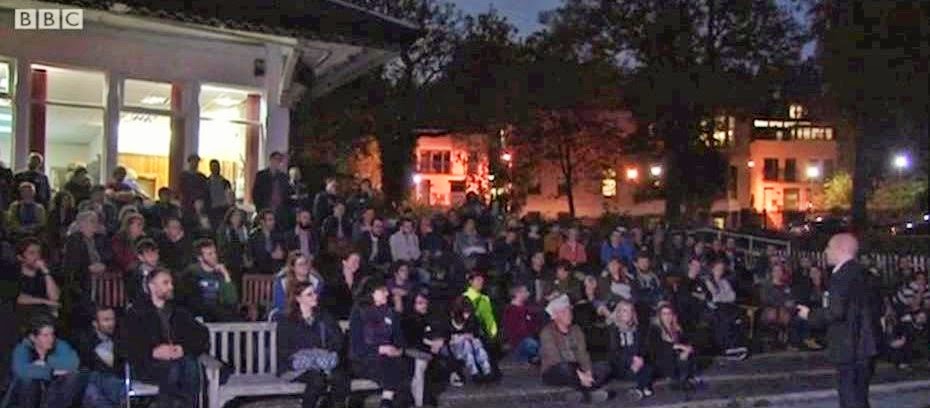
Below: looking for a new way; so many people turned up at the first post-referendum meeting of Glasgow Green Party that surprised party officers had to move the meeting outside the booked venue.

Tuesday, 20 May 2014

Guest Post: Bradley Allsop on Greens or UKIP?


Bradley Allsop explains why a Green vote is better than a UKIP one...

The past few months have seen a lot of attention on UKIP in the upcoming European elections, where the right-wing party are expected to come first or second.

Some are jubilant – I mean, they're sticking up a finger to the establishment and ridding us of an over-bearing EU in one stroke, aren’t they? Wrong.

If people want real change, and a party with a holistic vision of a fair future- then Greens are the only choice. Here are five reasons why a Green vote is a better vote than a purple one.

1. Green MEPs actually do something - Out of some kind of misguided belief that voting in the European Parliament would only “encourage” the Europhiles, Farage seems to actually take pride in his atrocious voting record in Brussels – compared to Greens who have the highest turnout out of any group. Whatever your views on the EU, we’re not going to leave it until at least 2017- so surely you want those elected into the European Parliament to actually try and fight your corner? Green MEP’s have already fought for caps on bankers’ bonuses, tougher regulation on City speculator’s, and measures to tackle youth unemployment- using their time in Brussels to actually help people. They’re also the only party talking about the US-EU Transatlantic Trade and Investment Partnership (TTIP) - one of the biggest threats to democracy we face.

2. Climate change - UKIP are climate change deniers. The party’s 2010 manifesto promised to end the teaching of climate change in schools. Climate change, and the impending energy crisis if we do not switch to renewables, are two of the biggest problems we as a species face. The Greens are committed to tackling this head on, so we can all live in a cleaner, more sustainable way, preserving the beauty of our world -  while UKIP opt for the “bury your head in the sand” technique. This also highlights a key reason to stay in the EU - it has already passed legislation concerning carbon emissions, recognising that climate change is not something any one nation can tackle alone. We need international cooperation of the sort that the EU can give us.

3. What you see is what you get - The Green party works in a far more democratic way that the other major parties. Conference (where any member can put forward a proposal, proposals that are voted for by ordinary members) is the highest authority, and there is no “whipping” of Green candidates and officials. As long as we adhere to what is decided by everyone at conference, we are given relative autonomy to fight for what we believe and do what we think is right. What you see is what you get with the Greens, a party not mired in scandal like certain other parties seem to be…

4. Fighting for the unrepresented - The Greens have fought tirelessly for the forgotten, on local, national, and international levels. We want the minimum wage to become a living wage, whereas UKIP want to impose a flat rate of tax – something which only benefits the rich. We have fought for LGBTQI rights, whereas UKIP blame them for the weather. We have made steps at conference and within party structure to have more BME candidates, whereas UKIP officials have told them to go back to “black land”.

5. Hope not fear - The Greens are offering a fair and bright future for everyone. UKIP are offering an ever-more divisive future, fraught with an ‘us and them’ mentality. The threats we face as a species demand cooperation between us all, not division. The Greens recognise problems with the EU and seek to reform it so it works for the hundreds of millions within it, whereas UKIP just seek to isolate us, and draw us into a stagnant culture devoid of variety. The Greens are calling on you to hope for better, whereas UKIP are asking you to fear the worst.

If you want to give the establishment a good kicking on the 22nd, don’t vote for a party of not-so-closeted racists led by a former stockbroker and ex-public school boy. Vote for a radical alternative to the mainstream parties – the Greens.

(This post was originally published on the Young Greens website HE|RE.)

Picture from the incomparable blogger, Another Angry Voice

Friday, 16 May 2014

Crash - Nigel Farage on LBC

Last week, I posited that there was a seminal moment on BBC Question Time when, however slowly, the wheels finally began to come off Nigel Farage's bandwagon.

Yesterday, in a live broadcast interview with LBC's James O'Brien, the wagon seemed to crash into the rails to the extent that Farage's media aide intervened to try to bring the interview to an end as the UKIP leader's refusal to have his expenses audited was raised. See it all here.


Thursday, 8 May 2014

"I have no time for you, sir!"

"I have no time for you, sir! None!"
The rejoinder to UKIP's leader Nigel Farage of a particularly eloquent and passionate but controlled member of the BBC's Question Time audience tonight as he dismissed the distortions and half-truths peddled by the populist snake oil salesman. Of course, the BBC has plenty of time for Farage - it was his 29th appearance since 1999, a record by far indeed.

But tonight, as the needle stuck yet again on Europe Endless, and as Farage even tried to justify his life of taxpayer-funded luxury as some weird sort of crusade, there was a sense of fatigue, of a bubble maybe not bursting, but certainly slowly, even subtly deflating. And the audience member's powerful face-off with the UKIP leader, pointing to how pseudo-patriotic populism has caused wars in Europe, could possibly be Farage's Nick Griffin Moment.  This could be the split-second event, the tipping point, when this over-exposed, hyped-up faux "character" was finally laid as bare and empty as the Emperor's wardrobe for new clothing.

Though of course, Nigel still got away with plenty of fibs - right to the very end where he claimed a presumably UKIP led British government outside of the EU would stop Pfizer's attempted takeover of Astrazeneca. In fact, the truth is UKIP favours a raft of "free trade agreements" which would effectively hand our sovereignty over to the the men in the Boardrooms and at the Directors' tables of multinational corporates. In such a scenario, any government trying to stop such a takeover would likely face being sued for damage to profits by Pfizer, whose right to taxpayer funded compensation would be written into law.

So, as the man said, no more time for Mr Farage. Please.

Wednesday, 2 April 2014

Neither Nigel Nor Nick, for the Common Good


As I write, we face another couple of hours of the yawn-athon that is the debate between Nigel Clegg and Nick Farage, two neoliberal con men devoted to preserving a system that works for the richest people and the largest corporations on the planet.

Sounds odd? After all, aren't these two meant to be polar opposites. Well, let's see:

- both support free trade areas, either with Europe and/or the USA (or in UKIP's case, Russia) which sounds great except that in practice it means more profits for big business and fewer services for citizens from Governments no longer able to raise money from border tariffs. Their only real difference is which free trade areas they want to be part of - indeed, Farage even wants to have one with the EU, which would mean in practice we would continue to have to follow all the things he complains about, but with absolutely no say in how they would work. So the real difference between them is simply volume and rhetoric, nothing more.

- they both support "flexible" (i.e., low wage & insecure) workforces: Clegg has stripped all of us of significant employment rights while in Government; Farage wants to do away with the rest of them completely.

- they both want to subsidise foreign companies to come and build nuclear power stations in Britain.

- they both support fracking in our countryside to produce yet more carbon emissions into our smog-filled atmosphere.

- both of them know and patronise the finest restaurants in Brussels, courtesy of the rest of us.

They are a prime example of what Noam Chomsky calls "the illusion of choice". In this, we are allowed a semblance of democracy with rows and angry debates over a small range of issues - but anyone wanting to debate the fundamentals, such as how our wealth is created and used and who owns it, how it is shared, is excluded. Just as the Green Party was excluded from the debates between the two men in suits.

So, if you are bored by the prospect of another evening of these two self-regarding poseurs on the airwaves and would prefer something different, here it is. The Greens' punchy and amusing response to the "debate" on Europe. Take a look - it's for the Common Good.

Friday, 14 February 2014

When Only The Wellies Are Green...

The flooding in recent weeks in the south west and Wales has now spread eastwards, perplexing our carbon-addicted political class more and more, and even posing a dilemma for climate change deniers in UKIP. Insufficient sea walls, lack of dredging and absence of enough pumping equipment are all routinely denounced as the causes of the devastation, with angry fingers jabbed at the cash-strapped Environment Agency and it's hapless Chair, Chris Smith.

So what to do for our political leaders? Reverse the cuts in energy conservation schemes so we can begin to tackle our emissions? Or ban fracking, which is set to exponentially increase CO2 release into our atmosphere?

No. Instead, much better than that, Cameron, Clegg, Miliband and Farage all reached a consensus on their response to the crisis.

They put on some green wellies and went and looked at the water and muttered things like "We'll do everything it takes!", "never again", "we spent more than them", "we are spending more than them" or "that water looks like it came from abroad."

Yes, as our country is gripped by just the precursor of the climate change to come, our future is in the hands of the Wallies in Wellies. But sadly, frighteningly, the only thing genuinely green about them is their designer footwear.

Time to flush the lot of them through the floodgates of history and down into the drain of just-a-vague-memory.

Nigel Farage was available for comment in the pub...
(with thanks to the anonymous web person who created this pic. Please send a link and will add!)

Friday, 24 January 2014

UKIP - the Tea Party of the 51st State

Forecast of Drivel Ahead - Farage has disowned his own party's manifesto
The United Kingdom Independence Party cites withdrawal from the European Union as its signature policy. Puffed up by a right-wing media, it has ridden on the back of xenophobic myths ranging from invisible hordes of Bulgarians battering down the doors of the Arrivals hall in Heathrow to invented tales of conspiratorial Brussels bureaucrats forcing Britons to eat nothing but straight bananas (though no one seems to ask where these are to be found either).

UKIP preys on worries about the poverty and social problems afflicting millions of Britons using manufactured fears about migrants and the EU while covering up the real causes - an ever greater hording of wealth by a tiny, rich elite; the widespread incidence of tax avoidance and evasion by large corporations; and the now near complete privatisation (or at least private contracting out) of our key public services.

But in fact, UKIP have a wide range of policies and stances that do not bear scrutiny set against the "party of the people" tone its leader Nigel "Blokey" Farage seeks to espouse. He is Everyman, supposedly, with his pint in one hand and fag in the other. He rarely promotes the fact that he made his money as a stockbroker (as did his errant friend and former colleague Godfrey Bloom, MEP), nor that he used to be an active member of what was at the time a fairly pro-European Tory Party.

Yet more than his past, which could be forgiven if he had genuinely changed his tune, Farage is haunted by his party itself, even although the party very much is him.

We have heard enough of late of bizarre but frankly quite trivial outbursts from strange UKIP members. The most prominent was Godfrey Bloom with his references to "bongo-bongo-land", sluts and bashing a journalist on the head with his agenda papers; then there was the town councillor who suggested the recent floods were God's vengeance for legalising gay marriage; and the county councillor who used Facebook to ask "Is tuna a real fish like ones that swim in water?"

"Trivial" not in the sense that these events and the attitudes they display are trivial, but rather in the sense that they pale in the face of much more troubling aspects of UKIP, its official policies and its supposedly sensible leader's own views.

Consider these issues, generally overlooked by the media:

- Godfrey Bloom, when a UKIP MEP, appeared in a video praising the French secret services for planting bombs on board the Greenpeace ship "Rainbow Warrior" which caused an explosion and killed a photographer. You can see him in action by clicking here.

- in 2006, the European Parliament voted by 545 votes to a mere 13 in favour of calling on all member states of the EU to adopt a zero-tolerance approach to violence against women, treat rape within marriage as a crime and to ban and prosecute all instances of female genital mutilation. Who would oppose such a sensible, ethical motion? Well, UKIP did. All 7 of its MEPs who voted, including Nigel Farage, voted against supporting such steps to protect women. Doubtless they would claim it was to do with asserting British independence - but what comes first: making a political point or protecting vulnerable women and girls from violence?

- UKIP supposedly stands for the UNITED KINGDOM. But there is little resonance beyond England. Farage complained about being heckled by an admittedly loud and probably counter-productive demonstration when he tried to hold a press conference in an Edinburgh pub (to launch a by-election campaign some miles away in Aberdeen - possibly he didn't have a satnav that covered so far north?). But he might have reflected that the Scottish people who turned out to greet him may have felt slightly aggrieved by the leader of his party's tiny Scottish wing, Lord Monckton, who had described his compatriots as "subsidy junkies", playing on the wildly inaccurate theme that Scotland receives more public expenditure than it pays in tax.

And then just this week, having claimed that he was getting rid of five unnamed "barmy" MEPs (over a third of  his group in the European Parliament), Farage went off the policy rails himself, finally unmasking his inner Tea Party libertarian self.

First, in a speech to his former colleagues in the City of London stockbroking fraternity, he railed against laws curtailing sex discrimination: he insisted that women face no discrimination at all in the City workplace, though he then contradicted himself by saying that women who take maternity leave are by default worth less than men to their employers.

And now, he wants to legalise handguns - pistols - which were banned in 1996 after Thomas Hamilton used them to kill 16 primary school children in Dunblane in Scotland. Nigel feels the ban is "ludicrous" - perhaps he will launch his campaign to change the law in a pub in the town; I will be happy to buy him a map so he can get to the right place to justify his call.

But third and perhaps most telling of all, Nigel Farage has denounced the manifesto he and UKIP fought the 2010 General Election on as "486 pages of drivel" which he had never got round to reading and which he has now disowned.

And no wonder; this was a manifesto that promoted a "flat tax rate" - massive tax cuts for millionaires and substantial increases for everyone else; it opposed any regulation of banks in spite of the wave of bad practice and corruption revealed by the 2008/9 crisis; and it even planned to introduce compulsory dress codes in theatres.

Drivel indeed - but let's get this right: although he was not leader at the General Election, Farage was leader until a short time before, stood as UKIP's most prominent candidate and resumed the leadership a short time later. And for all that time up until today, this allegedly Honest Man of British politics, this straight guy who says it how it is, was standing on a platform of drivel, promoting policies he had never even read. Really? This is the man who plans to restore trust in politics?

Unbelievably, he has now said UKIP won't have any new policies this side of the General Election. So we will be being asked to vote for a party with no policies - apart perhaps from whatever Nigel can scribble onto the back of his fag packet while he queues for his next pint. What are we left with? An ability to say whatever UKIP want to say at the time, but watch out for a change next week? Or, more worrying, a licence to play up any and every prejudice without any accountability? It is rank populism - like the US Tea Party.

If we do ever leave the EU, if Farage has his way, the chances are we would be quickly incorporated into the orbit of the libertarian wing of the USA, a sort of offshore 51st State of America, open for international big business and complete with our own huddled masses to fill the sweatshops. Stockbrokers' stock would rise accordingly.

All thanks to Nigel.

What a bloke. And what a joke. But who's laughing?

Friday, 3 May 2013

The Boston Tea Party - UKIP and the End of Britain

Erm....thanks, but no thanks?

The Boston Tea Party was in full swing earlier today. In the area of Lincolnshire covered by the orginal town of Boston, the rightwing, populist United Kingdom Independence Party took five of the seven wards up for election. It was part of a major breakthrough for the party, which took 16 seats in all on the local county council to become the official opposition. Tonight, the BBC estimates its national vote share at 23%, eclipsing the junior coalition partner the Lib Dems and snapping at the heels of the Conservatives on 25%.

So who are UKIP?

Established over 20 years ago by anti-European Thatcherites who wanted to leave the European Union, it has an essentially elitist/populist rightwing agenda - anti-Europe, anti-immigration and anti-"benefits scrounger". It opposes controls on the banks and backs massive tax cuts for millionaires. It  supports a so called flat tax of around 31% of income (this would also incorporate national insurance) - meaning tax rises for the majority of people and substantial cuts for the elite. In foreign policy, it wants the same relationship with the EU as Switzerland and Norway enjoy - associates rather than members, seeking the benefit of multinational companies to the detriment of ordinary employees in the name of so-called competitiveness.

UKIP is headed by Tories - its leader, Nigel Farage is a former stockbroker and son of a stockbroker, and a former Conservative Party activist. Most of its leadership hails from the Thatcherite wing of the Tories. It is backed financially by big business and some very wealthy people, whom it backs in return. But it plays on a classic divide and rule agenda - struggling to pay your mortgage? Well, that's because of Asians/fake disabled people/slothful benefits scroungers, etc. Nothing to do with corrupt bankers or millionaire tax dodgers. The majority of its voters are former Conservatives, but it has also tapped into disillusioned former Labour supporters, playing to an anti-migrant agenda - in Lincoln, for example, against the eastern Europeans who have moved there to work in the agricultural sector. It offers divisive but powerful explanations for society's problems, playing on the fears of the vulnerable and by doing so reinforcing the hold of the elite.

Farage likes to portray himself as a blokey man-of-the-people, pint and fag in hand, although the velveteen jacket lapels and checked bonnet can't quite hide his hankerings for country squire status. And behind him are some fairly unpleasant characters. Never mind that in the last European Parliament, several of his MEPs ended up in trouble for fiddling their expenses, with one actually jailed, while more recently the sole female MEP left because of alleged bullying - one of his colleagues, Godfrey Bloom, who sits for Yorkshire, openly backed the bombing of the Greenpeace ship Rainbow Warrior by the French secret services, apparently forgetting that a photographer was killed as a result.

UKIP candidates and elected representatives have called for a range of bizarre, antiquated practices, including not employing women of child-bearing age and taxing bicycles. Additionally and very oddly, they are committed to subsidising nuclear power to almost the equivalent of what they claim withdrawal from the EU would save the taxpayer. Like their Italian and American counterparts of Berlusconi's Forza Italia and Palin's Tea Party, they portray themselves as anti-establishment when in fact they are both of the establishment and keener than ever to reinforce its hold over ordinary people.

But of course people often don't vote for policies - they vote instead for the narrative: and UKIP's narrative is straightforward - vote for us for a return to a mythical 1950s of white guys in pinstripe suits and bowler hats smoking in the pub on the way home from the office, polite kids, women in the kitchen, gays in the closet and a grateful Empire. They are the "Madmen" of British politics - for as long as politics remain British.

For there is a further consequence - even if the Farage name has Gaelic rather than Saxon origins, UKIP is not British. It has little presence and even less interest in Scotland. For United Kingdom, read England .The party, for example, plays up the myth popularised by the right-wing media that Scots benefit financially from the English taxpayer. Lord Monckton, the party's deputy leader, recently depicted the Scots as dependent on "subsidies from Britain", ignoring the fact that Scotland actually contributes a larger per centage of public revenue to the UK Treasury that its population share merits - 9.4% of tax revenue from 8.4% of the population.

UKIP's rise mirrors the rise in English people identifying as English rather than British - in the 2011 national census, only 29% of the population of England viewed themselves in any way as "British", and 55% of UKIP supporters in one recent survey choose the option of "I am English, not British." or "More English than British." So the "UK" part of "UKIP" looks increasingly misleading, whatever Farage may claim to the contrary.

And so UKIP's successes today may further the view among a growing number of Scots that, faced with an increasingly neoliberal rightwing political consensus in England, it will bode well to leave an ever more fractious Union. This would free Scotland to preserve and develop a more egalitarian society independent of the somewhat harsher worldview that is emerging in English politics.

With UKIP working to repeat its showing in next year's European elections and Scotland voting in its independence referendum just a few weeks later, 2nd May 2013 could one day be looked back on not simply as the date of a surprising result in English local polls; it may also ultimately be seen as the day when the United Kingdom itself finally began to unravel.

And if you are reading this in Scotland, looking south at what is emerging between the rightwing Coalition Government, the continuation of neoliberal New Labour and the rise of the Faragists, why on earth not?

Back to the future or forward to the past - UKIP's ideal workplace?