Follow Viridis Lumen on Facebook

Follow Viridis Lumen on Facebook
FOLLOW VIRIDIS LUMEN ON FACEBOOK
Showing posts with label UKIP. Show all posts

Tuesday, 21 May 2019

Dry Cleaners of the World Unite: Democracy is in Danger!

 So yesterday in Newcastle Nigel Farage became the latest rightwinger to have a milkshake tossed over his lovely pinstripe suit.

It is a trend that started when would-be MEP Stephen Yaxley-Lennon, aka Tommy Robinson, was hectoring a young man who, pushed to the edge of reason, poured his own recently purchased liquid confectionery over the former EDL leader. Soon after, Carl Benjamin, aka Sargon of Akkad, a UKIP candidate in the south-west, was milked not once, not twice but four times. Even the Peterborough stall of the re-formed Social Democratic Party, a bolt-hole for allegedly moderate former Kippers, was splattered on Monday, though their only casualties were some leaflets.

Social media has of course been abuzz with pictures and memes - from relatively mild speculation about dairy-free alternatives for would-be vegan assailants through "this is what happens when lactose meets intolerance" to rather cruder speculation about neo-Nazi sexual practices. But, while predictably the rightwing mass media and rightwing groups have howled with rage about this alleged assault on free speech, so too have some on the left voiced concerns about the thin-end-of-the-wedge. Surprisingly, what would previously have been generally viewed as relatively minor, whimsical acts of protest are seen by a not small number of progressively-minded people as a serious threat to the democratic process.

You start with milkshakes, one Green activist warned me, and before you know it, people are committing atrocities like murdering Jo Cox.

Well, no. It may be a bit silly and an arguably counter-productive act to waste a tasty cold beverage on the likes of Farage, but there is a quantum difference between someone staining Nigel's jacket and Thomas Mair gunning down an MP in Birstall market.

The milkshake option (caramel and banana, I believe) follows a long tradition in political protest, one which, while messily dramatic, is ultimately entirely peaceful with clothing the only casualties and temporarily so given the prevalence of new-fangled contraptions like washing machines. It is just the medium that is new: in the past, a variety of soft food products were a popular option - precisely because, as with milkshakes, these can express disdain and anger with very little chance of anyone actually being hurt (physically at any rate, egos may be a different matter).

In 1970, after his car was pelted with eggs during the General Election campaign, Labour's Harold Wilson's response was to quip, "If the Tories get in, in five years time no one will be able to afford an egg." In 1992, Margaret Thatcher was hit by a bouquet of daffodils, while then Deputy PM John Prescott was doused in iced water by members of Chumbawamba at the 1998 Brit Awards.

Egged - Harold Wilson in 1970
My personal experience of this was standing behind the late Labour MP Tam Dalyell at a march against the looming Gulf War in 1991 when a flour bomb struck him between the shoulders, the powdery fallout temporarily bestowing my face with a ghostly Halloweenesque quality. Dalyell however dusted himself down, grinned at me and plunged into a speech about peace.

A few years earlier, at a meeting at Glasgow University where the SDP leader Roy Jenkins was speaking, I witnessed a paper aeroplane hurtle out of the mass of a far from sympathetic audience to land squarely between his bespectacled eyes. Jenkins' response was to coolly carry on speaking while he retrieved the missile from the desk in front of him before nonchalantly launching it back in the direction from which it had come.

There are scores of similar incidents down through the years. John Major, Nick Brown, Michael Heseltine, Nick Griffin, Peter Mandelson, Tony Blair, Ed Miliband - all these and many more have been pelted with rotten fruit, had chocolate eclairs shoved in their hair or ended up with egg on their faces. Democracy wasn't imperilled and politicians did not call the police to report crimes against their laundry.

Until yesterday, that is, when Farage bravely called the police and made a statement which landed his "attacker" in court charged with common assault and criminal damage.(Of course, Nigel has form when it comes to wasting taxpayers money on his whims - among other charges to the public purse, he similarly insisted on a prosecution of an egg-thrower in 2014.) Whisked on from Newcastle to Wakefield, he refused to leave the "safety" of his bus while vowing (I jest not) to "keep buying new clothes" until polling day.

The cream sours on Tyneside
Well, forgive me, but I shall not weep. In or out of the carton, milkshakes do not threaten democracy. What does are people like creepy "Sargon", who ponders on twitter about whether or not to rape a Labour woman MP; or Farage himself, who has belligerently promised his "People's Army" that he will "pick up a rifle" to ensure the Brexit of his choice happens.

Little more of course than inflammatory bravado when in truth he turns tail and runs from chocolate-dusted cream, but inflammatory all the same and it is this, not harmless acts of protest, that we should be worried about. Because Farage may never lift anything heavier than a pint - but who is listening to him, and what are they thinking and doing?

The murderer Thomas Mair shouted far right slogans - "Britain first!" - as he slaughtered Jo Cox with his knife and home-made gun, and just today we learned that the police and MI5 have been tracking scores of far right extremists who have plotted to murder Labour MPs and carry out major acts of terror. In a number of cases these fascists were dissuaded from committing slaughter only by agents revealing that they were being tracked and their plans were known: the police have not been able to arrest or prosecute in many cases. Instead, they walk our streets, their minds filled with rather more sinister ideas than dispensing sugary drinks over their opponents' heads.

So forgive me, but as I look at the comparisons, I am not losing any sleep over a millionaire's dry cleaning bill.

Friday, 12 April 2019

SHORT STORY: Election '22 - Or, Be Careful What You Wish For


It was a lovely day, that June morning all these years ago in 2022. The sun was up. The sky a crystal clear blue from the very first glow of golden dawn. But down here on Earth, it was as if the solar rays playing across the rooftops of the capital were mocking them as Britain was plunged into a great darkness. It was just the first day, the first of many days of despair that now, as he clutched his drenched jacket around him and tasted the salt in the cold flecks of spray, he remembered so well. So bitterly, terribly well...

"Mr Farage is expected at the Palace in the next twenty minutes to kiss the Queens' hand and accept appointment as Prime Minister... Afterwards, he and his likely Deputy Prime Minister, his coalition partner and leader of the UKIP, Gerard Batten will meet with their MPs to begin the process of forming a new government. The Brexit Party's Foreign Affairs spokesman, Katie Hopkins, has announced that the new PM has already spoken by skype to President Le Pen, herself a recent newcomer to office, to discuss their planned Budapest Compact for a New Europe. Viktor Orban of Hungary and Matteo Salvini of Italy are expected to join them as they prepare to radically overhaul the European Union into their planned Europe of the Nations confederation..."


Hard to believe, he thought, but it was there. Staring us in the eyes. In the f*cking face, in fact.

But of course, just as they'd never anticipated it, the liberals even now denied it. Someone must have stuffed the ballot boxes. The media told lies. The great unwashed had fallen for the Facebook ads and the Twitter memes yet again. Didn't they see it...??

But this was one vote they couldn't rerun and a process they couldn't drag out.

Sure, they had won the second referendum. Back in September 2019, the ChUKs champagne corks had popped and the Lib Dems shook in exotic spresms when, pushed from pillar to post, Theresa May had caved in and agreed a second referendum. Her deal, her precious deal, or... Remain. "No deal" wasn't an option because it apparently made no sense. "Anyone who wants to vote for that, is too stupid to be allowed to vote!" declared one Nu-Labour peer as the ballot bill was rushed through a somnolent Lords.

And so they won: three and a half years' after the first referendum, Remain on 54% of the vote carried the day.  After 6 weeks of ever more vicious and divisive argument, somehow even worse than the first plebiscite, 16.9 million backed staying in the EU. Article 50 was revoked and, tail between its legs, Britain sheepishly returned to the Eurofold. Bereft of her majority already and with Rees-Mogg's ERGers in open, permanent revolt, Theresa May retired to a wheatfield in the Home Counties. A National Government under Sajid Javid was forged between the rump of 220 Tory loyalists and the ChangeUK contingent, now swollen to 80 as Blairites fled the Labour Party en mass. The SNP provided "confidence and supply" in return for its own second indy referendum being agreed for 2025, ten years after the first.

No one could remember when the term zombie parliament first entered common parlance. It was probably before the referendum, but at any rate by early 2020 it was seared in permanent place. In the crumbling gothic ruins of Westminster, the patchwork of neoliberals and chancers kept things turning a little bit less each day. But outside, something was happening.

The Brexiteers had lost the referendum. But amidst sarcastic jokes of "best of three", and repeated expositions on how the winning Remain vote this time was numerically lower than the Leave vote last time, Squire Farage donned his finest tweeds and, harrumphing like a latter day Toad, proclaimed war on the Weasels of Westminster. And just as the SNP had hoovered up the YES vote after they lost the Scottish referendum in 2014, so the Brexit Party and, to a lesser degree, UKIP, found their stock rising in spite of the referendum result as they radiated and consolidated the seething anger of millions of Leave voters.

Or, as he pondered things now, perhaps because of it. For people who had switched back to the Tories and Labour in 2017 after both pledged to honour the first referendum turned away again. The shenanigans that had stretched all the way through 2019 had poisoned most citizens' views of the political system. The self-identifying Political Class never seemed so detached from reality as it did that year and, feeling no loyalty from their MPs, similarly millions of voters offered none in return.

Birthed in their successful 2019 campaign for the Euroelections they claimed should never have happened, the Brexit Party had faced something of a quandry about what to do after the second vote, but the formal defection of 40 ERG MPs from the Tories to Farage in early 2020 gave it a significant parliamentary presence for the first time. By late 2021, the rightwing collaborators stood at 29% in the polls, behind Labour's 32% but 13% clear of the Change UK party and 15% ahead of Javid's doomed Tories. Sensing its ultimate fate at the polls, the Government of the Undead stumbled on blindly with only Nick Clegg's Fixed Term Parliaments Act keeping them clinging on constitutionally to the aptly-named deadline for fresh elections in spirng 2022.

The General Election campaign was bitter indeed. The Leaders' debate between Javid, Farage and Corbyn oused with recriminations and accusations of treason, racism and corruption. Farage and Corbyn were seen as joint winners by the polls, with Javid sinking. But still, on polling day, Labour clung to a 3% lead - 35 to 32 - over the Faragists. The received wisdom was that  as UKIP had polled 14% in 2015 but won no MPs, then even with a much swollen vote, they might hope at best for "a Brexit dozen" as Ken Clarke scathingly predicted from behind a large cigar.

"Farage finished" proclaimed the Guardian, while the Independent favoured "Brexit's Last Gasp" and even The Sun cautioned "Nigel Nowhere?".

Polling was brisk, but in Leave-voting areas from the referenda, it was mobbed. Angry queues formed from early morning as Britain enjoyed the first days of a warm summer. Police fought with groups of right wingers who moved through London parks attacking black people, tourists and anyone - indeed, anything - they deemed foreign.

He spat as he remembered sitting with some Green and Lib Dem friends in a tapas bar in Limehouse. They had all been in high spirits as they traded tales of ignorant Brexit supporters on the doorsteps. As the sonorous election programme theme sounded and the red and blue graphics sparked and sparkled in the dim light of dusk, they had watched in jubilant anticipation.

"And our prediction is - Brexit-UKIP take 35% of the national vote and win with 312 MPs for the BP and 36 for UKIP. An overall majority for the alliance of 46 seats.  Labour remain the official Opposition with 201 and the SNP follow up with a much increased 49. The Tories polled 17% of the vote, better than expected, but held on to just 19 seats..."

"First-past-the-post," he heard himself mutter. "First-past-the-f*cking-post..."
They somehow hadn't reckoned on that, had they. 46% of the vote lost the Brexiteers the referendum; but just 35% won them an outright majority in the Commons, as it had done for Blair way back in 2005. 65% opposed them, but there was Farage in Downing Street and Tommy Robinson on his way to his new desk at the Home Office.

But of course, at least Britain was still in the EU. That would protect them, wouldn't it?

Wouldn't it?

As he sat now on the side of the raft on this grey day, his gaze switching from the lapping water to the distant Gallic shore, its haze-covered beaches traced with barbed wire and lookout towers, he knew better.

The distant hum grew louder and through the faint mist he watched the Border Protection Force frigate HMS Enoch Powell bearing down on the flotsam and jetsam of liberalism as it bobbed in the cold waters around him. He closed his eyes. And as the guns strafed the sea, he grew angry, his face contorting with pain.

Yet it was not from piercing bullets that his agony came, but from his seething disappointment. For in these, his final fleeting seconds, all he could think of, all that he could visualise, was David Cameron, his porcine chops grinning and puffing pretentiously, his condom-quiff wobbling and his porcelain-perfect teeth flashing with customary contempt.

A snoot laughing in the face of humanity forever...


Tuesday, 14 April 2015

The Grand Coalition of the Damned

A Green view of the political consensus between the old parties
Almost two and a half years ago, in Weimar Britain, I considered the parallels between the decline of the liberal-constitutional parties of inter-war Germany, and the exhausted "political consensus" of the three main parties of contemporary British politics. Just as the old German parties drew together around a mindless defence of market democracy in the 1920s in spite of its many failures, so their modern British equivalents have coalesced around a near identical agenda of privatisation of public services and tax breaks for the rich while, inexorably, the Welfare State is beaten down to slowly die. Its formal name is neoliberalism; its reality is people in one of the richest societies in the world unable to eat without food banks, worried about heating bills and rent rises, and consigned to marginalised employment on low wages and unknown hours.

Back in December 2012, UKIP's rise was barely begun and the later "Green surge" and the transformation of Scottish politics in the independence referendum were still a long way off. But all the signs were there - of a political class that has run its course and knows it, but is unwilling to go. An electorate disengaged far beyond apathy. And a rich elite accumulating wealth at a rate that would make the old Czarist nobility blush (indeed, by some indicators, Britain is now more unequal than pre-revolutionary Russia).

Since then of course our political system has juddered into crisis. UKIP topped the polls in the 2014 European elections; the Greens beat the Lib Dems nationwide and then saw their membership nearly quadruple in under a year while some of their poll ratings showed a 10-times increase. And the Scottish referendum brought hundreds of thousands of Scots into a level of political awareness and activity unseen in decades - and soon galvanised masses of people south of the border as well to seek new outlets for their political beliefs. The argument over whether to include UKIP as the fourth party in Leaders' debates on TV soon developed to whether or not to #invitetheGreens and in the end not four, not five, but seven party leaders stood behind podiums - with at least two others warning about legal action over their non-inclusion.

Yet if the Scottish referendum was perhaps the greatest of a whole series of catalysts in the evident disintegration of the old political system, so too was it a warning of just how hard, and how dirty, the Establishment would fight to keep its place at the top table - and defend the interests of its elite paymasters.

Just a couple of weeks before the referendum vote, one poll showed the YES to independence campaign take a narrow lead. Previously complacent Westminster politicians moved into panic mode. Prime Ministers' Questions in the Commons were cancelled as Messrs Miliband, Cameron and Clegg rushed northwards to mount a last-ditch defence of the Union. And like most ditches it was dirty - threats were repeatedly made about Scotland's inability to survive on its own, wild claims issued about capital flight and a repeated insistence of a refusal to share the Pound Sterling.

By voting day, the NO margin was restored, but at just 55 to 45% compared to a longer term expectation of a 70/75 to 30/25 voting down of independence, the result was remarkably close.


The changing faces of UK politics
An this is how it has been and how it will be. As we approach the 7 May General Election, the old parties are bust and know it.

So we have seen a media barrage against Farage (once their darling); exceedingly hostile interviews of Green Party leader Natalie Bennett, and all manner of wild tales about the SNP hordes investing Carlisle castle with siege equipment and eating babies on the way south. A satirical piece in the Daily Mash today caught the reality of what passes for debate rather well as it announced the Greens' newly launched manifesto had been banned for claiming oil won't last forever.

But the polls stubbornly point to parliamentary arithmetic which shows neither Labour nor Tory winning much above 280 seats. With the Lib Dems likely to be reduced to as low as 20, there is no prospect of either a Tory/Lib Dem or a Labour/Lib Dem Coalition reaching the magic number of 326 which is an overall majority in the Commons. With all of them locking out the SNP, who may have around 45 seats and similarly unlikely to be able to stitch a three party coalition with UKIP or the Greens without giving up more than they are willing, the final, more than obvious but only recently talked about option hoves into view.

Uniting around continuing with austerity, privatisation of health and other public services, and happy buddies on a range of laws on curbing civil rights and getting involved in foreign wars, the prospect of a Tory-Labour Coalition is far from unlikely. Like the current Grand Coalition of conservative CDU/CSU in Germany with their once-social democratic SPD rivals, the union of Tory and Labour in joint Government would actually be about the most honest thing the two parties would have done in years. Neither of them, nor their Lib Dem pet parrots, are interested in real change - quite the opposite. By uniting, they can continue to stymie calls for electoral reform and by doing so hope to lock out the new emergent parties and they can, for a time at least, buttress the defences of the rich.

The idea has already been trailed by Conservative and Labour grandees: Lord Baker for the Tories and former Home Secretary Charles Clarke for Labour; and it has was commented on favourably by both the rightwing Daily Telegraph and the notionally leftwing Guardian. Even today, with the Tory manifesto launch underway, one STV commentator explained that the two parties were stealing so much of each others' policy agenda that voters were struggling to distinguish between them.

Goering felt first-past-the-post would have helped the Nazis
A Grand Coalition may be an answer for them; but only for a time as it will finally crystallise the real fault lines in our politics - between incumbents and insurgents; between the grey status quo and a wide range of new options for change.

The extreme centre, as Tariq Ali has christened it, will not hold long. But if its proponents self-interestedly continue to refuse to reform our voting system to give all voters an equal say and all parties the representation they democratically deserve, they may want to reflect on the possible final outcome by considering the words of Nazi leader Hermann Goering at his post-war trial in Nuremberg.

Hitler had never won a majority in the Reichstag under Weimar's proportional voting system and the Enabling Act that transformed him into Fuhrer was only passed via arrests of some opponents and threats to others if they did not support it. None of this would have been necessary, the former Reichsmarschall declared, had Germany had Britain's first-past-the-post voting system because "(the Nazis) would have won every seat."

He was probably right.

Thursday, 1 January 2015

Reaching for the Future

Reaching for the Future - Glasgow, Saturday 13 September 2014
(author's photo)
January is named after the Roman deity Janus, god of endings and beginnings. And so on this first day of January, I thought I'd look back a little at the last year and forward into what promise to be, in the words of the ancient curse, "interesting times".

2014 opened with a sense of foreboding for many progressives - not least because of the challenges that lay ahead in a Europe littered with discredited "mainstream" governments unpopular with demoralised, austerity-abused publics. The far right was on the rise in election after election; even in Britain, although the extremist BNP was largely gone, the UK Independence Party, lampooned by some as fascists-in-suits and certainly adopting a range of beggar-thy-neighbour tactics in its divisive politics, seemed to be gaining ground with the endless encouragement of the media.

Into this stew, the Conservative-led Coalition Government proclaimed 2014 to be the time to "celebrate" the appalling war of 1914 - 1918. The then-Education Secretary, Michael Gove, proclaimed the conflict to have been a "noble" war seen as "just" by those fighting it. "In Remembrance of Lions" charts the arguments around this - the war was far from the narrative of thse armchair "warriors". At the close of the year, with the likes of Sainburys supermarkets invoking its memory to boost their Christmas sales, my closing blog, "Piping the Peace", sought to expand on the well-known story of the 1914 Christmas Truce to explore how a bitter hatred of a war that was widely held even at the time to be nothing but a power-play between competing elites led to the greatest challenge to authority by ordinary people in all of history.

The parallels between now and then have been constant through the year - and not in the superficial way desired by the likes of Gove and Cameron. The disconnect between rulers and ruled, now as then, is widening as the days pass. In a country where political leaders on the one hand continue to worsen climate change through approving massive expansion of fracking ("Inside the Mind of Ed Davey") ("No Wind Turbines to Spoil the View"), in spite of the evidence of global warming causing flooding across Britain ("When Only the Wellies are Green" ) and the slaughter of over 29,000 Britons every year from pollution-related illnesses ("Take Your Breath Away"), it is little wonder people look for other solutions. This is all the more compounded when the Establishment continue to fall back on scapegoating vulnerable groups such as disabled and unemployed people ("Choosing Poverty"), ("Having a Heart Attack? You Shirker...") while subsidising their rich friends to run public services ("The Coalition of Kleptocracy" ) and making it ever easier for them to hire and fire workers at will ("You're Fired!"). Even the one remaining, highly profitable and popular state railway company, East Coast, has been sold off to private speculators ("Keep East Coast Public") and the NHS, the most successful health service in the world, is being auctioned off piecemeal ("999 for the NHS"), a situation likely to be embedded if the Government's enthusiasm for the TransAtlantic Trade & Investment Partnership is allowed to come to fruition ("Death-Wish Lib Dems"). In response to the disaffection that inevitably has followed, all our current leaders seem capable of coming up with is surreptitious "reforms" to disenfranchise likely opponents, especially younger people ("Bite The Ballot") or threaten to deploy violence in the name of keeping order ("Water Cannon: Doing What It Says On The Tin").

As with the tumult of decades ago, first trailed back in December 2012 ("Weimar Britain"), the void deserted by mainstream politics offers up a variety of opportunities for change - some giving a glimpse of a far happier world, but others giving instead visions of a nightmare future. For myself, much of the first half of 2014 was given up to work as Campaign Manager for the Green Party European election effort in Yorkshire and the the Humber. As with Greens across the country and indeed throughout the EU, we faced a situation where much media attention was focused not on our ideas for a fairer and more sustainable world ("Neither Nick nor Nigel for the Common Good"), but rather on the prospects for rightwing "insurgents" like UKIP in Britain ("Still Nothing Worth Watching... UKIP TV")and the FN in France. In the end, while the Greens polled ahead of the Lib Dems in both votes and seats, UKIP won the election in the UK with just under 27% of the vote and in Yorkshire took 3 of the 6 seats (with barely one-third of the vote) and elsewhere other rightwing parties performed strongly on anti-immigrant, xenophobic platforms.

Echoes of the past sent a chill down the spine of many on the Left, all too aware as we are of where such visceral hatreds ultimately lead ("Don't Let The Lights Be Dimmed"). For the first time since the 1990s, Europe has been the scene of fighting, with conflict in the Ukraine ("Khrushchev's Crimea") ("Balkan Echoes"). Further afield, terror spread with the assault on Gaza by far superior Israeli forces and the kidnapping of women in west Africa by the Islamist Boko Haram ("Bloody Brothers") while self-centred western and Saudi interference in Syria led to the rise of Islamic State in the Middle East. However, in this last instance, women are a key part of the counter-attack in Kurdish areas, forming a third of the Rojavan army that is driving the slavers of ISIS back ("Sisters in Arms - Kobane, Kurdistan and Women Against ISIS").

Nevertheless, more optimistic vistas appeared as the year wore on: in Scotland, the independence referendum galvanised hundreds of thousands of people into unprecedented levels of political activity. Although a remarkably positive campaign for a separate Scotland ultimately failed under a barrage of vitriol and neoliberal State Power ("Scotland - Trust The Bankers"), the YES vote reached an unimagined 45% and tens of thousands of Scots joined up to the three pro-independence parties (the SNP, Scottish Greens and Scottish Socialists). Support for the SNP in particular has soared with the prospect now of former Scottish First Minister Alex Salmond potentially brokering who will form the next UK-wide Government. Both in Scotland and more widely, the power evidently wielded by ordinary people in search of social justice rather than the cold hostility at the heart of the UKIP and Tory agendas has found new outlets which promise that things really never will be the same again ("The Last Days of the United Kingdom"). The 999 for the NHS March, Occupy Westminster Green and the Britain Needs A Payrise protests all showed how large numbers of citizens, many previously not involved politically, are now rising to make themselves heard and call for real change.

As the summer moved to autumn, UKIP continued to poll well, but now so did the Green Party throughout Britain, in spite of a much lower level of media attention. By the end of the year, its membership matched UKIP's and its poll ratings had on numerous occasions overtaken the collapsing Lib Dem wing of the Coalition - the final Ipsos-Mori survey of the year put UKIP on 13% of the vote with the Greens just behind on 10% and the Lib Dems on 9%.

In spite of this and a petition from over a quarter of a million people, the Establishment closed ranks to exclude the Greens (and the SNP) from the leaders' debates in the upcoming General Election ("#fairdebate2015"). Yet, given what is at stake if any truly insurgent party challenging the power of Big Money and the Establishment breaks through, it is little surprise that something like UKIP would be employed and promoted as a sort of "licenced" opposition, a bit like the state-sponsored "opposition" parties in Putin's Russia ("The Men in Grey"). (Separately, I wrote a piece for the online Scottish socialist magazine "The Point" on the origins of the Union of 1707, "The Whales of Kirkcaldy", which, while providing me with some fascinating reading, pointed up just how corrupt and brutal Establishments can be in seeking to secure their self-interest and preservation). Smug in its belief of its own right to power, our political class continues to believe that it can get away with a pretence of democracy ("Seeing Through the Illusion of Choice") But, as with others who have thought this would work in the past, their days may now be numbered ("1905 Again").

Of course, for change to come, we must know what the alternatives are; how might a new world work; how can we found a society based on co-operation when all around us is a world formed of conflict and competition? How can we fashion a place where we might find happy people, content with their lives, living in harmony with other species and the biosphere that lets us exist?

It was to this end that it was good to spend time towards the end of the year looking at the history and development of ecosocialism - the green socialist ideas that offer some ways forward to a world where we value sharing rather than accumulation; where we put back what we take out so that our own and future generations will have the resources to thrive; where we learn to live by the idea of "enough" rather than pursuing the illusion of happiness being found in ever "more".

"Stories of Tomorrow - Ecosocialism and The World To Come" came from a talk I gave as part of a debate on ecosocialism. And for me it was an encouraging way to draw the year to an end. A look  forward to what could be if we have the imagination and courage. A way to a very different world, but one which harnesses the co-operative spirit and compassion which are inherent to our species. These are natural human qualities, but ones long twisted and denied by our socio-economic systems, from slavery through feudalism to capitalism. As capitalism stumbles, flailing dangerously in a world of diminishing resources and global warming, only the ever more tenuous and tiny layer at the top stands to benefit from its continuation - a miniscule elite numbering at most a few hundred thousand people ("On The Big Red Bus To Oblivion") while several billions hunger and our entire planet suffers. Humanity can do so very much better than this.


Most of history is neither a beginning nor an end - days simply follow days. Although 2014 is now over, the events that traced its course seem to offer no conclusion and only a vague sense of direction. Still, in the haze and confusion, perhaps some signposts are now dimly perceptible and while the journey is far from ended, in 2015 the time of transition is perhaps that little bit closer.

Another world is possible; and, if we want it enough, it is coming.


Happy New Year and, as this blog approaches its first quarter of a million views, thank you for reading.

Reaching for the Future - Wakefield, Sunday 24th August
(author's photo)

Sunday, 26 October 2014

Purple Haze: UK Voters Want to Stay in the EU

Just in case you've been missing him; a photo of Nigel Farage
We have been bombarded now for months, even a couple of years, of relentlessly being told that UKIP is surging a tidal wave of anti-European sentiment.With their powerful victory at Clacton likely to be followed up with another, probably less emphatic, win in Rochester in a few weeks time, print and broadcast journalists - especially the excitable, ill-read types who seem to inhabit the BBC these days - jabber about the "Brexit".

This, according to the BBC yesterday, is Britain's apparently more or less done deal on leaving the European Union (BRitish EXIT, geddit?) following a referendum, promised by David Cameron if the Tories win the next election and almost certainly a demand from any UKIP MPs in a Tory-UKIP Coalition (although it is to be noted that UKIP do not actually support a public vote: they would just withdraw as soon as they had the legislative power to do so).

And yet, as the Faragistas have risen and fallen and risen again through the year, almost completely unreported and certainly ignored by the mainstream media, has been another more substantial shift in public opinion. And that is, while UKIP have scrabbled up the polls from 10% at the start of the year to 16% in this weekend's UK Polling Report average, support for staying IN the European Union has risen exponentially among British voters.
Ipsos-MORI October 2014

Consider this: between September 2010 and February 2014, thirty out of thirty-three national opinion polls - showed clear majorities for Britain leaving the EU. Survation in January 2013 gave 54% for out and just 36% for staying in. And a whole slew gave the anti-EU vote in the mid to high 40%s with the pro-EU camp hovering in the low 30%s.

But since March this year, as the BBC hammered home UKIP's apparent inexorable rise ahead of and since the European elections, there has been a sea-change - possibly in response to the not-so-popular populism of Nigel Farage.

Of the twenty-seven polls published since March, only six have shown a majority for leaving the European Union, and even these have given margins well below half of the 15 to 20 points in polls of previous years. A single poll from June gave a dead heat, but all the others - 20 out of 27 - have shown majorities for Yes to staying in Europe. An Ipsos-Mori poll taken between 11th & 14th October gave 56% for staying and just 36% for leaving, with 8% unsure. Excluding the unsures, that is a 61 to 39 margin for remaining part of the EU, not far off the 66 to 34% margin in the 1975 referendum that confirmed our original membership of the Community. (note - these figures relate to polls about leaving the EU without any prior renegotiation of membership terms; a set of figures covering a renegotiated but continuing membership unanimously show big margins for Britain remaining part of the EU.)

Of course, these are just polls, but they perhaps point to a few things that our media should ponder long and hard if they intend to continue to emit the smokescreen over truth that is their evident obsession with UKIP.

1. UKIP may well be expressing the discontent of significant groups of people, but many more do not support its narrow, xenophobic take on the ills of our country. And indeed, even among UKIP voters, the EU is rarely top of their list of concerns - many, when you scratch the surface, actually support left of centre policies quite alien to their current party of choice.

2. The majority of British voters remain as they have always been - broadly progressive, fair minded and tolerant. The rise in support for the EU may be an expression of this - anti-Tory, anti-UKIP, pro-international engagement.

Source: Another Angry Voice
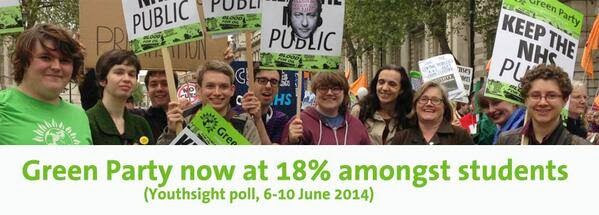
3. As traditional party politics collapse, UKIP has benefited as an officially sanctioned channel for discontent, a bit like the Czar tolerated the liberal Octobrists and Kadets in his Duma for a few years. But much deeper undercurrents are at work. A glance at the opinion polls will confirm that UKIP polls by far best among people aged 55 and over, while among young people support fades away and is negligible among first time voters - one recent poll tied them on 4% with the Lib dems. The Greens by contrast are chalking up figures in the mid-teens, often ahead of the Tories as in this month's Channel 4 survey. Simultaneously, membership of the party's youth wing, the Young Greens, has reached record levels. A new narrative is being written, one centred on a need for greater equality, tax justice rather than tax cuts; one in favour of public ownership, community service and personal freedom.

4. Public opinion has probably not been as volatile in over a century. And this uncertainty is disquieting to lazy journalists schooled in the comfort of an Establishment that is now peeling away. It's potential is also what should in contrast give heart to anyone with a socially progressive agenda.

5. All the above apply even more fully to younger people - almost two generations on from the fall of the Berlin Wall, and nearly sixty years since the Windrush, we have the rise of a new age of people at ease with diversity and used to travelling, learning, working, living and planning a future in and/or with other Europeans. Coupled with the radicalisation of Scotland in the recent referendum and the inspiration of actions like the Occupy Democracy protests outside parliament last week, the politics of grumpiness represented by Farage and his acolytes are dating faster than a dusty old reel of Alf Garnett. (Who he? - ed)

This is not to say that the European Union is something which progressives, Greens, ecosocialists or other leftists, should happily embrace in its current form. It is overweeningly pro-big business, as witnessed by the current shenanigans over the mooted TransAtlantic Trade & Investment Partnership (TTIP). Yet it provides some minimum degree of employee, consumer and environmental protection which would otherwise be absent (notably, these are the things UKIP and Tory Euroskeptics are keen to do away with while keeping the pro-business stuff). And we need transnational bodies like the EU if we are to have any hope in hell of countering the existential threats of resource scarcity and environmental collapse in the years ahead.

But it does give the lie to the narrative that UKIP represents some silent majority. It plainly does not. A focus group on UKIP voters a while back found them to be relentlessly negative about Britain - too much rubbish on the pavements, too much political correctness, too many immigrants, too many loutish youths, too many gay people, and so on. When they were asked if there was anything they liked about our country, the one thing - the only thing - they could think of was "The Past".

And, even now as Nigel makes his plans and swills another pint down his gullet to wash out his livid liver, that is indeed what they are - the past. A final burst of actually rather tragic melancholia, looking back to a  tarnished "golden age" of offices filled with Madmen, cigarettes smoked by doctors and women in pinnies in the kitchen. As the polls show, purple is the colour of the sunset.

The morning is green.


Wednesday, 15 October 2014

#fairdebate2015

As we run up to the General Election in May next year, the main TV broadcasters - the BBC, ITV, Channel 4 and SKY - have made a joint proposal for three leaders' debates in a sort of World Cup eliminator style (except the winners have already been decided).

They want three debates: the first with UKIP's Nigel Farage, Lib Dem Nick Clegg, Labour's Ed Miliband and Tory PM David Cameron.
Round Two would be Clegg, Miliband and Cameron; while Round Three just Tweedledum Ed and Tweedledee Dave by themselves.

Riveting stuff: four besuited white middle aged men with barely a cigarette paper between their views of the ideal neoliberal society droning on about how in fact there are really, honestly massive differences between them all and it is so exciting, etc, etc.

"Crowd-pulling" Lib Dems get a place but not Greens & SNP
No space for the Greens, who outpolled the Lib Dems at the last nationwide election - the Euros - in May and have been jostling with them in the polls for fourth place party ever since. No space for the SNP, now the third largest in terms of membership and with six times as many MPs as UKIP. No voice for anyone but the Westminster parties, with a reluctant nod to UKIP, the Licenced Opposition-by-Appointment to the Establishment. Rather, the format is set up to reinforce the status quo, to regulate and direct voters' choices.


Still Better Together?
The Greens and SNP are threatening legal action if they are not included - their two female leaders would provide perhaps the only left of centre voices as well as an added dimension to the gender of the Lads' debate.

Arguably of course the Leader's debates themselves are not welcome - shifting focus in a parliamentary democracy to the live performances of just a few individuals - but if they are taking place, then it is only right that all shades of opinion are included.

There are a couple of petitions circulating so please sign up and help to open just a chink of light on the debate. On Twitter, follow the hashtag #fairdebate2015

To include the Green Party:
CHANGE.ORG - INVITE THE GREENS 

To include all parties:
38 DEGREES - INVITE ALL PARTIES TO THE TV DEBATES

Sunday, 12 October 2014

The Men In Grey

Shades of grey - 4 variations on the same theme; even if there is a more "exciting" range of suit shades; sort of.

Nick Clegg famously (well, sort of) "realised" that austerity was a necessary remedy for Britain's banking crisis one morning as he was shaving during the 2010 election campaign - although he neglected to share his insight with the rest of us until after the polls had closed. After all, perhaps sales of "I Agree with Nick" memorabilia (for that is all it is now) would not have been so brisk at the Lib Dem shop.

Wind forward to earlier this year - the morning of 27 March to be precise, and you might have wondered what Nick was thinking as he looked in the mirror that morning - perhaps he had to look twice when he thought he spied a little Nigel Farage dart behind him with a broad smile requiring no toothpaste. After losing the first of their two televised debates by a wide margin (57 to 36% favoured Farage), Clegg must indeed have pondered about what he had let out the linen cupboard.

Fact-stuffed to his finger tips, Clegg had set out to disabuse the public of Farage's claims about the EU. In typically misguided technocratic fashion, he thought that he could blow away the UKIP leader by showing his claims to be little but castles of sand: £55 million a day for Britain's membership of the EU? Nonsense, it's a snip as £33 million net after deductions and repayments! 70% of British laws set by Brussels? Nonsense - anyone could tell you that it is between 10% and %50 depending how you catgeorise things. How could Farage possibly win the debate after getting such facts wrong?

Clegg like so many in the political class, inured to years of tick box politics, is blinded by facts: but the fact is that their much-loved evidence-based research can prove just about anything: hospital queues have increased or decreased;  poverty is better or worse (or absolute or relative and if so what sort of relative?); people are better or worse off - all dependent on which sleight of hand or "weighting" is applied. All these statistics, they believe, can justify what they have done, how they have behaved and prove pesky people like Nigel Farage wrong.

Except it doesn't work. Because Farage cleverly represents how some people feel and very powerfully in some respects. Like so many populists, he has caught a mood, played on it and capitalised on it. Fear of the (supposed) unknown: foreigners taking our jobs, foreign governments telling us what to do while supposedly breaking all the rules themselves, and so on. And as we have seen this week even in a town with few migrants indeed, Clacton-on-Sea, it works powerfully to UKIP's gain - and nearly did so hundreds of miles away in the north at the Heywood & Middleton by-election on the same day as well.

Now these feelings may not be based on facts (although years of spurious facts being peddled by the media has very effectively created the impression that they are). They may even be factually incorrect - but that still doesn't matter; because facing declining living standards and joblessness, some people will indeed turn to the most visible scapegoats offered up by UKIP (and reinforced by the media) in their midst, however wrong it may well be to blame them. Similarly, the "fact" that UKIP stands for tax cuts for millionaires, deregulation for bankers and cuts to the NHS may not go far unless there is an alternative narrative that says we can feel ok about ourselves and others, that we can trust our neighbours and unite against disproportionate inequality. So far, none of the main parties offer such, nor, with all of them united on things like the benefits cap, are they likely too.

And what our stats-driven, pseudo-technocratic elite don't understand, perhaps because to their Vulcan-mindsets it isn't logical, is feeling. How emotional can you get over a table of even the most damning figures set against a tearful human face, or a photo of an empty factory, or a queue at a food bank? Yet they will happily, even sociopathically, reel off lists of these things, their smug, knowing faces turning to perplexed confusion when it dawns on them that it isn't working. For while facts are important, especially in laying low some of the lies propagated by UKIP and others on the right, if they are all you have, then shorn of any Vision all you have is an encyclopaedia of today, not a manifesto for tomorrow.

New Labour started this trend among our politicians of putting figures up in place of politics; of citing "key performance measures" over political change. And little wonder, given Blair's abandonment of political ideology - performance targets were all he had left to try to make out it doesn't matter if your liver scan is done by the NHS or by profit-seeking Virgin Clinics or whoever. The result is the Deputy Labour leader, Harriet Harman, flailing about on national TV this morning trying to outdo UKIP on tackling immigration rather than offering a counter-view. But how could she? After so many years of evaluating stats and focus group analyses, she may well not actually have her own view any more, her original thoughts, feelings even, long since lost in the smoke and mirrors of think-tanks and policy wonkery.

So now we face the outcome of this: bereft of belief or values, the self-created, self-serving "political class" (the two words that say it all, really) spread among the two and a quarter established parties are left floundering as UKIP and others advance. UKIP triumphed last week and at the Euroelections in May. Simultaneously, both at the May vote and in many opinion polls since the Greens are vying to overtake the Lib Dems nationally in spite of a virtual media blackout - quite the opposite of UKIP's wall-to-wall coverage of Nigel's every pint.  Meanwhile in Scotland, the enthusiastic Yes campaign seems almost undiminished in spite of the referendum defeat as all the three Westminster parties can, still almost literally, bring themselves to say is, indeed, No or possibly Not Yet. The three Yes parties - the Greens, the Scottish Socialists and the SNP have each experienced an exponential growth in membership - the latter party now approaching 100,000.

 People are looking for alternatives - to my mind, some of these seem very unpleasant alternatives indeed whilst of course I have my own preferences; but what they all do, is touch on humanity (both its good and bad aspects) infinitely more than the anodyne, focus group media politics of the established parties. With UKIP, the challenge for the left is to avoid the pathetic denunciation of their voters as "f***ing thick" and "just fascists" (both cited on a supposedly progressive webpage today) and look beyond vote totals to the actual beliefs of many UKIP voters (as distinct from UKIP itself) - pro-welfare state, pro-public NHS, pro-rail nationalisation and in favour of a higher living wage, in some cases more emphatically so than Labour voters. These are people who feel abandoned because the Labour Party especially took the view so eloquently articulated by that Tribune of the People, Lord Peter Mandelson, when he suggested that "traditional" Labour voters had "nowhere else to go". Well, they've gone and they won't come back to Labour or any other party that treats them so off-handedly.

We need to offer a different story; the one that says ordinary people's problems are not caused by their disabled, migrant, ethnic minority or unemployed neighbours, but rather by the tax-minimising elitists who, among other big parties, fund UKIP. And that UKIP, offering yet another Man-in-a-grey-suit, are not a challenge to the current system - rather just more or the same with a little extra bile and bombast.

The collapse of the political system that has effectively prevailed for the last century marks many dangers ahead - but also the greatest opportunities yet to build a new, fairer society: we can only achieve that by providing a positive way ahead, an end to the politics of fear and loathing and transition to the inclusive, more egalitarian democracy that so many are so desperately seeking.


Below: looking for a new way; so many people turned up at the first post-referendum meeting of Glasgow Green Party that surprised party officers had to move the meeting outside the booked venue.

Saturday, 11 October 2014

The Nazis - A Warning from Yesterday

Above - the first meeting of Hitler's Coalition Cabinet in January 1933. On the front right sits Franz Von Papen, his Vice-Chancellor, who thought he could control the Nazis to promote the interests of his own corporate sponsors and fellow nobles. A year later, it was Hitler who sacked Von Papen, who then was exiled as Ambassador to the Vatican City.

Tuesday, 16 September 2014

The Last Days of the United Kingdom

Glasgow's George Square had a certain balmy calm when I arrived on Friday afternoon. The late summer heat had cast a faint grey mist across the sky, and there was a certain air of poignant expectancy as I wandered by the statues in front of the City Chambers, the great Victorian building that has for over a century and a quarter housed the council of Scotland's largest city. I reflected how, with the polls becoming ever tighter, it might be the last Friday that the city would see as truly part of the United Kingdom; for even if a Yes to independence vote still leaves months of negotiations before formal separation, no one would doubt that by Friday coming everything would have changed anyhow. "Scotland on the cusp of  making history" read the news-ticker above the corner of St Vincent Place.

Reaching for the future; Glasgow 13 September 2014
And on Saturday, the relaxed atmosphere of Friday evening transformed into something else - still oddly relaxed, yet passionate and positive too. Thousands of YES SCOTLAND supporters, swathed in blue saltires, or blue and white hats, scarves (in spite of the heat), tee shirts and tops, with balloons and flags, gathered on the steps of the Concert Hall. Cheery, singing everything from Flower of Scotland through Proclaimers' melodies to Singing I-i-yippy-ippy-i, there was almost two hours of simple communion. And smiles. Even when two BETTER TOGETHER supporters made their way into the middle of the crowd to hold up their Vote NO placards, the reaction was of  mutual amusement and pantomine, not the subliminal violence that the media has darkly suggested. But that didn't stop the Sunday Times the next day characterising the campaign as just so, in spite of offering little beyond some damaged posters and an egg broken across Labour MP Jim Murphy's highly sensitive shoulders.

So much for the traditions of Scottish politics where banter and flour bombs harmlessly demonstrated the passion at their heart. My own great uncle was arrested for impersonating former PM Asquith during the Paisley by-election of 1920 in a stunt that involved driving a coach and two horses through a crowd and ended with an evening in the police station. It was tame stuff compared to some of the events of those days, but likely to have seen him demonised as a menace to public order, or worse, in our era of corporately-owned, sanitised and paranoid politics.

Now, you shouldn't get too passionate about anything, because you need to be reconciled to nothing changing. Now, with this referendum, you are to vote NO out of fear of not being able to get a mortgage/ losing your job/ paying more for your milk and bread/ not being able to see Dr Who on the TV/ your telephones not working/ being more prey to terrorist attack/ facing border posts at Gretna Green/ experiencing massive economic collapse/ oil running out/ zombie plague attack...

But in the end, it isn't actually much about Scotland being separate or not. Not really. It is about a polity, a community democratically voting to defy the wishes of the Establishment - not just the political one, but the economic, the financial, above all the Corporate one too. They could countenance Scotland going - and some Tory MPs such as Nadine Dorries have sarcastically reiterated the old myth of Scottish dependency culture to ask "Why are we paying them to eat deep-fried Mars Bars when we don't have a decent NHS (in England)?"

But what they can't countenance is the massive blow to the Establishment a YES vote would be: at least in part because what has become an extraordinary mass movement might inspire similar demands  in other parts of the remainder of the UK, and even beyond - Catalonia especially is following the campaign closely, and on social and regional media the talk is increasingly of who next? Northern Ireland seems likely. Wales, possibly. But also there are stirrings for greater local governance in Cornwall, the North East, Yorkshire, and onwards, reflecting a reaction to the messy hodge podge of half baked devolution arrangements put in place by Labour and untouched by the Coalition.

YES supporters gathered at the Concert Hall
And so, in typical technocrat fashion, a plethora of tired out grey men in grey suits trooped up to Scotland to utter a myriad of panicky promises of future powers to the Holyrood Parliament. Lots of technical details about at least three if not more possible amendments to the remit of the Scottish legislature - a timetable even for its consideration; but nothing concrete, nothing agreed. And just as their pitch has been one of relentless fear of the future beyond a Yes vote, equally they have offered nothing meaningful in return - and nothing at all to foster any notion of a shared future, or celebrate the UK's achievements. It reached a culmination in a performance today by David Cameron in which the Prime Minister pleaded on behalf of the Union - supposedly the most successful democracy in the world, stopping slavery in the 19th century and facists in the 20th. 

But no mention of now - no mention of our becoming the second most unequal society on the planet; no mention of his Government's privatisation of our health service (hobbled with tens of billions of debt by the last Labour Government's Private Finance Initiative); no mention of the tax cuts for millionaires and the continuing assault on the poor which have been the hallmarks of the Tory-Lib Dem regime, and are set to continue with Labour signed up to the same spending agenda. And no mention of the true history of the British people - of the Tolpuddle Martyrs, or the Peterloo massacre, or the Matchstick strikes, or the sufragettes, of the men, women and children who fought tooth and nail against Cameron's predecessors to wrest democratic rights and some limited form of social justice from an ever resistant elite.

And so on Thursday, Scotland's voters - people of all religions, origins and social classes -will  have a dual potency. First, to Scotland and deciding on a choice to retake their lost sovereignty; and second, to deliver a body blow to the smug, corrupt complacency of the British political class.Whatever the outcome, the political system of the UK is broken irreparably. The three Westminster parties will be - already are - in existential crisis. Fixed parliaments or not, the end of the Coalition and a General Election may be just a few weeks away.

These are the last days of the United Kingdom. However the vote goes - and it is to be hoped it will be "Yes" - nothing will be the same again. Whichever side of the Border we find ourselves on, the challenge is how we fashion what comes next and make it better for all our people, for the poor and the vulnerable, for the creative and, above all, for the generations to come. Whether Britain continues to exist as a political entity or not, surely that would truly be a legacy worthy of the best of what has gone before - the Britain of the NHS, of the welfare state, of free education and of social change?  A largely vanished Britain of compassion and progress, now little more than a finally fading memory. A golden isle set in a silver sea, a hope of what might have been, but sadly never was.


Monday, 26 May 2014

Don't Let The Lights Be Dimmed

The last 24 hours has been filled with repeated fanfares and breathless TV newspeople proclaiming about the earthquake caused by the increase of the United Kingdom Independence Party's vote in the British stage of the European elections. A group of millionaires and friends of millionaires, funded by a multi-millionaire, have managed to win a 27.5% vote share (on a 34% turnout = 9.5% of eligible voters)  - up from 16.5% last time (on a 35% turnout - 5.8% of eligible voters) and have the biggest grouping of MEPs from the UK in the European Parliament.

But UKIP's historically lazy MEPs are not the real issue - the issue is the attitudes and culture they foster and amplify. And these are ones of manufactured anger and fear of difference; of lies about EU regulations which often are the sole protection for workers and consumers against the big predatory multinational corporations that UKIP loves; and of a willingness to berate and bully their opponents in the name of a twisted democracy.

During the campaign, UKIP candidates successfully had the police visit a Green blogger to have him delete an internet posting about UKIP policy, even although the police themselves admitted no crime had been committed. And then another issued a letter to voters calling for both his opposing candidates and anyone who voted for them to be hanged for treason. If they are like this in opposition, what sort of country will they run if they ever come to power?

And they are not alone. All across Europe in these elections, we have seen the rise of bitterly angry, right-wing eurosceptic parties, perverting the troubles of the poor into a crusade against equally poor migrants while shoring up the real problem - the tax-dodging, austerity-imposing rich. Although Greece has turned more to the leftwing Syriza coalition in response to the neoliberal European Central Bank's savage public spending cuts, the far right has grown there too. Neo-Nazi Golden Dawn has taken one in ten Hellenic votes and there is even talk of an army coup - according to Forbes Magazine the "only half joking" preference of some international financiers.

In France, the Front National under Marine Le Pen has taken first place with a quarter of the vote, wiping out the Greens and pushing the governing socialists into third place. In Denmark, the far right People's Party topped the poll while the extreme-right Jobbik, widely accused of racism and anti-Semitism, finished second in Hungary. In the Netherlands, the Dutch Freedom Party of Geert Wilders' - which plans an alliance with Le Pen - finished joint second in terms of seats. Similarly the far right has performed well in Finland.

All these parties, and similar ones in other EU states, have common themes of taking back their countries, which generally translates into a call to continue with free trade by big business but to do away with laws such as the working time regulations and common product safety standards. This is because these, apparently, destroy the culture of their respective countries. But they don't talk about consumer protection, they talk about bureaucracy; they don't refer to safety in the workplace, but rather decry job-destroying red tape. They use the fears of ordinary people to reinforce the power of the elite.

Perhaps most troubling of all, rightists from Flanders, Denmark and elsewhere happily endorse Vladimir Putin as a true democrat after their own hearts, echoing as he does their calls to "take (his) country back". And perhaps it is Putin's Russia - also praised by Farage - that provides us with the nationalist right's  ideal template for a "country taken back". Putin's nationalism uses the language of patriotic freedom to crush many of the values and freedoms we have achieved, however tenuously, here. Gender equality, gay rights, respect for cultural diversity, freedom of expression, any attempt to seek economic or social justice - these are all subordinated to and largely suffocated by the National Will, expressed by a Leader selected via a managed democracy on behalf of a super-rich elite. "Difference" is tolerated very narrowly: and those who find the courage to kick against the limits placed on them end up out of work, in jail or exile, or dead in a ditch.

As growing numbers of Europeans embrace the xenophobia and monoculturalism of the Far Right, and the Establishment parties flounder, hoist on their outsourced elitist petards, now more than ever is it vital for the Left to advance the true alternative. That has to be one that focuses on a renewed drive towards egalitarianism, traversing national and cultural barriers to challenge the unbridled capitalist economic system and the thousand multinational corporations to whom our planet is so in thrall. It is possible - and if the elections show one thing, it is that, with their low turnouts, even the allegedly surging far right are still supported by minorities of national populations. We must not cede a narrative that allows the corporate media and the Tory rightwing to use UKIP's 9.5% share of the electorate to dictate yet further assaults on the rights and welfare of ordinary people.

As twice before, Europe sits on the fault-line: we can eradicate the gross inequality of wealth and power at the centre of our economic orthodoxy; we can put co-operation rather than competition at the heart of our Continent and yet become a beacon to the world. But equally, if our Demoi, our voters, commentators and political class, continue to indulge the grinning masks of Farage and his internationally franchised ilk, if we turn our world into one of closed borders and closed minds, we may once again sleepwalk into a nightmare from which, this time, there will be no coming back.


Saturday, 24 May 2014

UKIP - To the Barricades or the Boozer?

The local election results were declared yesterday with the media trumpeting a fanfare of stories about UKIP breaking through, parroting Nigel Farage's claims that UKIP are foxes in the "Westminster hen house" and that the main parties will need to adopt UKIP's agenda, especially on immigration, for any of them to have any chance of success next year in the General Election. Although no one has quite yet suggested UKIP will be swept to power itself, the prospect of "Kingmaker" Farage has emblazoned many a headline today. Additionally, there have been some pretty sycophantic interviews with Farage including such searching questions as "Is this a big breakthrough for UKIP?"; and "Have people voted for you because you say what ordinary people are thinking?"

 By contrast, although Labour won almost as many councillors as everyone else put together, reading some papers today, the impression given is that Ed Miliband is in crisis. And today the BBC even stooped to giving airtime to a complete lie that the Leader of the Opposition had pinched some Fanta from a Subway outlet (perhaps subliminally trying to link Ed to Fanta's dodgy origins as the soft drink of choice of Nazi Germany when the local Coca Cola franchise was isolated from its US parent at the outbreak of hostilities in 1941 - oh, as if they would be so subtle or well-informed!). At least they had to apologise afterwards.

UKIP's media people are pretty crap at their work, but it hardly matters when journalists seem more than a tad keen to do their job for them. In the case of print/online corporate media with its deregulatory agenda, this is no surprise, but with notionally impartial broadcast media (other than the notable exception of LBC) it falls into the category of a disgraceful breach of quality and possibly even regulatory standards. In fact, beyond someone in the newsroom telling them UKIP has done well, you seriously wonder if many of the TV interviewers actually took any time to check any facts before fawning over the beer-swilling former stockbroker. Little wonder that a twitter account parodying the BBC's Chief Political Correspondent Nick Robinson tweeted today;


But the whole narrative, the whole story, is fantasy. UKIP have done reasonably well - and certainly as a Green supporter, this blogger would have been delighted to see the Greens making the gains UKIP did (although, hidden away from the headlines, the Greens have actually polled very well indeed and more than doubled their councillors). But the rightwing, pro-business, anti-NHS Faragista party's showing is not exactly, to borrow an old phrase, "breaking the mould of British politics."

The facts are:
- UKIP won 162 seats out of 4,200 contested: 3.6% of the total
- UKIP polled an assessed national vote of 17%. That's up 13% on the last time the seats at stake were fought, but it is nearly 7% DOWN on their showing this time last year at the county council elections.
- Turnout was 36% across the country, meaning just 6.12% of the electorate chose UKIP
- UKIP polled extremely badly in London; their own spokesperson has bizarrely said this is because they struggle to win the support of educated people, something of an insult to his own supporters.

Who would have guessed Labour won the elections?
However reluctantly, no one would deny UKIP had a good night. But it was not the Spectacular! they were anticipating, nor the Breaking-News-Fest that the 24 Hour News media are portraying it as being. This isn't sour grapes - but rather a concern that by giving yet again a completely false impression of a groundswell for UKIP, a fiction will inform even further the panic among the three establishment parties, who will respond with ever more illiberal, rightwards shift in policy and action. Already senior Labour MPs are saying they must "talk more" about immigration, and Tories are even calling for a pact for the general election next year.

The truth is that UKIP have no functional party machinery across whole swathes of the country - in Kirklees they managed to put up in just 5 out of 23 wards (Greens and even the Lib Dems fought all of them) - and other than a big donation for the Euro-elections from a single donor, they are not flush for money. Their members tend to be semi-activists, reflecting the armchair location of many of them, and large quantities of their leaflets were delivered by commercial companies (including those with low wage, zero hours Eastern European staff).

Just as its arguments and policies depend on appeals to blind emotion rather than any informed facts, its organisation such as it is appears to be haphazard and chaotic. While the feelings of its voters obviously deserve to be taken note of and given the same weight as others, UKIP's showing should not be allowed to dictate the terms of political discourse - notwithstanding, of course, that more than a few in the three old parties in truth share much of UKIP's neoliberal worldview. Whatever happens, even if as is likely they perform better in the European results announced tomorrow, the polling of this revanchist, populist party should not be allowed to legitimise or necessitate an even further lurch rightwards in our politics.

So it's not a revolution - 6.12% is a theatre-outing rather than the People's Army march that Farage hubristically declared it to be. UKIP is lazy politics and the equally lazy (or biased, surely not?!) media would do well to take note. No one is going to the barricades when the leader is already down the pub.