Showing posts with label Greens. Show all posts

Monday, 29 October 2018

FRACKING: No One Could Possibly Have Guessed This Would Happen...

Lancashire's future? Fracking has caused significant earthquake damage in the USA
 So tonight Cuadrilla have had to halt fracking operations at their Preston New Road site for the third time in two weeks after a third tremor abpve the 0.5 Richter scale trigger. The increase seems exponential - from 0.5 to 0.8 to 1.1 and while still relatively minor, their increasing power in such a short time has to be bad news for the shale-peddling carbonistas.

The area surrounding the site near Blackpool in Lancashire has seen 27 seismic events captured by the British Geological Survey in just 11 days. This compares to just two others in the entire rest of the UK over the same period - one in North Wales and one in the Norwegian Sea off the Shetlands. There were no seismic events in Lancashire in the 89 days prior to Cuadrilla commencing drilling.

While most of these are small, the incremental impact on the area if operations continue as planned for many years becomes sadly all too predicatble.

The only crumb of comfort in this could be that this litany of problems for Cuadrilla knocks future plans across the UK on the head and, quite aside from the appalling environmental impact of fracking, makes the whole project financially unviable for the profiteers who are prepared to sacrifice our country and planet for the sake of their bank balances.

Of course, the Greens and environmentalists who warned of this years ago, before fracking permits were opened up by the Liberal Democrat Energy Secretary Ed Davey during the Coalition government, were denounced as hysterical fantasists and Luddites.

After all, who could possibly have guessed this would happen...?!

Source: British Geological Survey  https://earthquakes.bgs.ac.uk/earthquakes/recent_uk_events.html

Monday, 16 October 2017

The Twin Pillars of Survival: What is the Green Party For?


"We cannot tackle climate change unless we address the system that has caused it,"
 John McDonnell, now Labour Shadow Chancellor, writing in Another World Is Possible - A Manifesto for 21st Century Socialism in 2007.

Ten years on, there was the same man, just yesterday, on the BBC Marr Programme, doing his best to reassure the audience that a Labour Government would prevent any post-election run on the Pound by working hard with the City to keep the confidence of the financial speculators, something he has already been busy doing. Marr himself signed off laconically with the observation, "I do like the picture of John McDonnell sitting down with asset managers all the time."

McDonnell's caution is understandable - the precarious situation of the Tory-DUP pact makes a further election far from an impossibility in the coming months. Labour's vulnerability to the fury of the capitalist media and quite inaccurate but well-embedded psychological fiction that greedy Tories are better with public money has lost them more than one election.

Yet, for all Labour's exuberant return to its programme remains inherently social democratic rather than socialist. And for all Mr McDonnell talked about tackling climate change yesterday, his economic plans remain fully anchored in 1940s style Keynesianism, with continued growth at their heart. It may be a welcome shift in emphasis from the grasping privatisation of the Tories (and discredited New Labour), but it is avowedly not a Manifesto for 21st Century Socialism, nor indeed for 21st Century Survival. For, with the climate emergency threatening to overtake us and deep scarcity looming across a range of vital resources in barely a decade from now, traditional economics are no longer fit for purpose, whether touted by the Tories or by Labour.

This conundrum much occupied the agenda of the Green Party conference last week. For the Greens, the General Election was a bitter-sweet outcome: their decision to stand down in upwards of 35 constituencies may have made sufficient of a difference to deprive the Tories of their outright majority, but equally the party saw its vote halve from its 2015 record over over 1.1 million votes and in spite of huge efforts in several seats it failed to advance on its solitary MP, the Co-Leader, Caroline Lucas - though it is worth bearing in mind that this was still its second best-ever General Election performance, both in terms of its national aggregate poll and votes-by-seat.

Under the circumstances, some degree of reflection was both to be expected and very necessary. Corbyn's manifesto had swept up a wide range of Green proposals from 2015 and with them had taken several hundred thousand Green voters - where now, then, for their twin pillars of environmental sustainability and social justice? Time, some suggested, to return to their verdant roots and focus on being an ecological party. Two motions proposed that climate change should be included in every conceivable message. Another called for all talk of alliances with Labour to be closed down. A workshop on campaigning heard demands for the Greens to focus on winning Tory votes and to drop calls for taxing the rich or taking resources into public ownership.

Fortunately, all these were voted down - the Greens were not, after all, so ready to stop highlighting their commitment to social justice alongside tackling environmental sustainability. Indeed, many questioned why anyone would doubt the interdependency of the one with the other - as even a longstanding ecologist argued, a steady-state economy would not be feasible without massive redistribution of wealth.

Yet by itself, this reaffirmation of the twin pillars of their values is far from enough to give the Greens' continued resonance and purpose in the political arena. The ecologists were right to argue that the party needs to highlight its differences with the Labour Party rather than appear like a willing subset of Momentum. The need to campaign on climate change in these days of Trumpian America and a British Government with Brexititis is daily more evidently critical - but far, far beyond raising the threat of global warming, the party needs to focus on what is central to defeating it: economics and ownership.


The cruel fact is this - Labour's social democracy will fail. For all their inspiration and well-meaning, Corbyn and McDonnell inevitably are dragged down by the bureaucracy and incumbency and even conservatism that comes with leading the Official Opposition. Hence the Marxist lamb sits down with the Asset-stripping lions and cautiously pushes change within the contradiction of consistency - a word McDonnell repeatedly used in his interview with Andrew Marr. 

Sooner or later, in a world of systemic collapse, it will not be enough. In a time when politics has never been more volatile, with voters earnestly or even desperately searching for new answers to increasingly challenging questions, only a party or movement convincingly embracing genuine radical change, far, far beyond building new roads and stopping PPI hospital contracts, can offer a positive way forward. All else leads ultimately to ever more pain and chaos.

As we face a world slipping week by week further towards climate chaos, the challenge to the Greens is whether it is they who can fashion a clear, radical and egalitarian economics - one founded on a steady-state economy that brings nearly all resources into common ownership, that embraces the bounty that new technology can bring in freeing people from labour and that stewards our limited resources fairly and sustainably. To do this, they need to address how to remove the market system from large swathes of economic activity and so reduce waste and inequity. They need to develop a clear narrative of how localised economies can work for the benefit of all.

Then they need to show how all of these things would work, day by day, for citizens, for families and communities. In a Green society, how would you get a house, or an education? What sort of jobs would exist and what would your working conditions be like? How would you travel about and would it still cost anything? What would you be able to do with the free time gained from a shorter working week? What new possibilities might open up post-capitalism, post-scarcity, post-rat race?

They also need to get angry: they need to bare their teeth not just to the frackers and tree-cutters, which so many Greens and their allies have very bravely done so well of late, but to all the vested corporate interests that are commodifying everything on our planet - even, it turns out, our individual DNA. Such behemoths will not go gently into the night; Greens need to gird themselves for a harder and longer struggle than Mr McDonnell seems willing to contemplate as he sups with the Futures traders, regardless of the length of his spoon.

And with the imbalance of wealth, nationally and globally, at historically obscene and environmentally unsustainable levels, yes, they need to take on the rich because the rich are not the friends of humanity nor of our planet. They never were, they are not now and, no matter how much charity a few of them dole out, they never will be.

But beyond them, beyond their fetish for accumulation and alienation, the rest of us, the vast, overwhelming majority of homo sapiens can transform our world and share it equitably.

Of all the parties capable of producing a first blueprint of that new world, perhaps only the Greens have the space to dream it into being, to fashion it into something real, meaningful and genuinely transformative. Many good policies are already in place covering everything from citizens' income to a maximum wage to employee ownership - but they have still to be joined up and given a compelling narrative, a true vision of tomorrow. 

It must be one they are open to sharing with other radicals on the left as the dynamics of our politics remain as potently fluid as they are now. They need to stand ready to work with those with shared values from other parties, transcending the tribalist barriers that all too often have frustrated the popular will - and one of these parties, for the foreseeable future by far and away the largest, will be Labour, or at least part of Labour.

Unencumbered by the Establishment weights increasingly affixed to McDonnell and Corbyn, the Greens can be the forge to generate the ideas and build a movement to create the conditions for deep, radical cultural change. Through this we can then finally unleash, in the words of the ecosocialist Murray Bookchin, "the basic sense of decency, sympathy and mutual aid (which) lies at the core of human behaviour."


Murray Bookchin, ecosocialist

Saturday, 6 May 2017

Comrade Corbyn's Last Chance


Labour's losses in yesterday's local elections came as little surprise; and nor for anyone reflecting on how our first-past-the -post voting system works was the collapse of UKIP to just one councillor (from 145) a true shock. Even the Tory resurgence in Scotland was predictable given their showing in last year's Scottish Parliamentary elections (and nor was it that spectacular - one "incredible" result was on the basis of 629 votes on the tenth count to win the last seat in a 4-member ward; not the stuff of revolutions, or perhaps more appropriately reaction).

Unsurprising too was Jeremy Corbyn's vow to fight on and John McDonnell, the Shadow Chancellor, explaining it all away as not as bad as expected. What politician doesn't try that - UKIP after all claim their losses were because they are victims of their own success, while the Lib Dems "Tiny" Tim Farron hailed their net loss of 42 councillors as a stunning success. Among opposition parties, only the Greens (up 6) and Plaid Cymru (up 33) actually had any concrete good news, but both were studiously written out of nearly all news stories.

What is surprising is Labour's attitude, both before but especially now after their bad local showing, to those smaller opposition parties given Corbyn's previous calls for political pluralism. In the face of all reality, they continue to talk as if it is still 1950 and the Tories and Labour stand to poll 97% of the vote between them.

The Greens have debated the idea of working with Labour and others in a "Progressive Alliance". The objectives of such a beast - was it to gain electoral reform or simply beat the Tories? - generated more greenhouse  heat than light at times, as did the vexed question of whether or not the Lib Dems might be welcomed to root among the progressive compost. But with Theresa May's snap election called three weeks ago, the overtures to Labour gained a real urgency given the Tories' commanding lead in the polls.

Green leaders Caroline Lucas and Jonathan Bartley both offered to talk with Jeremy Corbyn, while in almost every region of the country, local Green parties offered to consider local accommodations where Green voters are numerous enough to make a possible difference to the outcome. So far, a couple of agreements have been reached in Brighton Kemptown and in Ealing where the Greens will back the Labour candidate in return, among other things, for a commitment to support proportional representation. Greens have also stood down in Shipley, along with the local Lib Dems, to back the Women's Equality Party against the odious Tory incumbent Philip Davies, but so far Labour are adamant they will stand in spite of having little prospect of success. With a few honourable exceptions such as Clive Lewis, this is typical of their national stance: Labour are prepared to stand down absolutely nowhere at all, for any one else. Period.

On Radio 4 just yesterday, Labour's Lord Faulkener insisted the "minor parties" have been wiped aside and it is a straight contest between Tory and Labour ignoring the fact that these same parties had just won almost exactly the same number of council seats as Labour. A few days previously, speaking in Batley (where, ironically, all the major parties stood down in favour of Labour after Jo Cox's murder), Labour Front Bencher Emily Thornberry responded to a question asking if she felt only two parties - Labour and Tory - should be standing in the elections with a plain, "Yes."

So much for Corbyn's pluralism. And so much for any chances of stopping a Tory tidal wave.

We are where we are in good part because of our undemocratic voting system: first-past-the-post, with its winner-take-all outcomes, had repeatedly produced election results completely at odds with the wishes of voters. Time and time again, Government's have gained outright power with a minority of votes cast - only once since the war, in 1955, has the winning party achieved over half the vote.

Keir Hardie, the first leader of the Labour Party, recognised this. He declared first-past-the-post as unfit for purpose, especially outside a two-party system, and the Labour Government of 1929-31 actually introduced a Bill for electoral reform which was held up by the House of Lords until the Government collapsed. With Labour's success in 1945, the party's commitment to a fairer voting system was quietly forgotten.

And so we are left with this impasse: Labour decry those on the Left who stand against them as stooges for the Tories because of how the voting system works. And yet they refuse to change that system for all sorts of spurious reasons, but at its core is the repeated mantra that we are a two-party country and the choice we face is purely binary.

These claims however are a denial of reality. While in 1951 97% did indeed vote Tory or Labour, in 2015 that figure was just 65%, with more people (35%) voting for "minor parties" compared to Labour's total of just 29%. Just look at Scotland, where the SNP virtually eliminated Labour and where the party continues to fall relentlessly and the claim that UK politics are binary is immediately swept away. And while UKIP is clearly on the wane in England, this is largely because the hard right Tories have adopted their agenda - there is no dividend for Labour. The Greens, meantime, while not at breakthrough, have continued to grow steadily in elected representatives and their current poll ratings show them at least likely to equal if not just yet better their record 2015 showing.

So what on earth possesses Labour, including Jeremy Corbyn, like some sort of Death Wish?

The announcement of a Progressive Alliance and real reciprocation between Labour, Greens, Plaid and the SNP up to the close of nominations on Thursday would produce a wave of support far beyond the current sum of its parts. The Tories have decried such an entity as a "Coalition of Chaos", but it is in fact the thing they fear most - because far more unites these parties than divides them. Faced off against the lacklustre Tory campaign, an alliance would catch the popular imagination and reinvigorate the political landscape.

And yet, although it is technically possible even now, there is little sign of it from the Labour ranks. Regrettably, and almost certainly in vain, Corbyn puts his party's tenuous and frankly impossible unity ahead of the needs of the country. For the sake of trying to conjure up the illusion of a two-party contest, Labour risk delivering Britain into the grim reality of a One Party state.


Thursday, 9 July 2015

The Long, Lingering Death of Labour? (Part One)

People across the left join to oppose austerity in London in June
The Labour leadership election contest is well underway with four MPs competing for what might be increasingly seen to be a post that comes complete with its own poisoned chalice. With the collapse of the party in its old Scottish heartlands, its vote in northern England eaten into by UKIP and with many leftwing young voters switching to the Greens, the rushed vote to replace Ed Miliband is rapidly revealing a party that is bereft of both unity and a soul.

In the media at least, the frontrunners are seen as Yvette Cooper and Andy Burnham, both very much graduates of New Labour, while the odious Liz Kendall seems to be positioning herself day by day more and more to the right. These three represent all that has gone wrong since Blair's ditching of Clause 4 and the subsequently quick march to the right. Committed to market economics, privatisation, austerity and spending cuts, the party has abandoned all the things that it once stood for - in place of equality comes choice (determined by access to cash); in place of public services comes "partnership" with the profiteers; and in place of fairness is at best an emphasis on "opportunity" rather than outcomes. You can't help but wonder why they don't just join the Tories and get on with it; except of course that would vacate the Labour Party to those on the left who still have some desire to stand for something, to work for something better, more egalitarian. People who even now sometimes dare to whisper the word "socialism".

Labours Choice: Cooper, Corbyn, Kendall and Burnham
People like Jeremy Corbyn. This left wing Labour MP may yet be the surprise in an election which, to be fair, embraces a very broad constituency - members all now get one vote as the electoral college and union block votes have been abolished. Anyone can register as a supporter for £3 and vote. Many on the non-Labour Left have done just this to have the chance to vote for Corbyn, whose unalloyed commitment to end austerity and return to socialist values have put the only sparks into an otherwise tedious contest between would-be meritocrats. With his meetings drawing vast audiences and key unions backing him over the pseudo-left Burnham, there is every chance that Corbyn will poll very strongly indeed. If he wins, which is not impossible, he will be at odds with the hierarchy of his party, but he will have a powerful mandate to change the party and begin to shape a genuine choice in 2020.

On the other hand, the smart money remains on Cooper or Burnham and herein lies the seeds of yet more problems for Labour. For if either of them scrape through in a second or third round over Corbyn after he polls the largest minority vote in the first round, Labour's splits will come ever more into the open. This may finally lead to a fracturing and realignment of progressive politics in England, perhaps on a par with the huge shift in Scotland. If other parties on the left, and especially the Greens, stand open to co-operate and welcome new allies, it may finally be possible to build a genuine alternative to the politics of austerity, fear and profiteering. Caroline Lucas, the Green MP, has already talked about cross-party co-operation and plenty was evident across the Left in the recent People's Assembly March Against Austerity. With the budget this week showing a Tory Government warring on the poorest yet again, the appeal of a genuinely socialist left alternative is growing.

Corbyn campaigning with Greens Romayne Phoenix & Caroline Lucas MP
It will be no fast task. But it is feasible and even essential. A good showing for Corbyn may ironically hasten the process of party disintegration and realignment, but it won't be before time. If Labour is no longer a political home for someone such as Tommy Shepherd, formerly a senior Labour member but now an SNP MP (see the video below), then it is little wonder if, faced with Tory versus Pseudo-Tory, voters abandon Labour. What real purpose does it now play apart from validating the deeply illusory nature of our supposedly democratic system?

It is unlikely to be a pretty or comforting process. It may take many years to complete the change fully, but voters are less and less impressed by the major parties and, just as Corbyn is wowing crowds for the leadership election, who knows what unexpected train of events might kick in very rapidly indeed if there was a substantial and real leftwing choice on offer? Syriza and Podemos may yet reach our shores.


Saturday, 6 June 2015

TTIP - Treaty To Increase Profiteering


Green MP Caroline Lucas and anti-TTIP protestors

The TransAtlantic Trade & Investment Partnership plans for a massive free trade area between the European Union and the USA reach a critical stage next week with a vote in the European Parliament. Negotiated in secret, with MEPs having to go pre-booked into a special room to quickly read updates on the talks, the treat masquerades as a wealth-expanding, job-creating measure. In truth, it delivers what is left of democracy and public services into the hands of profit-seeking multinational corporations, unaccountable to anyone and disinterested in anything other than the company's bottom line. The environment, the people who work for these companies, the people who buy from them and the communities they live in - what protections they have now will be either stripped away outright or whittled away by a process of attrition in the years to come.

Check out BIG BAD LAW on Facebook and Twitter
Few free trade schemes have worked to the genuine, lasting benefit of the populations they cover - and this one is no exception. It will reduce public income from taxes by reducing and removing tariffs on imports; it will push governments to privatise public services, including the NHS in Britain, and open up those that do not to endless, costly law suits from companies seeking compensation for denial of profits in secret courts through the Investor-State Dispute Settlement (ISDS). US tobacco giant Philip Morris has just invoked similar free trade rules to sue the British Government for billions of pounds in compensation for plans to force cigarettes to be sold in plain packets - just a taste of what is to come if TTIP is adopted.

It is also likely to have a big impact by forcing down European standards on public safety, employment rights and consumer protection to the much lower US standards so that it is "fair" to big companies - no thought to European (or American) workers or consumers. Everything from safety protection in the workplace to food standards and mobile phone tariffs could be affected to the disadvantage of ordinary people.

In the European Parliament, and at Westminster, Conservatives, Lib Dems and most Labour politicians have signed up to the TTIP. Opposition has mainly come from the Green Party and, in the EU, its allies in the Greens/EFA, which includes SNP and Plaid Cymru, as well as from the Nordic Green Left. UKIP have been absent from most debates on it - they tend to favour free trade agreements in most circumstances though they may dislike this one purely because of its connections to the EU.

Millions of Europeans and Americans have been working to oppose TTIP, with international days of action in recent months and many previous demonstrations. Trade unions, including the AFL-CIO in the USA, have been vocal in their concerns. However, with the negotiations going on in secret and the Governments of nearly all member states signed up to the mantra that all trade is good trade, only the members of the European Parliament are likely to be able to put any block on its passage.

This week may be our last chance to stop this dangerous and potentially irreversible treaty. Green MEPs including England's Molly Scott Cato and Jean Lambert have produced a series of short videos outlining why TTIP matters and why we should be concerned.

If you agree,
- please share the videos (click through to Youtube on each video for the share button)
- please sign the petition on this link HERE (it is now close to the two million signature mark)
- and please write/email/contact your MEPs - details HERE

If you are on Facebook, take a look at Big Bad Law, a Green page taking a slightly satirical but urgent swipe at the TTIP.


Big Bad Law on Facebook


Sunday, 26 October 2014

Purple Haze: UK Voters Want to Stay in the EU

Just in case you've been missing him; a photo of Nigel Farage
We have been bombarded now for months, even a couple of years, of relentlessly being told that UKIP is surging a tidal wave of anti-European sentiment.With their powerful victory at Clacton likely to be followed up with another, probably less emphatic, win in Rochester in a few weeks time, print and broadcast journalists - especially the excitable, ill-read types who seem to inhabit the BBC these days - jabber about the "Brexit".

This, according to the BBC yesterday, is Britain's apparently more or less done deal on leaving the European Union (BRitish EXIT, geddit?) following a referendum, promised by David Cameron if the Tories win the next election and almost certainly a demand from any UKIP MPs in a Tory-UKIP Coalition (although it is to be noted that UKIP do not actually support a public vote: they would just withdraw as soon as they had the legislative power to do so).

And yet, as the Faragistas have risen and fallen and risen again through the year, almost completely unreported and certainly ignored by the mainstream media, has been another more substantial shift in public opinion. And that is, while UKIP have scrabbled up the polls from 10% at the start of the year to 16% in this weekend's UK Polling Report average, support for staying IN the European Union has risen exponentially among British voters.
Ipsos-MORI October 2014

Consider this: between September 2010 and February 2014, thirty out of thirty-three national opinion polls - showed clear majorities for Britain leaving the EU. Survation in January 2013 gave 54% for out and just 36% for staying in. And a whole slew gave the anti-EU vote in the mid to high 40%s with the pro-EU camp hovering in the low 30%s.

But since March this year, as the BBC hammered home UKIP's apparent inexorable rise ahead of and since the European elections, there has been a sea-change - possibly in response to the not-so-popular populism of Nigel Farage.

Of the twenty-seven polls published since March, only six have shown a majority for leaving the European Union, and even these have given margins well below half of the 15 to 20 points in polls of previous years. A single poll from June gave a dead heat, but all the others - 20 out of 27 - have shown majorities for Yes to staying in Europe. An Ipsos-Mori poll taken between 11th & 14th October gave 56% for staying and just 36% for leaving, with 8% unsure. Excluding the unsures, that is a 61 to 39 margin for remaining part of the EU, not far off the 66 to 34% margin in the 1975 referendum that confirmed our original membership of the Community. (note - these figures relate to polls about leaving the EU without any prior renegotiation of membership terms; a set of figures covering a renegotiated but continuing membership unanimously show big margins for Britain remaining part of the EU.)

Of course, these are just polls, but they perhaps point to a few things that our media should ponder long and hard if they intend to continue to emit the smokescreen over truth that is their evident obsession with UKIP.

1. UKIP may well be expressing the discontent of significant groups of people, but many more do not support its narrow, xenophobic take on the ills of our country. And indeed, even among UKIP voters, the EU is rarely top of their list of concerns - many, when you scratch the surface, actually support left of centre policies quite alien to their current party of choice.

2. The majority of British voters remain as they have always been - broadly progressive, fair minded and tolerant. The rise in support for the EU may be an expression of this - anti-Tory, anti-UKIP, pro-international engagement.

Source: Another Angry Voice
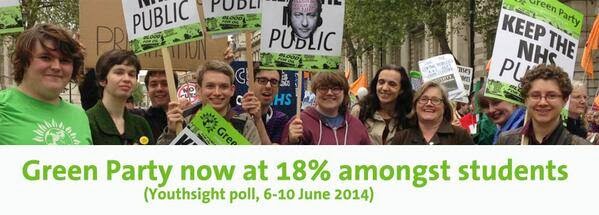
3. As traditional party politics collapse, UKIP has benefited as an officially sanctioned channel for discontent, a bit like the Czar tolerated the liberal Octobrists and Kadets in his Duma for a few years. But much deeper undercurrents are at work. A glance at the opinion polls will confirm that UKIP polls by far best among people aged 55 and over, while among young people support fades away and is negligible among first time voters - one recent poll tied them on 4% with the Lib dems. The Greens by contrast are chalking up figures in the mid-teens, often ahead of the Tories as in this month's Channel 4 survey. Simultaneously, membership of the party's youth wing, the Young Greens, has reached record levels. A new narrative is being written, one centred on a need for greater equality, tax justice rather than tax cuts; one in favour of public ownership, community service and personal freedom.

4. Public opinion has probably not been as volatile in over a century. And this uncertainty is disquieting to lazy journalists schooled in the comfort of an Establishment that is now peeling away. It's potential is also what should in contrast give heart to anyone with a socially progressive agenda.

5. All the above apply even more fully to younger people - almost two generations on from the fall of the Berlin Wall, and nearly sixty years since the Windrush, we have the rise of a new age of people at ease with diversity and used to travelling, learning, working, living and planning a future in and/or with other Europeans. Coupled with the radicalisation of Scotland in the recent referendum and the inspiration of actions like the Occupy Democracy protests outside parliament last week, the politics of grumpiness represented by Farage and his acolytes are dating faster than a dusty old reel of Alf Garnett. (Who he? - ed)

This is not to say that the European Union is something which progressives, Greens, ecosocialists or other leftists, should happily embrace in its current form. It is overweeningly pro-big business, as witnessed by the current shenanigans over the mooted TransAtlantic Trade & Investment Partnership (TTIP). Yet it provides some minimum degree of employee, consumer and environmental protection which would otherwise be absent (notably, these are the things UKIP and Tory Euroskeptics are keen to do away with while keeping the pro-business stuff). And we need transnational bodies like the EU if we are to have any hope in hell of countering the existential threats of resource scarcity and environmental collapse in the years ahead.

But it does give the lie to the narrative that UKIP represents some silent majority. It plainly does not. A focus group on UKIP voters a while back found them to be relentlessly negative about Britain - too much rubbish on the pavements, too much political correctness, too many immigrants, too many loutish youths, too many gay people, and so on. When they were asked if there was anything they liked about our country, the one thing - the only thing - they could think of was "The Past".

And, even now as Nigel makes his plans and swills another pint down his gullet to wash out his livid liver, that is indeed what they are - the past. A final burst of actually rather tragic melancholia, looking back to a  tarnished "golden age" of offices filled with Madmen, cigarettes smoked by doctors and women in pinnies in the kitchen. As the polls show, purple is the colour of the sunset.

The morning is green.


Wednesday, 15 October 2014

#fairdebate2015

As we run up to the General Election in May next year, the main TV broadcasters - the BBC, ITV, Channel 4 and SKY - have made a joint proposal for three leaders' debates in a sort of World Cup eliminator style (except the winners have already been decided).

They want three debates: the first with UKIP's Nigel Farage, Lib Dem Nick Clegg, Labour's Ed Miliband and Tory PM David Cameron.
Round Two would be Clegg, Miliband and Cameron; while Round Three just Tweedledum Ed and Tweedledee Dave by themselves.

Riveting stuff: four besuited white middle aged men with barely a cigarette paper between their views of the ideal neoliberal society droning on about how in fact there are really, honestly massive differences between them all and it is so exciting, etc, etc.

"Crowd-pulling" Lib Dems get a place but not Greens & SNP
No space for the Greens, who outpolled the Lib Dems at the last nationwide election - the Euros - in May and have been jostling with them in the polls for fourth place party ever since. No space for the SNP, now the third largest in terms of membership and with six times as many MPs as UKIP. No voice for anyone but the Westminster parties, with a reluctant nod to UKIP, the Licenced Opposition-by-Appointment to the Establishment. Rather, the format is set up to reinforce the status quo, to regulate and direct voters' choices.


Still Better Together?
The Greens and SNP are threatening legal action if they are not included - their two female leaders would provide perhaps the only left of centre voices as well as an added dimension to the gender of the Lads' debate.

Arguably of course the Leader's debates themselves are not welcome - shifting focus in a parliamentary democracy to the live performances of just a few individuals - but if they are taking place, then it is only right that all shades of opinion are included.

There are a couple of petitions circulating so please sign up and help to open just a chink of light on the debate. On Twitter, follow the hashtag #fairdebate2015

To include the Green Party:
CHANGE.ORG - INVITE THE GREENS 

To include all parties:
38 DEGREES - INVITE ALL PARTIES TO THE TV DEBATES

Friday, 4 May 2012

Green Gains

Greens are performing well as results are declared in local elections throughout Britain. At the time of writing, with most English and Welsh results announced and Scottish ones ongoing, Green parties have picked up on average 9% of the vote where they stand, up 1% on last year, and have made a net gain of 11 new council places. This is in spite of the big swings to the Labour Party which might have been expected to squeeze the Greens down.

More here:
GREEN PARTY OF ENGLAND AND WALES WEBSITE

in Scotland, some big breakthroughs:
SCOTTISH GREEN PARTY

and here
BBC ELECTION RESULTS

Friday, 20 April 2012

With Respect, Vote Green

In a move that gives encouraging evidence that the most significant components of the political Left in Britain are shedding their traditional sectarianism and reaching out to build a new movement for change, the leader of the Respect Coalition, Salma Yaqoob, has called on her party supporters to vote for the Green Party in local polls in Birmingham.

Hot on the heels of George Galloway's sweeping victory in the Bradford West by-election, where he shattered the traditional politics of the city and united people from different communities, Salma Yaqoob's call  shows that the Left is poised to build for change that chimes very powerfully with ordinary people. By sharp contrast to the right wing/nationalist alternative parties like UKIP, the English Democrats and the BNP, when people are polled about actual policies - like redistributing wealth and devolving decision-making to local communities - the policies of Respect and the Greens poll far ahead of their opinion poll ratings.

In the Greens' case, when the party manifesto was "blind tested" on quarter of a million people on the Vote-for-Policies website at the 2010 general election, they polled in top place. British culture is more aligned to the principles of the left than years of "middle-England"-obsessed machine politicians realise. The current recession, the dismantling of the Welfare State and the damaging reform of the NHS, as well as the privatising of the education system, are all anathema to most British people - but all three of the main parties are signed up with little but variations on a common theme to separate them.

With opinion polls consistently showing the "Other" parties at above 15% and the Lib Dems imploding to as low as 8%, this may turn out to be a key moment in creating a real, socialist and green alternative to the main parties. Galloway's return to the Commons last week was marked by a distinctively frosty reception from many of his former Labour colleagues who are perhaps increasingly aware that their core vote is softer now than ever after years of being taken for granted by centrists like Tony Blair and Jack Straw, as well as the false dawn of Ed Miliband.

The possibilities for a significant advance by the Left are there: they echo the rise of the Left candidate Melenchon for the French Presidential election, while three parties to the Left of PASOK, the traditional socialist party in Greece, are set to win about 35% of the vote and probably form at least part of the new Government in the upcoming general election. In Britain, the first-past-the-post voting system may frustrate electoral gains by the Left but, as Caroline Lucas' success in Brighton and Galloway's victory in Bradford show, the real alternative can win through even the most stacked and unfair system - all it takes is for both Left wing parties and voters to be true to ourselves.

For Salma Yaqoob's Blog, click HERE