Showing posts with label freedom. Show all posts

Wednesday, 17 March 2021

Statues and Statutes


If we needed any more proof of the Government's inherent illiberalism, and the range of prejudice and bigotry that accompanies it, the last week has surely provided a surfeit. The awful murder of Sarah Everard was a shocking example of how, allegedly, the mere impression of acting on state authority can be misused to appalling ends. 

Yet the response of Boris Johnson and Home Secretary Priti Patel has been to seize the moment to propagandise and push through even stronger laws to control and squash the citizenry - literally hours after the terrifying image of a 5foot2 woman thrown to the ground and cuffed face down by police as they broke up the vigil for Sarah on Clapham Common, one of the last places she passed through alive. The apparent circumstances of her murder prompted women and men to come to remember her and to "reclaim the night", just as women did decades ago when Peter Sutcliffe's killings in Yorkshire led to the authorities telling women not to go out alone, a suggestion echoed in the wake of this latest murder. The same authorities had the option of allowing an organised, socially distanced gathering, but chose instead to deploy public health rules to forcibly break up the spontaneous one that took place anyway.

In as tone deaf an example of misogyny as you could get, the Government's proposed initiative to protect women now is to deploy large numbers of undercover police to trawl post-lockdown pubs and clubs to identify and supposedly detain potential rapists and murderers. With the endorsement of Opposition Leader Keir Starmer, the alleged misdeeds of one police officer will apparently be solved by having more police officers mixing secretly with the public.

Except we know how that has gone in the past. Police spies infiltrated a wide range of peaceful groups, particularly in the environmental movement but also trade unions, race justice groups and others pursuing perfectly legal aims. 

Supposedly to remain undercover, some of them developed relationships with women activists, living with them and even fathering children before disappearing. Some acted as agents provocateurs, initiating others to commit often trivial offences but offences nevertheless that got them criminal records and were used by the state to tighten legislation against its opponents. One case, highlighted repeatedly by Green Party MP Caroline Lucas using parliamentary privilege, allegedly involved a police officer setting off a bomb outside a department store in order to frame an animal rights activist.  

In this new paradigm, how far will undercover duties involve officers mingling in night clubs acting "in role"? What potential is there for abuse of position and power to do quite the opposite to protection? Rather than acting to counter the cultural objectification of women, it seems more a very conscious misrepresentation of a terrible event to enable an ever-creeping interference in normal social life and activities.

Yet this same week's Policing bill uses precisely the zeitgeist of peaceful activism as a national secruity threat to enact the most draconian legislation in our history - now past its second reading in the Commons, the new laws as they stand will make it illegal to protest too loudly, or to "cause annoyance" to even one person. If you commit such an appalling excess, you can face ten years in jail.

The legislation is clearly pitched at environmental protests such as Extinction Rebellion - demonised by a former police officer's report for the rightwing Policy Exchange thinktank in 2019 and listed as an extremist ideology by Counter-Terrorist police a few months later. Also in sight are initiatives like the Black Lives Matter protests last summer and many of the anti-fracking protests that spiked the attempts to destroy swathes of the English countryside in the entirely unnecessary search for shale gas. While most fracking is now cancelled or on indefinite hold, the Tories' funders have long and unforgiving memories and a long backstory has been created all the way back to David Cameron's Coalition era pledge to crackdown on "non-violent extremism"

Be too different (travelling communities will now be required to have special identity cards), or too radical and it doesn't matter how pacific or law abiding you are, you are still an annoyance - a decade in the clink beckons.

Attack a woman, of course, is a different matter. Almost simultaneously to passing the policing legislation, the Government turned down a range of proposals to make it easier to protect women facing domestic violence and to turn misogyny into a hate crime, although a very recent concession will involve recording gender and sex-based crimes where these are judged to be factors. In a blatant lie, the ill-titled Safeguarding Minister appeared on TV to claim that hate legislation is "mainly for minority groups" and  as women are the majority, it couldn't apply to them.

Never in the field of British politics have so many been misled so much by the guardians of the few. To paraphrase that Tory icon, Winston Churchill.

Unlike women, though, this much "white"-washed character, with his very mixed legacy of wartime leadership, anti-Indian racism and sexist jibes about women's faces, is carefully protected: deface Churchill's statue, or those of any of

the slave traders and mercantilist thieves that grace our cities, and a special place awaits you in Patel Hell. For, it seems, these lumps of Victorian marble that stare down silently on largely disinterested people, who barely give them a passing glance, are integral parts of our national culture. And the snowflake fascists can't bear the idea of anyone disrespecting them by doing something like drawing attention to the historical facts of their icons' lives and deeds - leading to a police guard being set around Churchill's image near Scotland Yard this week, just in case. 

It seems that when the Left disagree vocally with something, such as Rees Mogg speaking at a university or an AltRight candidate speculating about raping a Labour MP, this is "political correctness gone mad" and "cancel culture" - even although the perpetrators are pretty free to carry on sounding off as much as they like: witness the oaf Piers Morgan's tantrum when he was criticised by a weather presenter over his highly personalised attack on Meghan Markle last week. He chose to walk, but no one made him. No one actually shut him up - someone simply disagreed with his pompous bombast.

But now, block a road with a demonstration, shout too loudly or spoil someone's enjoyment of their day by warning about climate catastrophe, or campaigning about racism - or remembering a murdered woman...  and the freedom-loving Tories will lock you up for the next decade. The same people who wax lyrical, tearfully even, about the Magna Carta and mythical English rights to avoid wearing face masks during a deadly pandemic will incarcerate those who offend or annoy them. Cancel culture deluxe.

So we face what so many of us have long feared and warned about - post-purple wave, the Conservatives are no longer small state advocates, but rather Big Statists. Not the sort who want to use the state to better lives, or at least not the lives of all. Instead, they are seizing and deploying state power to embed themselves and their friends and funders into the ownership of the nation. 

The market system, bad though it was, is decaying, replaced not with the common good, but instead with the rise of  the nobility of Varoufakis' "techno-feudalism". This is now a place where an Etonian chumocracy acquires the state and its authority to preserve and extend their writ indefinitely, and where  the last serious socialist challenge to its ascendancy is demonised into a hate-filled totem of fear and loathing; Jeremy Corbyn channelled as the Emmanuel Goldstein of the 21st century.

A place where the future is a boot - a copper's boot - stamping on the face of change, the face of hope. Forever.

And yet, thousands commemorated Sarah Everard around the country; thousands turned up outside Parliament to oppose the new legislation. And hundreds of thousands joined the BLM protests and XR actions. You can kill the canary if you like, but the fires are still burning - our species and our planet are at severe risk; people still demand justice - for racial minorities, for the female majority and for all society. No politician can legislate these truths away. 

And we won't let them.


Sunday, 5 August 2012

I Predict A Riot - Russia's Circular History

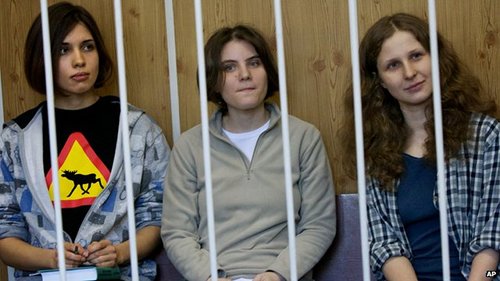
The most notable news story from Russia in recent weeks has been the arrest and trial of the three members of Pussy Riot. This is the female punk band that staged an anti-Putin protest with a satirical hymn to the Virgin Mary in Christ the Saviour Cathedral in Moscow during the run up to the Presidential elections earlier this year (although it is to be noted the music track on the video below was not played in the Cathedral, but overlayed when it was uploaded to Youtube and the world).

Needless to say, their performance was executed without the approval of the religious authorities of the Russian Orthodox Church and the women are now facing up to seven years in jail for "hooliganism motivated by religious hatred." Their trial began last week and appears to be a parody of justice - the prosecution witnesses talk about how they felt hearing the song, while only three of the thirteen defence witnesses have been allowed to be called. The prosecution witnesses are questioned about their religious beliefs, giving them full opportunity to stigmatise the defendants as blasphemers, while any attempts to show the defence witnesses to also have Christian beliefs have been repeatedly ruled out of order.

 Nadezhda Tolokonnikova, Yekaterina Samutsevich and
Maria Alekhina
  face 7 years in jail.
It is a case that even RT News has admitted is dividing Russia between those who cling to Putin's nostalgic and increasingly repressive nationalism, and those who for the last two decades have been working for a free, democratic society where freedom of expression is a given. It is of little surprise to discover that the group was motivated to stage its protest where it did because of the Russian Orthodox Church Patriarch's public call for worshippers to vote for Putin. This was/is at a time when millions of Russians were protesting their suspicions of the President's "manipulation" of first the Parliamentary and then the Presidential elections. As the established Church in Russia - the Patriarch swears the President into office - its head should be at least formally neutral but, in the "managed democracy" that is the Russian Republic, this was blatantly broken - but  unlike the singers, no cleric has faced any charges such as abuse of office or breach of election law.

The outcome is expected soon. Putin appears mildly embarrassed by the international attention it has drawn, with politicians and celebrities across the world calling for the charges to be dropped. Today, he seemed to be suggesting there should be some degree of leniency shown in sentencing (this before a verdict is given). But it is already too late for him to pretend that somehow Russia has any sort of functioning civil society: the struggle between authoritarians and liberals is now fully on, and the trial is only one of several aspects of this, including the unprecedented range of anti-government demonstrations in recent months.

Supporters see the case as key to freedom of speech in Russia
For Russia, it is not an unfamiliar scenario, at least in the perspective of history. Almost exactly 99 years ago, Czarist Russia was rocked by a strikingly similar set of circumstances, albeit with rather different and more serious charges involved. Likewise, it marked a turning point in the political struggle between liberalism and authoritarianism.

In Kiev, in spring 1911, a young boy, Andrei Yutshinsky, was found murdered, stabbed dozens of times in what the rightwing "Black Hundreds" (who agitated violently on behalf of the Czar) and the gutter press quickly decided was a ritual murder of a Christian by Jews. A witch-hunt followed with a Jewish man, Mendel Beilis, arrested and charged in spite of a total lack of evidence - but in the two years he waited in prison for his trial, he was utterly demonised as a "Drinker of Christian Blood". His wish to do such a thing was based on the false "Protocols of the Elders of Zion", a tract written by the Czar's police, which created the myth of a Jewish conspiracy to take over the Christian world: Hitler later used it to great effect.

Two Russian policemen discovered the truth - the boy had in fact discovered that a friend's mother had been involved with a black market gang and threatened to report her, only to be murdered by the gang. However, on the Czar Nicholas' orders, they were dismissed and the prosecution of Beilis went ahead in September 1913 in order to "prove" the Jewish conspiracy theory was real. The Judge was met by the Czar and promised promotion if there was a conviction; the jury was packed with Government sympathisers and the defence was repeatedly denied the right to put its full case.

Outside the Court, Russian society was fractured, with liberal and socialist parties calling for Beliss' acquittal and decrying the whole affair as a disgrace to Russia' faltering steps towards a modern society. By contrast, the nationalists and royalists called full throttle for Beilis' execution and the expulsion of the Jews (tens of thousands had been murdered in recent years in vicious pogroms tacitly encouraged by the authorities). Abroad, the celebrities of the day petitioned for Beilis' freedom - H.G. Wells, Thomas Mann, Thomas Hardy, academics, politicians and students among them.

In the end, the case against Beilis was so thin that even the biased Court proceedings and the pro-Czarist jury didn't convict him. He was released and fled the country within a few weeks, never to return. But the Czarist Government continued with its repression unabated, the Beilis case being perhaps the final nail in the coffin of the very limited political and social reforms following the 1905/6 Revolution.

Putin and his coterie of course look back wistfully to the Czarist days and the ceremony around the Russian Government now owes much to the Romanov Court in its final days. Likewise, the restored, pre-eminent position of the Orthodox Church, used by the State now in the same way as the Czar to associate good, normal Russians with God and the President.

But as we await the outcome of this trial, a key one for freedom in Russia, Putin might do well to reflect that in less than four years after the Beilis case, the whole rotten edifice of Romanov Imperial Russia was to collapse in the flames of the revolutions of 1917. No autocracy can last forever. "Czar" came from the title "Caesar" in the old Byzantine Empire, where Emperors on their Coronation Day were accompanied by two men, one of whom whispered constantly to the ruler, "Remember, you are mortal." And the other one measured him for his coffin.

Saturday, 2 July 2011

Good Morning America: The Knock on the Door for Peace Activists

Orwell has come to the States. This is a surreally appalling video of two FBI officials questioning a peace activist about nothing she has done but about "what might happen". Land of the free?

Monday, 30 May 2011

Myth & Reality In The Land of the Free...

The Myth...

"In the Land of the Free, you can be what you wanna be..."

Holly Johnson's 1989 hit single "Americanos" was a paean to American consumerism and the concept of the land of opportunity and freedom. Tongue-in-cheek, it's snappy melody and mildly satrical lyrics captured the gauche optimism of the American Dream, an ideal sold to the world, with some success. Across the planet, other countries are shedding ancient cultures and beliefs to embrace the liberal economics that seemingly epitomise the USA.

Holly Johnson's American Dream
And yet, setting aside for a moment the domination of American society by huge mega-corporations for at least the last century, the last two decades have seen increasing assaults on freedom of speech and assembly. Rights which have allegedly been fundamental to the "American Way" for the nation's entire existence have come under assault through the all-embracing PATRIOT Act and its successors, and the Department of Homeland Security has a long reach.

And, as can be seen in the second video here, US authorities also have a quite ludicrous response to peaceful protest - rather adeptly making their opponents' point for them by arresting people for the dreadful crime of silent dancing.


The Reality...

An RT America television host Adam Kokesh was violently slammed and choked by police who arrested the host after he took part in a flash-mob at the publicly-funded Jefferson Memorial.

On May 28 Adam and other activists were arrested seconds after they started silently dancing in what they say was a celebration of the first amendment's champion.

www.rt.com 

Thursday, 18 November 2010

William and Kate: why the gods are laughing

"UNEMPLOYED WOMAN TO MARRY INTO WELFARE FAMILY", so one wag wrote online, pointedly aping the "Daily Mail"'s normal approach to any examples, real or, as often, imagined, of out-of-work people or folk with a disability having the temerity to have the same human emotions and desires as those rich enough to afford them.

The difference here, of course, is that the woman and family concerned are Kate Middleton, aka "Princess-in-waiting" since her schooldays, and the Windsors, who live in a huge house at the taxpayers' expense at the end of The Mall in London.

No such derogatory treatment for this Royal lot, who ironically refer to themselves as "The Firm" -presumably a very heavily state-subsidised one. Rather than scream about the shocking costs of a state-funded Royal Wedding, or about the extra public cash coming Prince William's way once he acquires his wife, the Press has been predictably full of photos and speculation - what will she wear? (a dress, possibly?) What jolly japes and restaurant-smashing will his stag night involve? Should he have given her his mother's ring? Will Prince Harry be at the wedding or will it be restricted to family-only? (well, I made up that last bit, or stole it from a friend - you decide!)
William and Kate - just the same as all of us, really...
No one would want to rain on any one's parade when they decide to get married. That two young people feel close enough and sure enough to make such a commitment is fine. However, as they themselves acknowledge, they are no ordinary couple: one day, he is likely to be the Head of State, with notionally supreme power over the entire government and country. If William dies while his offspring is under 18 years old, Kate will likely inherit his authority as Queeen Regent until the child comes of age.

So, rather than worry about the fripperies of their wedding day (or even the cost, obscenely great as it will be in the midst of Austerity Britain), perhaps this is as good a moment as any to reflect more fundamentally on why we have a monarchy at all.

Britain is unusual even among so called "constitutional monarchies", like Sweden or the Netherlands, in that we don't actually have a constitution - not a properly written one anyway. Instead, we have a myriad of conventions and precedents which loosely sum up how the state functions. The monarch, although so often portrayed as a passive, somehow neutral guarantor of our liberty, is actually at the heart of this web of law and ritual.

In France, you are a citizen of the Republic: the state is your servant; the President is elected for a fixed term and their authority is derived from the People. The President has a duty among other things to uphold your rights as a citizen and the functioning of the organs of the state. Not perfect and like any system open to abuse by human beings; but by contrast to Britain, it is a truly revolutionary arrangement.

In the United Kingdom, you are a subject of the King (even if the King is actually a Queen, she is still the King). In the final analysis, you are a servant of the King and the state. The King's legitimacy and authority are inherited, lifelong and absolute; his right to rule stems from the descent of the monarch (in legend at any rate) from Cerdic, the first King of the West Saxons, who pitched up around Southampton from somewhere in Germany around 490 AD. Cerdic's authority in practice probably came from the size of his axe, but also rested on his claimed descent from Odin, Father of the Gods of Valhalla.
Pagan relatives on the guest
list dilemma: Odin on
his way to St Paul's?

On this divine provenance, the unwritten British Constitution rests. And while the monarch may no longer actively participate in political life, the fact of the office's existence and its supreme power over its subjects still matters very much indeed. The King's authority now rests with the Prime Minister, who is appointed by the King with the convention that they must have the confidence of parliament - though this is something that could be changed should the monarch decide, albeit with a major political storm certain to ensue.

This arrangement may seem so theoretical as to be meaningless, except that it is used to grant the Prime Minister and Cabinet very substantial powers to act without parliamentary approval. Acts of war, for example, did not require the support of the Commons until this right was voluntarily surrendered by the last Labour Government. In areas of finance, policing, covert operations and military action, there is little real democratic restraint, all because the government can trace its powers back to the P.M.'s position as "king-in-parliament-under-God".

In a modern age, is this seriously how we want to do things? The "war on terror" of the last few years has shown how popular fears have been manipulated and exaggerated to empower the authorities without any need to account of themselves to parliament or the public. As further serious issues loom about our resources and their distribution, these powers are already being used against people and targets unmentioned when they were initially made law - trade unionists and the environmentalist movement are likely early targets as corporate power seeks to defend its redoubt in the difficult times that capitalism faces. And whatever the intent of any current set of politicians, the concentration of such absolute power, ultimately of life and death even, is all too readily open to abuse by those of ill-intent.


http://www.republic.org.uk/
Government in a democracy needs to be accountable to people who are its citizens and collective masters, with their rights inalienably their own rather than granted and withdrawn at the whim of the ruler. A republic with an elected Head of State is critical to establishing the framework for this. In turn, a written constitution needs to be established, clearly setting out the recognised rights of citizens, alterable only by  wide consensus. It must enshrine the human rights we all need to be safe and secure in an uncertain world.

A republic of itself is no guarantee of good governance: plenty of dictatorships have been run as republics and the USA can hardly be described as a paragon of democratic virtue. But at least the form of a republic establishes certain precedents and concepts, of citizenship and rights, which a monarchy simply does not address. Indeed, were some of the recent actions of British governments attempted by politicians in many republican democracies, they would have collapsed before they started.

Great Uncle Edward would
 have approved.
The apparent popularity of the chocolate box Royalty of the UK is used as a brocaded veil to hang over this subversion of freedom and democracy: a supposedly happy, just-like-the-rest-of-us family, smiling and waving back at a grateful nation. And after some years of repeatedly dysfunctional goings on being exposed, from the awful circumstances around Princess Diana's bulimia, to Harry's Nazi outfit and Philip's "slitty-eyed" outbursts, the superficial normality and evidently genuine warmth for each other of Kate and William must feel like manna from heaven for the beleaguered Firm. A new franchise has been created, hopefully to tide them over for another 20 or 30 years.

So amidst the Kate tea-towels and the William mugs, the Bride-to-be front covers and the reverential tones of BBC commentators, we need to reflect that this is indeed no ordinary wedding and no ordinary couple. They may not actively involve themselves in politics, but their gleaming smiles reflect nothing less than the grinning triumph of a velvet-gloved dictatorship, resplendent still in its continuing and absolute denial of our validity and citizenship.

In Valhalla, the gods are laughing. Odin must be proud of his boy.

The grinning triumph of velvet-gloved dictatorship?


Thursday, 1 October 2009

"Everything is fine today - that is our illusion." - Voltaire

It is a widely promulagted fiction that Britain's political system is the fruition of centuries of linear development towards a liberal democracy: we arrogantly grant our Houses of Commons and Lords the title "The Mother of Parliaments". No gory French Revolution for us; no Latin American military juntas or Nazi dictatorship. The British people have over centuries of graceful partnership, moderation and, well, plain jolly good sense worked out the wonderful paragon of freedom and democratic practice we are today.

The truth is very different - both today and in history.

Today, we are ruled by a Government that, thanks to our voting system, holds 60% of the seats in Parliament with just 35% of the votes cast - would Mugabe have got away with this? A Government which rules as "King-in-parliament". This means that the constitutional legitimacy of the Government stems from its appointment by the monarch, the Queen, rather than by the choice of the people. We all are, in any case, subjects of the monarch. In most European countries, the Constitution establishes the rights of the citizen; in the United Kingdom of Great Britain, our rights and freedoms are granted by the Monarch, and able to be removed at any time. Unlike most Europeans, the USA and many, many others, we have no written constitution - only rules and precedents established over time, open to wide interpretation and fairly arbitrary change.( http://www.historylearningsite.co.uk/british_constitution1.htm )

Surely it doesn't matter that much? It is just theory - in practice, we are free. But consider this: in the last 8 years, buoyed along by the USA after 9/11 and showing no sign of stopping, the British Government has established hundreds of new criminal offences and state powers to spy on you and arrest you for nothing more than the suspicions of some petty official.

A protest exclusion zone around Parliament has led to the arrest and prosecution of peace activists for nothing more threatening than reading out the names of British soldiers killed in Iraq at the national Cenotaph; terrorist law has been used to confiscate green activists' toothbrushes as dangerous weapons and arrest a teenage girl for riding her horse in a suspicious manner; and notoriously, Labour Party member Walter Wolfgang survived Nazi persecution arriving in the UK in 1937 as a Jewish refugee only to end up being arrested and held by police for several hours for booing the Home Secretary during his speech at the 2005 Labour party conference. You may even now be arrested for handing out leaflets in town centres without a proper licence - in some, you cannot do it at all as many of our public spaces have been sold off to prviate landowners and, as such, are private property.

In themselves, these instances may seem obstructive and nonsensically counterproductive - the laws have even been used to spy on the incorrect use of dustbins - but the return of Binyam Mohamed from Guantanamo earlier this year to the UK reminds us of the more sinister side of this. ( http://www.guardian.co.uk/uk/2009/feb/23/binyam-mohamed-guantanamo-plane-lands ) This man was held for seven years, tortured by proxy by Pakistan and Moroccan security services using questions provided by the UK. The most damning evidence against him? That he had read a joke article by a leftwing magazine about how to make your own nuclear bomb from the contents of your kitchen cupboard - ( http://www.guardian.co.uk/commentisfree/libertycentral/2009/feb/21/barbara-ehrenreich-guantanamo ). Detained without charge or trial, he is home now, a broken man. And in the UK, horrendously, a raft of people - mainly wanted by the security services in such free countries as Jordan and Algeria - are held in indefinite home arrest.

And coming soon...a national database of every email, telephone call and text message you send, preserved by the State and its tens of thousands of officials to inspect, interpret and act upon as they decide; a database of the details of every child in the UK (let's put the vulnerable at as much risk as possible!); and then the greatest of all - the National Identity Card - not compulsory, but required if you want medical treatment, social security and just about any service requiring proof of identity. The Government has already admitted the ID scheme will not work against terrorism, but is throwing up to £18 billion into it - a little know fact is that one of the the private companies bidding to be involved has on its Board the former Home Secretary who introduced the scheme - David Blunkett. ( http://en.wikipedia.org/wiki/British_national_identity_card )

The current Government claims of course that all this is simply to protect us from the allegedly innumerable threats against our peace and security; our way of life, it is said, is at threat. Yet what are we left defending when we surrender the freedoms we have fought for centuries in a matter of months?

And fought we did. Not just in the war against Hitler, which is usually meant when people say that. The fact is, we had to fight tooth and nail for our freedoms against an instransigent, often violent and oppressive state which sought to demonise, exclude and destroy any and every threat to the Establishment that runs our society. For centuries, Church and State combined to keep the Order of things intact through a mix of faith and fear. And when with the passage of time that became harder, they did not change their method, but rather refined it - controlling "freedom" of speech and arresting those too radical to be accommodated within the system.
The Magna Carta is often touted as the start of constitutional government in England; yet this was little more than a Baron's Charter. It retained the feudal order intact, while the Parliaments of de Montfort incorporated the new merchant classes into the Established way of things. These were instruments which maybe rearranged the existing order a little, allowed some "New Men" in, but ultimately left the system untouched. Even Cromwell suppressed the first socialist stirrings of the Levellers and Covenanters during our short-lived Republic and the "Glorious Revolution" of 1689 simply enshrined bigotry and hierarchy in spite of the titles given to laws such as the "Bill of Rights".

In the late 18th century, Thomas Spence emerged as a radical thinker who advocated land redistribution, freedom of the press, voting rights for men and women, and social security for those unable to work. Under slogans such as "The Land is the People's Garden", he and his supporters advocated social reform which quickly gained popularity, so much so that the Government quickly took to arresting many and closing down the pamphleteers who spread their ideas - this, a foretaste of today, was done for the sake of national security and public order, with France rather than Islam as its bogeyman. Spence himself was imprisoned several times.

After his death in 1814, Spencean societies were formed as part of a widespread, decentralised movement, with public houses as their meeting places and social and economic equality their watchwords. Government spies inflitrated them and in 1816 the authorities violently suppressed a rally and charged several leaders of the movement with high treason, with death as the penalty. Fortunately, the jury system meant they were acquitted. (The jury system is one of the few mechanisms that seems rooted in British thinking, though in recent years even this has come under threat from the current Government).

In 1819, at Peterloo in Manchester, a rally by people demanding the right to vote for Parliament (a right at that time granted to a tiny handful of the richest members of society) was charged by cavalry, killing 15 and injuring as many as 700 people. The Government followed this up by a strikingly familiar raft of new laws called the "Six Acts". These made it possible to arrest someone suspected of undertaking irregular military training; allowed homes to be searched arbitrarily for weapons; reduced the opportunities for bail; required public meetings to be registered if more than 50 people attended; imposed stiffer penalties for publishing material held to be seditious; and taxed newspapers which published opinions as well as facts. ( http://en.wikipedia.org/wiki/Six_Acts )

Unsuprisingly, this did nothing to reconcile the Spenceans to the Government, and during the succession crisis following the death of the King in 1820, twelve of the most radical attempted an ill-conceived plot to muder the entire Cabinet at dinner - later known to history as the Cato Street Conspiracy after the site of their shortlived base of operations. This ended in a sword and gunfight and the execution or exile of the leaders.( http://www.spartacus.schoolnet.co.uk/PRcato.htm )( http://thomas-spence-society.co.uk/ )

Over the rest of the century, trade unions, socialist societies and many religious reformers struggled hard for change - and slowly won changes, however grudgingly surrendered by the Establishment. As late as 1884 many men did not have the vote and a further 45 years (and several deaths of suffragettes) were to elapse before all women were to enjoy that right too. And every step of the way, the Establishment resisted - even when overt violence declined and political debate did become more established, the incumbent Order continued to resist any changes or challenges to how things are - even now, with the collapse of the banking system and the economy of the world in disarray, it kicks back and resists any suggestions of real, deep seated change.

So Britain remains prey to those who would limit and remove the rights we have won over centuries of struggle. And our lack of a written constiution and the fact of our Monarchy combine to make us ever more vulnerable to those who would hold our freedom in their hands, to dispense with as they please. If this is not quite entirely the intention of the current Government, what guarantee might we have of the motives of a future one, perhaps of different hue? How much easier has this Government made the path to Britain's future concentration camps?

We need a written constitution and a republic if we are to have any chance of establshing a truly fair and free society and changing the rotten core of inequality, greed, excess and waste that is at the heart of capitalism. Violence, actual and implied, has been at the heart of the struggle for rights for all for centuries - most of it instigated by the Government of the day, the agent of the status quo. Our political masters, in the Name of the King, are all-powerful, their police state mentality cleverly concealed in a cloak of liberalism. If we allow, it could soon just as easily be a shroud, a winding-sheet for democracy and freedom.
http://www.unlockdemocracy.org.uk/